. 2011;11(10):9426-41.
doi: 10.3390/s111009426. Epub 2011 Oct 3.

Human thrombin detection through a sandwich aptamer microarray: interaction analysis in solution and in solid phase

Affiliations

Human thrombin detection through a sandwich aptamer microarray: interaction analysis in solution and in solid phase

Alice Sosic et al. Sensors (Basel). 2011.

Abstract

We have developed an aptamer-based microarray for human thrombin detection exploiting two non-overlapping DNA thrombin aptamers recognizing different exosites of the target protein. The 15-mer aptamer (TBA1) binds the fibrinogen-binding site, whereas the 29-mer aptamer (TBA2) binds the heparin binding domain. Extensive analysis on the complex formation between human thrombin and modified aptamers was performed by Electrophoresis Mobility Shift Assay (EMSA), in order to verify in solution whether the chemical modifications introduced would affect aptamers/protein recognition. The validated system was then applied to the aptamer microarray, using the solid phase system devised by the solution studies. Finally, the best procedure for Sandwich Aptamer Microarray (SAM) and the specificity of the sandwich formation for the developed aptasensor for human thrombin were optimized.

Keywords: aptamer; sandwich aptamer microarray; thrombin.


Figures

Figure 1.
Figure 1.
Representation of the Sandwich Aptamer Microarray (SAM) for thrombin detection performed following the two-steps (a) and the one-step (b) procedure. TBA1, anchored on the glass slide, is used as capture layer for thrombin. Fluorescently labelled TBA2 is used as detection layer. Modification on TBA1 was the introduction of 5′-NH2 group for aptamer anchorage on slide surface plus a polyT spacer for accessibility of the G-quadruplex to thrombin. Modification on TBA2 was the 5′-conjugation with the fluorescent label Cy5 for detection of the fluorescence signal by a laser scanner.
Figure 2.
Figure 2.
Electrophoretic Mobility Shift Assay (EMSA) of unmodified TBA1 and thrombin in presence (a) and in absence of Potassium (b). TBA1 was incubated with the protein under the conditions described. We have indicated in the figure the respective TBA1 and thrombin concentrations. A control reaction without thrombin was performed in all experiments. KCl was added to the polyacrilamide gel and to the running buffer. Binding reactions were applied on a 12% non-denaturing PAA gel containing 1X TBE buffer and KCl 10 mM. The mobility of free and complexed aptamers, stained by SybrGreen II®, was detected using the Geliance 600 Imaging System.
Figure 3.
Figure 3.
Electrophoretic Mobility Shift Assay (EMSA) of TBA1-NH2 with thrombin (a) and of TBA1(12T)NH2 with thrombin (b). TBA1-NH2 and TBA(12T)NH2 were separately incubated with the protein under the conditions described. We have indicated in the figure the respective aptamer and thrombin concentrations. A control reaction without thrombin was performed in all experiments. Binding reactions were applied on a 12% non-denaturing PAA gel containing 1X TBE buffer and KCl 10mM. The mobility of free and complexed aptamers, stained by SybrGreen II®, was detected using the Geliance 600 Imaging System.
Figure 4.
Figure 4.
Electrophoretic Mobility Shift Assay (EMSA) of unmodified TBA2 with thrombin (a) and TBA2Cy5 with thrombin (b). Each aptamer was incubated with the protein under the conditions described. We have indicated in the figure the respective aptamer and thrombin concentrations. A control reaction without thrombin was performed in all experiments. Binding reactions were applied on a 12% non-denaturing PAA gel containing 1X TBE buffer and KCl 10 mM. The mobility of free and complexed aptamers, stained by SybrGreen II®(a,b) was detected using the Geliance 600 Imaging System.
Figure 5.
Figure 5.
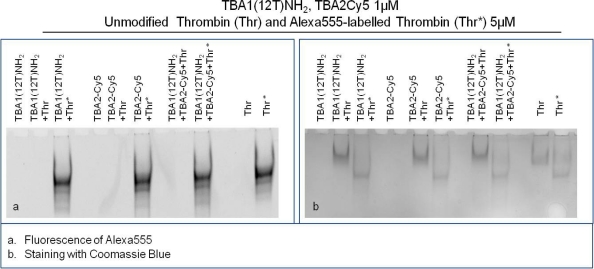
Electrophoretic Mobility Supershift Assay (EMSA) of TBA1(12T)NH2 + thrombin + TBA2Cy5: detection of Alexa555-labeled thrombin (a); detection of thrombin with Coomassie Blue staining (b). Each aptamer was incubated separately or simultaneously with the unmodified and fluorescently labeled protein under the conditions described. We have indicated in the figure the respective aptamer and thrombin concentrations. A reaction control without thrombin was performed for each aptamer; other reaction controls were the unmodified and fluorescently labelled thrombin incubated without any aptamer. Binding reactions were applied on a 12% non-denaturing PAA gel containing 1X TBE buffer and KCl 10 mM. The mobility of free and complexed aptamers was detected using the Geliance 600 Imaging System.
Figure 6.
Figure 6.
Images of the slide after the Sandwich Aptamer Microarray (SAM). In each sub-array TBA1(12T)NH2 was printed on the left, while OTA on the right. The fluorophore Cy5 emitted red light, while Alexa555 emitted green light. For this reason red fluorescence represents TBA2Cy5 and green fluorescence represents labeled thrombin. In chambers 2 and 4, in which labeled thrombin was incubated, the fluorescence was detected with two different contrasts to reveal first red light and then green light: yellow spots indicate the simultaneously localization of the two fluorophores.

References

    1. Ellington AD, Szostak JW. In vitro selection of RNA molecules that bind specific ligands. Nature. 1990;346:818–822. - PubMed
    1. Tuerk C, Gold L. Systematic evolution of ligands by exponential enrichment: RNA ligands to bacteriophage T4 DNA polymerase. Science. 1990;249:505–510. - PubMed
    1. Stoltenburg R, Reinemann C, Strehlitz B. SELEX—A (r)evolutionary method to generate high-affinity nucleic acid ligands. Biomol. Eng. 2007;24:381–403. - PubMed
    1. Collett JR, Cho EJ, Ellington AD. Production and processing of aptamer microarrays. Methods. 2005;37:4–15. - PubMed
    1. Crawley JT, Zanardelli S, Chion CK, Lane DA. The central role of thrombin in hemostasis. J. Thromb. Haemost. 2007;5:95–101. - PubMed

Publication types

LinkOut - more resources