


Bromocresol green/mesoporous silica adsorbent for ammonia gas sensing via an optical sensing instrument
- PMID: 22163836
- PMCID: PMC3231325
- DOI: 10.3390/s110404060
Bromocresol green/mesoporous silica adsorbent for ammonia gas sensing via an optical sensing instrument
Abstract
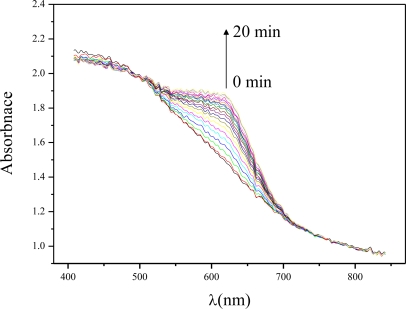
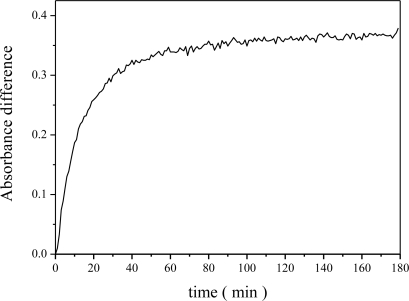
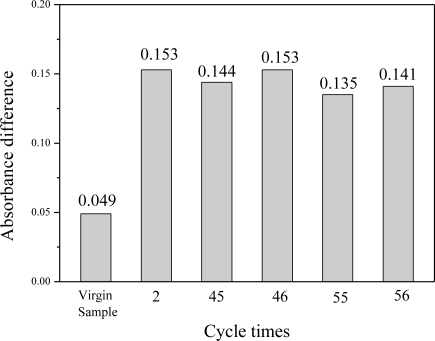
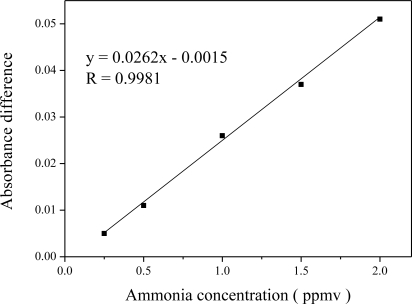
A meso-structured Al-MCM-41 material was impregnated with bromocresol green (BG) dye and then incorporated into a UV-Vis DRA spectroscopic instrument for the online detection of ammonia gas. The absorption response of the Al-MCM-41/BG ammonia sensing material was very sensitive at the optical absorption wavelength of 630 nm. A high linear correlation was achieved for ppmv and sub-ppmv levels of ammonia gas. The response time for the quantitative detection of ammonia gas concentrations ranging from 0.25 to 2.0 ppmv was only a few minutes. The lower detection limit achieved was 0.185 ppmv. The color change process was fully reversible during tens of cycling tests. These features together make this mesoporous Al-MCM-41 material very promising for optical sensing applications.
Keywords: UV-Vis absorbance; ammonia gas; bromocresol green dye; mesoporous silica material; optical sensor.
Figures
References
-
- Kanzawa K, Kitano J. A Semiconductor device manufacturer’s efforts for controlling and evaluating atmospheric pollution. Proceedings of 1995 IEEE/SEMI Advanced Semiconductor Manufacturing Conference and Workshop; Cambridge, CA, USA. 13–15 November 1995; pp. 190–193.
-
- Ruth JH. Odor thresholds and irritation levels of several chemical substances: A review. Am. Ind. Hyg. Assoc. J. 1986;47:A142–A151. - PubMed
-
- Agency for Toxic Substances & Disease Registry (ATSDR) Toxicological profile for ammonia. 2004. Available online: http://www.atsdr.cdc.gov/ (accessed on 1 October 2010) - PubMed
-
- The US Occupational Safety and Health Administration (OSHA) website. Available online: http://www.osha.gov (accessed on 1 October 2010)
-
- The US National Institute of Occupational Safety and Health (NIOSH) website. Available online: http://www.cdc.gov/niosh (accessed on 1 October 2010)
Publication types
MeSH terms
Substances
LinkOut - more resources
Full Text Sources
