. 2011 Oct 14;9 Suppl 1(Suppl 1):S4.
doi: 10.1186/1477-5956-9-S1-S4.

ATPsite: sequence-based prediction of ATP-binding residues

Affiliations

ATPsite: sequence-based prediction of ATP-binding residues

Ke Chen et al. Proteome Sci. .

Abstract

Background: ATP is a ubiquitous nucleotide that provides energy for cellular activities, catalyzes chemical reactions, and is involved in cellular signalling. The knowledge of the ATP-protein interactions helps with annotation of protein functions and finds applications in drug design. The sequence to structure annotation gap motivates development of high-throughput sequence-based predictors of the ATP-binding residues. Moreover, our empirical tests show that the only existing predictor, ATPint, is characterized by relatively low predictive quality.

Methods: We propose a novel, high-throughput machine learning-based predictor, ATPsite, which identifies ATP-binding residues from protein sequences. Our predictor utilizes Support Vector Machine classifier and a comprehensive set of input features that are based on the sequence, evolutionary profiles, and the sequence-predicted structural descriptors including secondary structure, solvent accessibility, and dihedral angles.

Results: The ATPsite achieves significantly higher Mathews Correlation Coefficient (MCC) and Area Under the ROC Curve (AUC) values when compared with the existing methods including the ATPint, conservation-based rate4site, and alignment-based BLAST predictors. We also assessed the effectiveness of individual input types. The PSSM profile, the conservation scores, and certain features based on amino acid groups are shown to be more effective in predicting the ATP-binding residues than the remaining feature groups.

Conclusions: Statistical tests show that ATPsite significantly outperforms existing solutions. The consensus of the ATPsite with the sequence-alignment based predictor is shown to give further improvements.


Figures
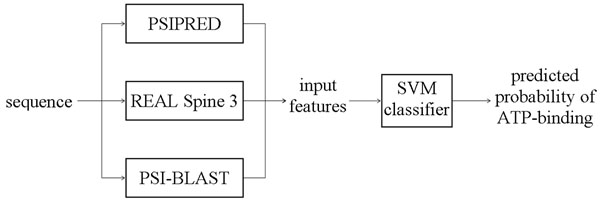
Figure 1
Figure 1
Architecture of the ATPsite predictor.
Figure 2
Figure 2
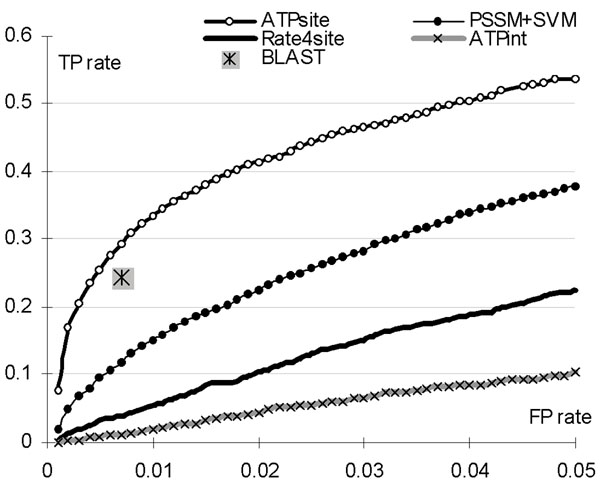
ROC curves for ATPsite, ATPint, rate4site and the predictor based on PSSM with SVM classifier. The FP-rate is constrained to [0, 0.05] range and the BLAST-based solution is shown using a single point that corresponds to the binary predictions. The full ROC curve can be found in the Supplementary Figure 1 in the online supplement at http://biomine.ece.ualberta.ca/ATPsite/.
Figure 3
Figure 3
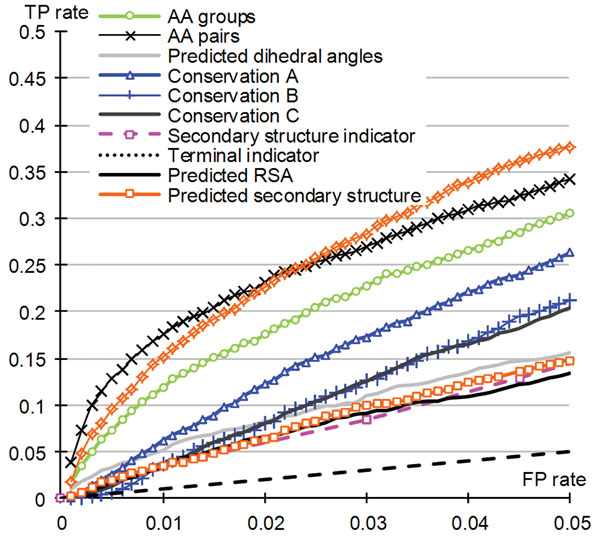
ROC curves calculated based on predictions generated using individual input types. The FP-rate is constrained to [0, 0.05]. The full ROC curve can be found in the Supplementary Figure 2 in the online supplement at http://biomine.ece.ualberta.ca/ATPsite/.
Figure 4
Figure 4
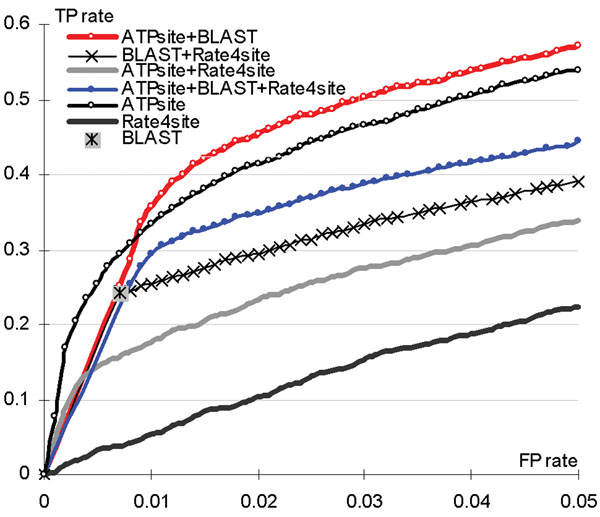
ROC curves of the ensemble predictors. The FP-rate is constrained to [0, 0.05]. The full ROC curve can be found in the Supplementary Figure 3 in the online supplement at http://biomine.ece.ualberta.ca/ATPsite/.
Figure 5
Figure 5
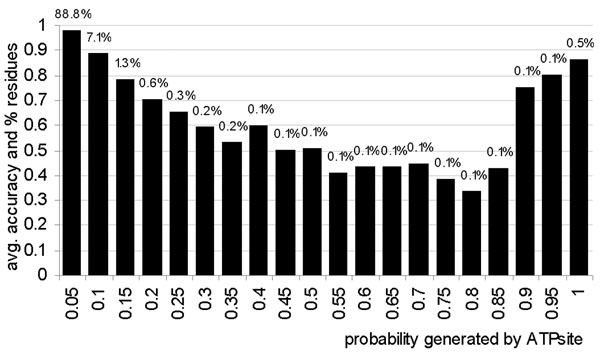
The distribution of average accuracies (shown using bars) for residues binned into twenty 0.05 wide intervals based on their probability of ATP-binding predicted by ATPsite. The percentage of the residues in each bin is shown above the bars.
Figure 6
Figure 6
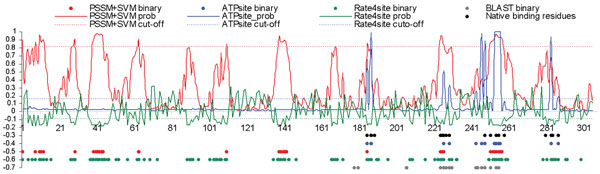
Comparison of predictions for chain A of phosphofructokinase6 (PDB id 3CQD). Solid lines at the top show the predicted probabilities for PSSM+SVM (in red), rate4site (green), and ATPsite (blue). The dashed lines denote cut-offs used to binarize the probabilities and the corresponding binary predictions are shown using dots (one dot per residue) at the bottom. Black dots denote native ATP-binding residues, and blue, red, green and gray denote predictions from ATPsite, PSSM+SVM, rate4site and BLAST, respectively.

References

    1. Berman HM, Westbrook J, Feng Z, Gilliland G, Bhat TN, Weissig H, Shindyalov IN, Bourne PE. The Protein Data Bank. Nucleic Acids Res. 2000;28:235–42. doi: 10.1093/nar/28.1.235. - DOI - PMC - PubMed
    1. Maxwell A, Lawson DM. The ATP-binding site of type II topoisomerases as a target for antibacterial drugs. Curr Top Med Chem. 2003;3:283–303. doi: 10.2174/1568026033452500. - DOI - PubMed
    1. Rock FL, Mao W, Yaremchuk A, Tukalo M, Crépin T, Zhou H. et al. An antifungal agent inhibits an aminoacyl-tRNA synthetase by trapping tRNA in the editing site. Science. 2007;316:1759–1761. doi: 10.1126/science.1142189. - DOI - PubMed
    1. Walker JE, Saraste M, Runswick MJ, Gay NJ. Distantly related sequences in the alpha- and beta-subunits of ATP synthase, myosin, kinases and other ATP-requiring enzymes and a common nucleotide binding fold. EMBO J. 1982;1:945–951. - PMC - PubMed
    1. Moodie SL, Mitchell JB, Thornton JM. Protein recognition of adenylate: an example of a fuzzy recognition template. J Mol Biol. 1996;263:486–500. doi: 10.1006/jmbi.1996.0591. - DOI - PubMed