


Aggressive therapy in patients with early arthritis results in similar outcome compared with conventional care: the STREAM randomized trial
- PMID: 22166255
- PMCID: PMC3306166
- DOI: 10.1093/rheumatology/ker355
Aggressive therapy in patients with early arthritis results in similar outcome compared with conventional care: the STREAM randomized trial
Abstract
Objective: To compare the effects of aggressive tight control therapy and conventional care on radiographic progression and disease activity in patients with early mild inflammatory arthritis.
Methods: Patients with two to five swollen joints, Sharp-van der Heijde radiographic score (SHS) <5 and symptom duration ≤2 years were randomized between two strategies. Patients with a definite non-RA diagnosis were excluded. The protocol of the aggressive group aimed for remission (DAS < 1.6), with consecutive treatment steps: MTX, addition of adalimumab and combination therapy. The conventional care group followed a strategy with traditional DMARDs (no prednisone or biologics) without DAS-based guideline. Outcome measures after 2 years were SHS (primary), remission rate and HAQ score (secondary).
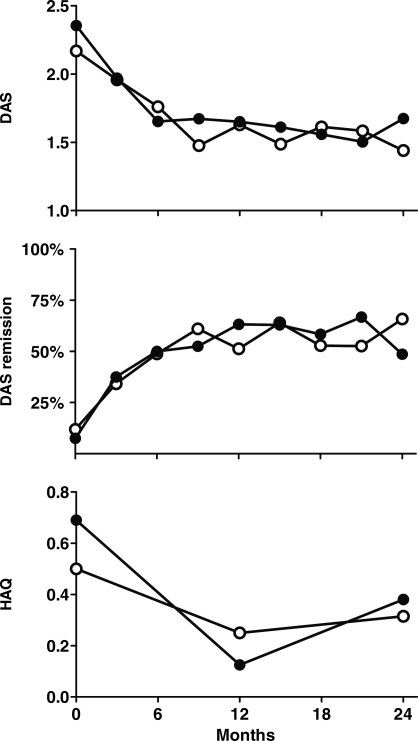
Results: Eighty-two patients participated (60% ACPA positive). In the aggressive group (n = 42), 19 patients were treated with adalimumab. In the conventional care group (n = 40), 24 patients started with hydroxychloroquin (HCQ), 2 with sulfasalazine (SSZ) and 14 with MTX. After 2 years, the median SHS increase was 0 [interquartile range (IQR) 0-1.1] and 0.5 (IQR 0-2.5), remission rates were 66 and 49% and HAQ decreased with a mean of -0.09 (0.50) and -0.25 (0.59) in the aggressive and conventional care group, respectively. All comparisons were non-significant.
Conclusion: In patients with early arthritis of two to five joints, both aggressive tight-control therapy including adalimumab and conventional therapy resulted in remission rates around 50%, low radiographic damage and excellent functional status after 2 years. However, full disease control including radiographic arrest in all patients remains an elusive target even in moderately active early arthritis. Trial registration. Dutch Trial Register, http://www.trialregister.nl/, NTR 144.
Figures


References
-
- Boers M, Verhoeven AC, Markusse HM, et al. Randomised comparison of combined step-down prednisolone, methotrexate and sulphasalazine with sulphasalazine alone in early rheumatoid arthritis. Lancet. 1997;350:309–18. - PubMed
-
- Korpela M, Laasonen L, Hannonen P, et al. Retardation of joint damage in patients with early rheumatoid arthritis by initial aggressive treatment with disease-modifying antirheumatic drugs: five-year experience from the FIN-RACo study. Arthritis Rheum. 2004;50:2072–81. - PubMed
-
- Goekoop-Ruiterman YP, Vries-Bouwstra JK, Allaart CF, et al. Comparison of treatment strategies in early rheumatoid arthritis: a randomized trial. Ann Intern Med. 2007;146:406–15. - PubMed
-
- Hetland ML, Stengaard-Pedersen K, Junker P, et al. Aggressive combination therapy with intra-articular glucocorticoid injections and conventional disease-modifying anti-rheumatic drugs in early rheumatoid arthritis: second-year clinical and radiographic results from the CIMESTRA study. Ann Rheum Dis. 2008;67:815–22. - PubMed
-
- Saunders SA, Capell HA, Stirling A, et al. Triple therapy in early active rheumatoid arthritis: a randomized, single-blind, controlled trial comparing step-up and parallel treatment strategies. Arthritis Rheum. 2008;58:1310–7. - PubMed
