


Newborn screening for medium chain acyl-CoA dehydrogenase deficiency in England: prevalence, predictive value and test validity based on 1.5 million screened babies
- PMID: 22166308
- PMCID: PMC3243649
- DOI: 10.1258/jms.2011.011086
Newborn screening for medium chain acyl-CoA dehydrogenase deficiency in England: prevalence, predictive value and test validity based on 1.5 million screened babies
Abstract
Background: Medium chain acyl-CoA dehydrogenase deficiency (MCADD) is a rare, life-threatening condition. Early diagnosis by screening asymptomatic newborns may improve outcome, but the benefit to newborns identified with variants not encountered clinically is uncertain.
Objective: To estimate, overall and by ethnic group: screen-positive prevalence and predictive value (PPV); MCADD prevalence; proportion MCADD variants detected of predicted definite or uncertain clinical importance.
Setting: All births in areas of high ethnic minority prevalence in England.
Methods: Prospective multicentre pilot screening service; testing at age five to eight days; standardized screening, diagnostic and management protocols; independent expert review of screen-positive cases to assign MCADD diagnosis and predicted clinical importance (definite or uncertain).
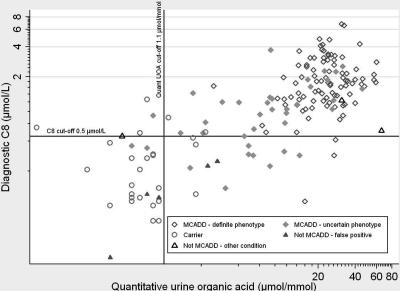
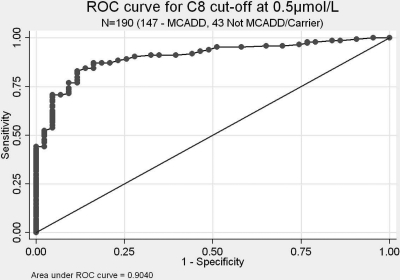
Results: Approximately 1.5 million babies (79% white; 10% Asian) were screened. MCADD was confirmed in 147 of 190 babies with a positive screening result (screen-positive prevalence: 1.20 per 10,000; MCADD prevalence: 0.94 per 10,000; PPV 77% [95% CI 71-83]), comprising 103 (70%) with MCADD variants of definite clinical importance (95 white [95%]; 2 Asian [2%]) and 44 (30%) with variants of uncertain clinical importance (29 white [67%]; 12 Asian [28%]).
Conclusion: One baby in every 10,000 born in England is diagnosed with MCADD by newborn screening; around 60 babies each year. While the majority of MCADD variants detected are predicted to be of definite clinical importance, this varies according to ethnic group, with variants of uncertain importance most commonly found in Asian babies. These findings provide support for MCADD screening but highlight the need to take account of the ethnic diversity of the population tested at implementation.
Figures
References
-
- Chace DH, Hillman SL, Van Hove JL, Naylor EW Rapid diagnosis of MCAD deficiency: quantitative analysis of octanoylcarnitine and other acylcarnitines in newborn blood spots by tandem mass spectrometry. Clin Chem 1997;43:2106–13 - PubMed
-
- Grosse SD, Khoury MJ, Greene CL, Crider KS, Pollitt RJ The epidemiology of medium chain acyl-CoA dehydrogenase deficiency: an update. Genet Med 2006;8:205–12 - PubMed
-
- Maier EM, Liebl B, Roschinger W, et al. Population spectrum of ACADM genotypes correlated to biochemical phenotypes in newborn screening for medium-chain acyl-CoA dehydrogenase deficiency. Hum Mutat 2005;25:443–52 - PubMed
-
- Pourfarzam M, Morris A, Appleton M, Craft A, Bartlett K Neonatal screening for medium-chain acyl-CoA dehydrogenase deficiency. Lancet 2001;358:1063–4 - PubMed
-
- Zytkovicz TH, Fitzgerald EF, Marsden D, et al. Tandem mass spectrometric analysis for amino, organic, and fatty acid disorders in newborn dried blood spots: a two-year summary from the New England Newborn Screening Program. Clin Chem 2001;47:1945–55 - PubMed
Publication types
MeSH terms
Substances
Supplementary concepts
Grants and funding
LinkOut - more resources
Full Text Sources
Medical
