Review
. 2012 May 1;64(6):496-507.
doi: 10.1016/j.addr.2011.11.013. Epub 2011 Dec 4.

Microfabrication technologies for oral drug delivery

Affiliations
Review

Microfabrication technologies for oral drug delivery

Shilpa Sant et al. Adv Drug Deliv Rev. .

Abstract

Micro-/nanoscale technologies such as lithographic techniques and microfluidics offer promising avenues to revolutionalize the fields of tissue engineering, drug discovery, diagnostics and personalized medicine. Microfabrication techniques are being explored for drug delivery applications due to their ability to combine several features such as precise shape and size into a single drug delivery vehicle. They also offer to create unique asymmetrical features incorporated into single or multiple reservoir systems maximizing contact area with the intestinal lining. Combined with intelligent materials, such microfabricated platforms can be designed to be bioadhesive and stimuli-responsive. Apart from drug delivery devices, microfabrication technologies offer exciting opportunities to create biomimetic gastrointestinal tract models incorporating physiological cell types, flow patterns and brush-border like structures. Here we review the recent developments in this field with a focus on the applications of microfabrication in the development of oral drug delivery devices and biomimetic gastrointestinal tract models that can be used to evaluate the drug delivery efficacy.


Figures

Fig. 1
Fig. 1
Schematic of the structure of the epithelium. Molecules can be transported across the epithelial barrier by passive diffusion through transcellular or paracellular pathways, or actively transported across by membrane-derived vesicles or membrane bound carriers. Uptake can also occur due to adsorptive endocytosis via clathrin-coated pits and vesicles, uid phase endocytosis, and phagocytosis induced by M cell antigen sampling. Reproduced with permission from ref. [123].
Fig. 2
Fig. 2
A) Schematic of fabrication of multi-layer poly(ethylene glycol methacrylate)-laden SU-8 microdevice; B) A uorescent micrograph composite of a layered hydrogel prepared with DNP-BSA, FITC-BSA and Texas red-BSA (from the outermost layer to the innermost). The grey dotted-line box highlights the reservoir area and the red dotted-line box the outer area of the microdevice; C) A uorescent micrograph of each individual lter for the labeled BSA is presented for three unique hydrogel- lled microdevices. Reprinted with permission from [124].
Fig. 3
Fig. 3
A) Single-reservoir microdevices released in water showing asymmetrical plate-like geometry with ring-shaped microwell in the center for drug loading; B) Multiple-reservoir microdevices released in water, each containing 14 closed reservoirs surrounded by a number of open reservoirs; C) Microcapsule microdevices made from PLGA as sustained release depots; D) Self-folding polymeric microdevice with enhanced mucoadhesion for transmucosal drug delivery, E) Folded microdevices grabbing onto pig intestinal mucosa with stable adhesion even after water rinsing. Reprinted with permission from [32].
Fig. 4
Fig. 4
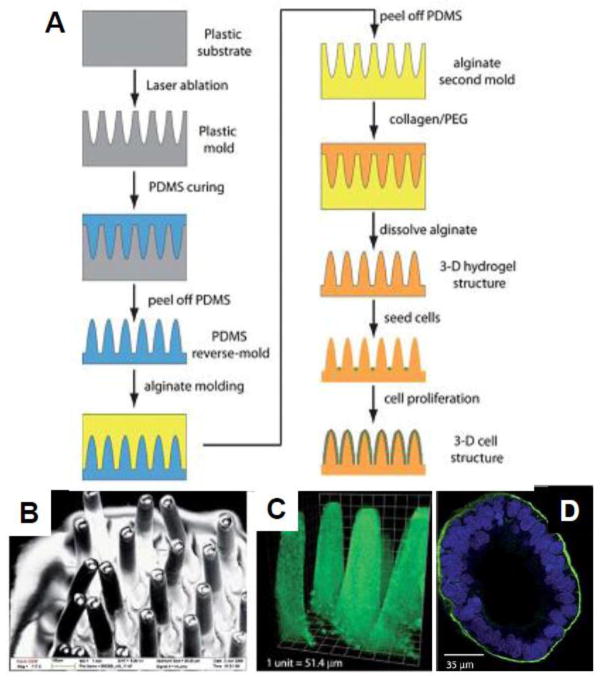
Tissue engineering approach to create in vivo-like microenvironments; A) Schematic of fabrication process of crypt-like microstructures. First plastic mold is created by laser ablation, from which the PDMS reverse-mold is created. The alginate second mold is made from the PDMS, and dissolved after the nal hydrogel structure is made. B) SEM image of the PDMS villi structure; C) Confocal microscope image of the collagen scaffold showing crypt-like topography. D) Confocal x-y image of Caco-2 cells on the collagen scaffold, stained for actin (green) and nucleic acid (blue). Reprinted with permission from Sung [103].
Fig. 5
Fig. 5
Microfluidic-based approaches to create perfused in vitro models for drug absorption; i) Fabrication process of the micro uidic device. (a) Prepolymer of PDMS poured over an SU-8 structure; (b) the PDMS structure is peeled from the mold master; (c) coating CYTOP inside of microchannel; (d) the semipermeable membrane and magnetic stir-bar are placed on the PDMS layer for assembly; (e) PDMS layers are bonded. ii) Schematic illustration of the integrated micro uidic device. Caco-2 cells are cultured only on the semipermeable membrane in the AP side culture chamber. The stir-bar is driven by motor- controlled permanent magnets beneath the device. iii) Photograph of the micro uidic device. Reprinted with permission from [113].
Fig. 6
Fig. 6
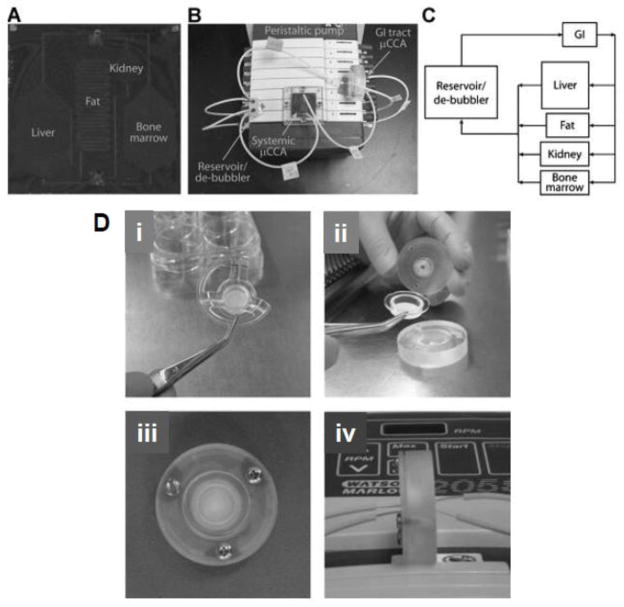
Gastrointestinal tract on a chip to predict ADME after oral drug administration; A) Image of the systemic μCCA containing liver, kidney, bone marrow, and fat chamber. The channels connecting compartments were 100 mm deep. The other poorly and well-perfused tissues were represented by the external de-bubbler, which was a 200 μL reservoir. B) Image of the systemic and GI tract μCCA experimental set-up. C) A schematic of the ow pattern in the μCCA system. D) GI tract μCCA device and assembly. i) The Snapwell membrane; ii) The Snapwell membrane being placed in between the top and bottom pieces of the GI tract μCCA; iii) The top of the assembled GI tract μCCA; iv) The inlets and outlets on the apical and basolateral sides of the assembled GI tract. Reprinted with permission from [108].

References

    1. Peppas NA, Carr DA. Impact of absorption and transport on intelligent therapeutics and nanoscale delivery of protein therapeutic agents. Chemical Engineering Science. 2009;64:4553–4565. - PMC - PubMed
    1. Goldberg M, Gomez-Orellana I. Challenges for the oral delivery of macromolecules. Nat Rev Drug Discov. 2003;2:289–295. - PubMed
    1. Martinez MN, Amidon GL. A mechanistic approach to understanding the factors affecting drug absorption: A review of fundamentals. Journal of Clinical Pharmacology. 2002;42:620–643. - PubMed
    1. Hauss DJ. Oral lipid-based formulations. Adv Drug Deliv Rev. 2007;59:667–676. - PubMed
    1. Morishita M, Peppas NA. Is the oral route possible for peptide and protein drug delivery. Drug Discovery Today. 2006;11:905–910. - PubMed

Publication types

Substances