. 2011 Dec 14:11:101.
doi: 10.1186/1471-2393-11-101.

Effects of chronic carbon monoxide exposure on fetal growth and development in mice

Affiliations

Effects of chronic carbon monoxide exposure on fetal growth and development in mice

Carolina C Venditti et al. BMC Pregnancy Childbirth. .

Abstract

Background: Carbon monoxide (CO) is produced endogenously, and can also be acquired from many exogenous sources: ie. cigarette smoking, automobile exhaust. Although toxic at high levels, low level production or exposure lends to normal physiologic functions: smooth muscle cell relaxation, control of vascular tone, platelet aggregation, anti- inflammatory and anti-apoptotic events. In pregnancy, it is unclear at what level maternal CO exposure becomes toxic to the fetus. In this study, we hypothesized that CO would be embryotoxic, and we sought to determine at what level of chronic CO exposure in pregnancy embryo/fetotoxic effects are observed.

Methods: Pregnant CD1 mice were exposed to continuous levels of CO (0 to 400 ppm) from conception to gestation day 17. The effect on fetal/placental growth and development, and fetal/maternal CO concentrations were determined.

Results: Maternal and fetal CO blood concentrations ranged from 1.12- 15.6 percent carboxyhemoglobin (%COHb) and 1.0- 28.6%COHb, respectively. No significant difference was observed in placental histological morphology or in placental mass with any CO exposure. At 400 ppm CO vs. control, decreased litter size and fetal mass (p < 0.05), increased fetal early/late gestational deaths (p < 0.05), and increased CO content in the placenta and the maternal spleen, heart, liver, kidney and lung (p < 0.05) were observed.

Conclusions: Exposure to levels at or below 300 ppm CO throughout pregnancy has little demonstrable effect on fetal growth and development in the mouse.


Figures
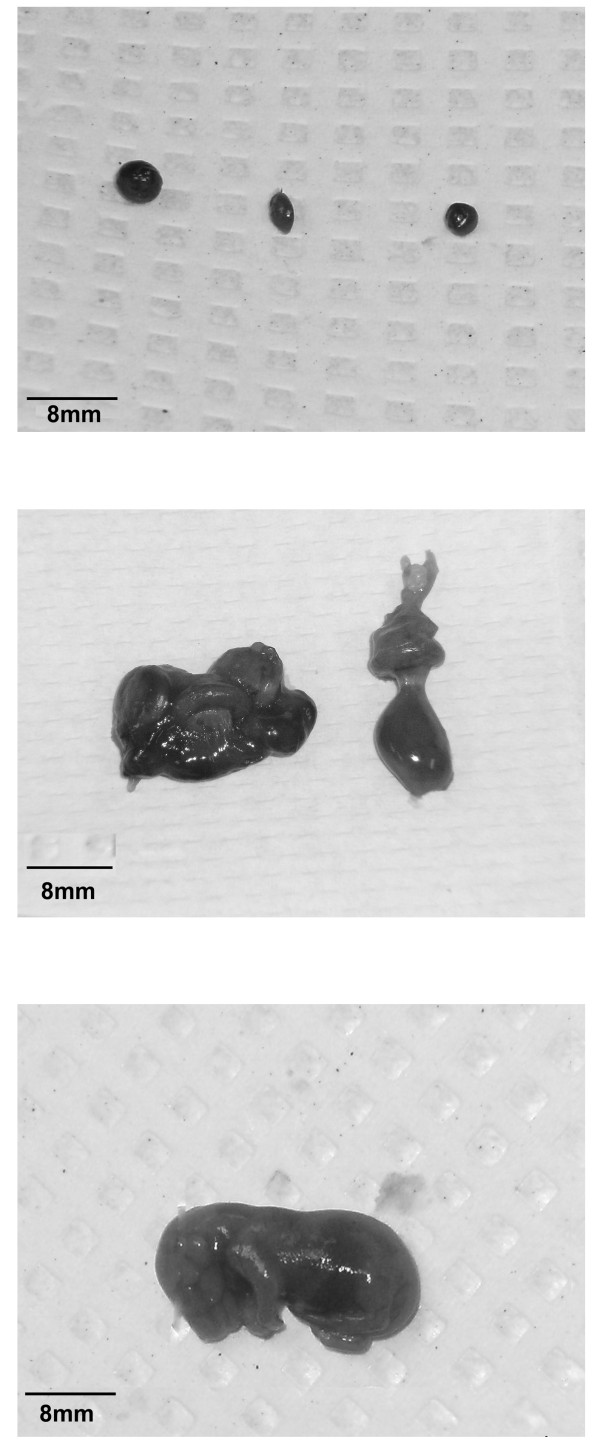
Figure 1
Figure 1
Representation of fetal early/late gestational death. A typical fetal early gestational demise is shown in A, a fetal late gestational death is shown in B, a normal fetus at GD17 is shown in C.
Figure 2
Figure 2
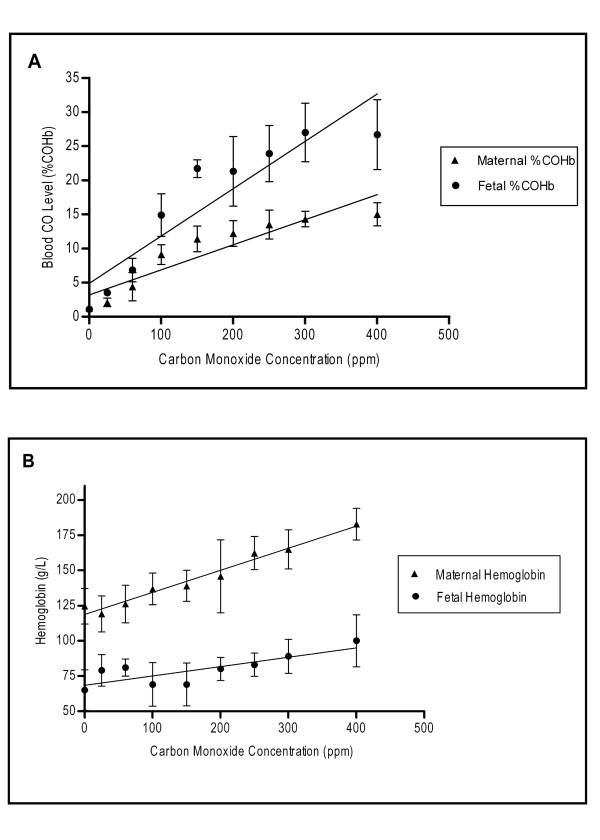
Dose responses of maternal/fetal Hb and CO levels to increasing maternal exogenous CO exposure. A positive trend was observed with both maternal and fetal blood %COHb vs. CO concentration exposure (A). A positive trend was observed with both maternal and fetal Hb vs. CO concentration exposure (B).The slope of the line significantly deviated from zero in both cases, A and B (p < 0.05).
Figure 3
Figure 3
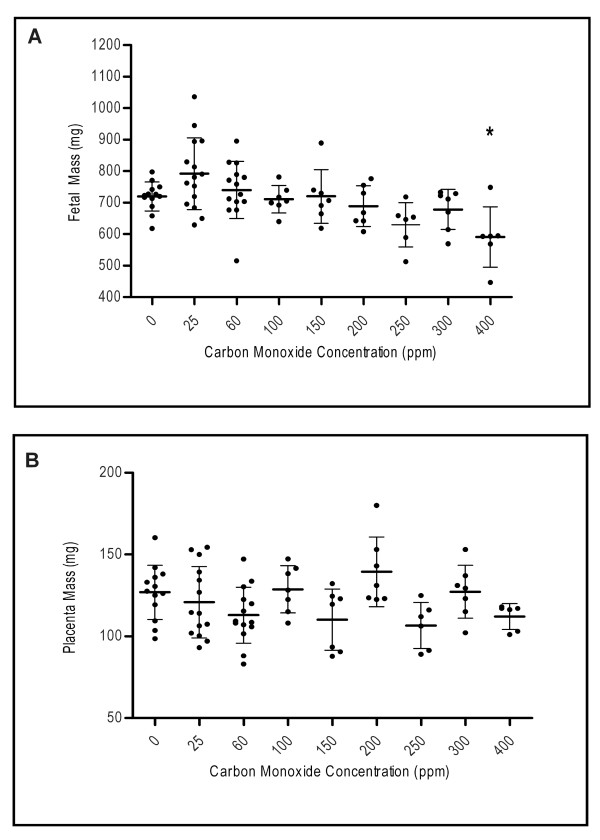
Comparison of mean fetal and placental mass to maternal exogenous CO exposure. Mean fetal mass for each CO exposure level is displayed in figure A, with a significant decrease in mass observed only at 400 ppm (* p < 0.05). Mean placental mass for each CO exposure level is displayed in figure B; no significance at any of the CO exposures was observed (p > 0.05).
Figure 4
Figure 4
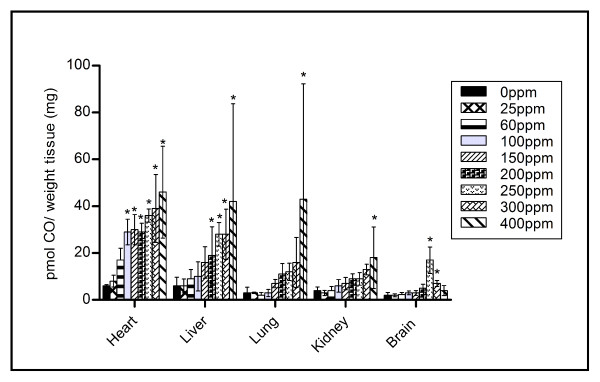
Maternal tissue CO levels in heart, liver, lungs, kidney and brain for each CO exposure. Significance was found in the heart tissue at CO levels ≥100 ppm, in the liver at CO levels ≥ 200 ppm, in both the lung and kidney at the CO level of 400 ppm only and finally in the brain at CO levels of 250 and 300 ppm only (* p < 0.05).
Figure 5
Figure 5
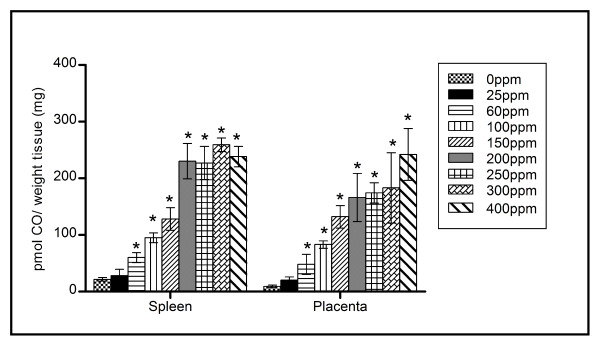
Placenta and maternal spleen tissue CO levels with increasing CO exposure. Compared to control, significance was observed in both placenta and spleen at CO levels ≥ 60 ppm exposure (* p < 0.05).

References

    1. Von BR. Carbon monoxide. J Appl Toxicol. 1999;19:379–386. doi: 10.1002/(SICI)1099-1263(199909/10)19:5<379::AID-JAT563>3.0.CO;2-8. - DOI - PubMed
    1. Weaver LK. Carbon monoxide poisoning. Crit Care Clin. 1999;15:297–317. doi: 10.1016/S0749-0704(05)70056-7. viii. - DOI - PubMed
    1. Wang R. Resurgence of carbon monoxide: an endogenous gaseous vasorelaxing factor. Can J Physiol Pharmacol. 1998;76:1–15. doi: 10.1139/y97-187. - DOI - PubMed
    1. Brune B, Ullrich V. Inhibition of platelet aggregation by carbon monoxide is mediated by activation of guanylate cyclase. Mol Pharmacol. 1987;32:497–504. - PubMed
    1. Song R, Kubo M, Morse D, Zhou Z, Zhang X, Dauber JH. et al.Carbon monoxide induces cytoprotection in rat orthotopic lung transplantation via anti-inflammatory and anti-apoptotic effects. Am J Pathol. 2003;163:231–242. doi: 10.1016/S0002-9440(10)63646-2. - DOI - PMC - PubMed

Publication types