


The Inter-Valley Soil Comparative Survey: the ecology of Dry Valley edaphic microbial communities
- PMID: 22170424
- PMCID: PMC3329106
- DOI: 10.1038/ismej.2011.170
The Inter-Valley Soil Comparative Survey: the ecology of Dry Valley edaphic microbial communities
Abstract
Recent applications of molecular genetics to edaphic microbial communities of the McMurdo Dry Valleys and elsewhere have rejected a long-held belief that Antarctic soils contain extremely limited microbial diversity. The Inter-Valley Soil Comparative Survey aims to elucidate the factors shaping these unique microbial communities and their biogeography by integrating molecular genetic approaches with biogeochemical analyses. Although the microbial communities of Dry Valley soils may be complex, there is little doubt that the ecosystem's food web is relatively simple, and evidence suggests that physicochemical conditions may have the dominant role in shaping microbial communities. To examine this hypothesis, bacterial communities from representative soil samples collected in four geographically disparate Dry Valleys were analyzed using molecular genetic tools, including pyrosequencing of 16S rRNA gene PCR amplicons. Results show that the four communities are structurally and phylogenetically distinct, and possess significantly different levels of diversity. Strikingly, only 2 of 214 phylotypes were found in all four valleys, challenging a widespread assumption that the microbiota of the Dry Valleys is composed of a few cosmopolitan species. Analysis of soil geochemical properties indicated that salt content, alongside altitude and Cu(2+), was significantly correlated with differences in microbial communities. Our results indicate that the microbial ecology of Dry Valley soils is highly localized and that physicochemical factors potentially have major roles in shaping the microbiology of ice-free areas of Antarctica. These findings hint at links between Dry Valley glacial geomorphology and microbial ecology, and raise previously unrecognized issues related to environmental management of this unique ecosystem.
Figures
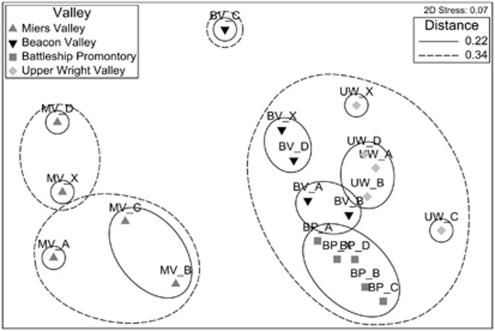
 ); Beacon Valley (BV), upturned black triangles (▾); Battleship Promontory (BP), gray squares (
 ); Upper Wright Valley (UW), gray diamonds (
 ). Contour lines enclose samples with distances below certain thresholds (0.22, solid line; 0.34, dashed line).
 ); Beacon Valley (BV), upturned black triangles (▾); Battleship Promontory (BP), gray squares (
 ); Upper Wright Valley (UW), gray diamonds (
 ). Contour lines enclose samples with similarities above certain thresholds (bacterial ARISA: 0.20, solid line; 0.40, dashed line) (cyanobacterial ARISA: 0.20, solid line).
References
-
- Abdo Z, Schütte UME, Bent SJ, Williams CJ, Forney LJ, Joyce P. Statistical methods for characterizing diversity of microbial communities by analysis of terminal restriction fragment length polymorphisms of 16S rRNA genes. Environ Microbiol. 2006;8:929–938. - PubMed
-
- Adams B, Bardgett R, Ayres E, Wall D, Aislabie J, Bamforth S, et al. Diversity and distribution of Victoria Land biota. Soil Biol Biochem. 2006;38:3003–3018.
-
- Adams B, Wall D, Gozel U, Dillman, Chaston, Hogg I. The southernmost worm, Scottnema lindsayae (Nematoda): diversity, dispersal and ecological stability. Polar Biol. 2007;30:809–815.
-
- Aislabie J, Chhour K-L, Saul D, Miyauchi S, Ayton J, Paetzold R, et al. Dominant bacteria in soils of Marble Point and Wright Valley, Victoria Land, Antarctica. Soil Biol Biochem. 2006;38:3041–3056.
-
- Babalola O, Kirby B, Le Roes-Hill M, Cook A, Cary SC, Burton S, et al. Phylogenetic analysis of actinobacterial populations associated with Antarctic Dry Valley mineral soils. Environ Microbiol. 2009;11:566–576. - PubMed
