


The immunologic revolution: photoimmunology
- PMID: 22170491
- PMCID: PMC3279601
- DOI: 10.1038/jid.2011.405
The immunologic revolution: photoimmunology
Abstract
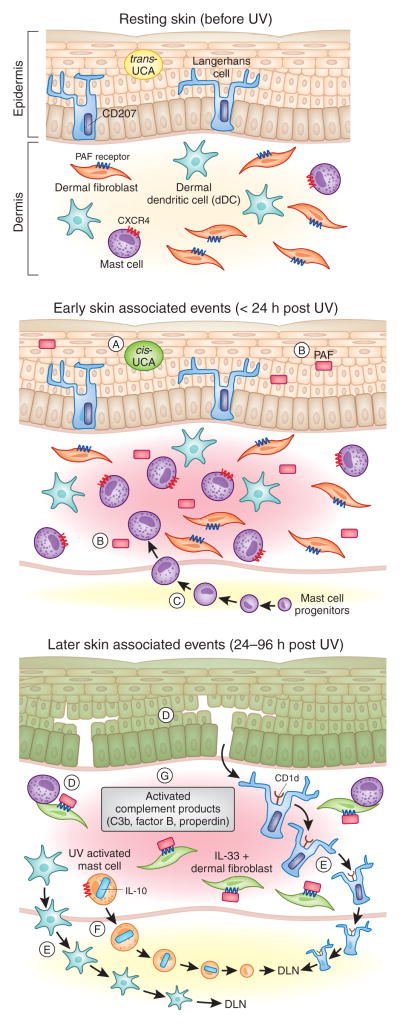
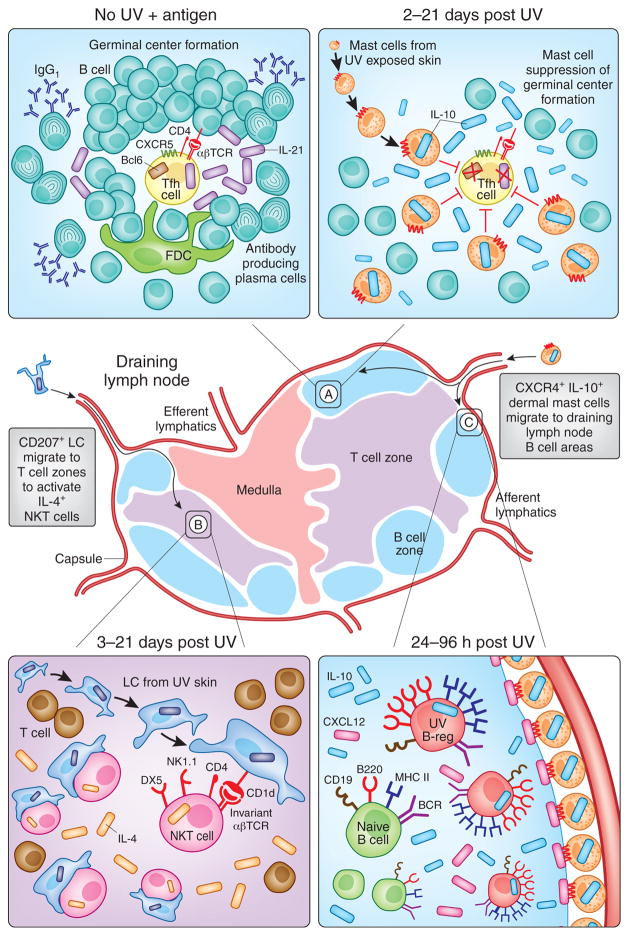
UV radiation targets the skin and is a primary cause of skin cancer (both melanoma and nonmelanoma skin cancer). Exposure to UV radiation also suppresses the immune response, and UV-induced immune suppression is a major risk factor for skin cancer induction. The efforts of dermatologists and cancer biologists to understand how UV radiation exposure suppresses the immune response and contributes to skin cancer induction led to the development of the subdiscipline we call photoimmunology. Advances in photoimmunology have generally paralleled advances in immunology. However, there are a number of examples in which investigations into the mechanisms underlying UV-induced immune suppression reshaped our understanding of basic immunological concepts. Unconventional immune regulatory roles for Langerhans cells, mast cells, and natural killer T (NKT) cells, as well as the immune-suppressive function of lipid mediators of inflammation and alarmins, are just some examples of how advances in immunodermatology have altered our understanding of basic immunology. In this anniversary issue celebrating 75 years of cutaneous science, we provide examples of how concepts that grew out of efforts by immunologists and dermatologists to understand immune regulation by UV radiation affected immunology in general.
Conflict of interest statement
Figures
References
-
- Alappatt C, Johnson CA, Clay KL, Travers JB. Acute keratinocyte damage stimulates platelet-activating factor production. Arch Dermatol Res. 2000;292:256–9. - PubMed
-
- Alard P, Kurimoto I, Niizeki H, Doherty JM, Streilein JW. Hapten-specific tolerance induced by acute, low-dose ultraviolet B radiation of skin requires mast cell degranulation. Eur J Immunol. 2001;31:1736–46. - PubMed
-
- Alard P, Niizeki H, Hanninen L, Streilein JW. Local ultraviolet B irradiation impairs contact hypersensitivity induction by triggering release of tumor necrosis factor-alpha from mast cells. Involvement of mast cells and Langerhans cells in susceptibility to ultraviolet B. J Invest Dermatol. 1999;113:983–90. - PubMed
-
- Alves-Filho JC, Sonego F, Souto FO, Freitas A, Verri WA, Jr, Auxiliadora-Martins M, et al. Interleukin-33 attenuates sepsis by enhancing neutrophil influx to the site of infection. Nat Med. 2010;16:708–12. - PubMed
-
- Anglin JH, Jr, Bever AT, Everett MA, Lamb JH. Ultraviolet-light-induced alterations in urocanic acid in vivo. Biochim Biophys Acta. 1961;53:408–9. - PubMed
Publication types
MeSH terms
Grants and funding
LinkOut - more resources
Full Text Sources
Medical
Miscellaneous
