


Effect of rebleeding on the course and incidence of vasospasm after subarachnoid hemorrhage
- PMID: 22170890
- PMCID: PMC3466499
- DOI: 10.1212/WNL.0b013e31823ed0a4
Effect of rebleeding on the course and incidence of vasospasm after subarachnoid hemorrhage
Abstract
Objective: Rebleeding of an aneurysm is a leading cause of morbidity and mortality after subarachnoid hemorrhage (SAH). Whereas numerous studies have demonstrated the risk factors associated with rebleeding, few data on complications of rebleeding, including its effect on the development of delayed cerebral ischemia (DCI), are available.
Methods: A nested case-control study was performed on patients with rebleeding and control subjects matched for modified Fisher scale, Hunt-Hess grade, age, and sex previously entered into a prospective database. Rebleeding was defined as new hemorrhage apparent on repeat CT with or without new symptoms. Incidence and time course of DCI and hospital complications were compared. A secondary analysis of DCI and hospital complications was also performed on subjects surviving to postbleed day 7.
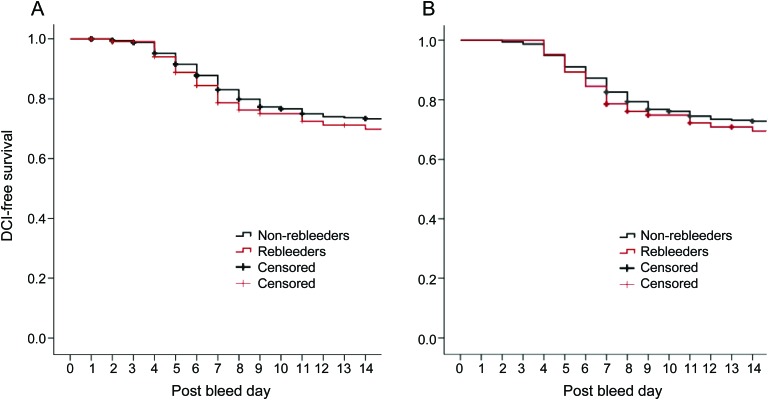
Results: We identified 120 patients with rebleeding and 359 control subjects from 1996 to 2011. The rebleeding rate was 8.6%. In both the primary and secondary analyses, there was no difference in the incidence of DCI or its time course (29% vs. 27%, p = 0.6; 7 ± 5 vs. 7 ± 6 days, p = 0.9 for primary analysis; 39% vs. 31%, p = 0.1, 7 ± 5 vs. 7 ± 6 days, p = 0.6 for the secondary analysis). In a multivariate logistic regression model, rebleeding was associated with the complications of hyponatremia, respiratory failure, and hydrocephalus. Patients with rebleeding had higher rates of mortality, brain death, and poor outcomes.
Conclusions: Rebleeding after SAH is associated with multiple medical and neurologic complications, resulting in higher morbidity and mortality, but is not associated with change of incidence or timing of DCI.
Figures
References
-
- Naidech AM, Janjua N, Kreiter KT, et al. Predictors and impact of aneurysm rebleeding after subarachnoid hemorrhage. Arch Neurol 2005; 62: 410–416 - PubMed
-
- Broderick JP, Brott TG, Duldner JE, Tomsick T, Leach A. Initial and recurrent bleeding are the major causes of death following subarachnoid hemorrhage. Stroke 1994; 25: 1342–1347 - PubMed
-
- Kassell NF, Torner JC, Jane JA, Haley EC, Jr, Adams HP. The International Cooperative Study on the Timing of Aneurysm Surgery, part 2: surgical results. J Neurosurg 1990; 73: 37–47 - PubMed
-
- Kassell NF, Torner JC, Haley EC, Jane JA, Adams HP, Kongable GL. The International Cooperative Study on the Timing of Aneurysm Surgery: part 1: overall management results. J Neurosurg 1990; 73: 18–36 - PubMed
Publication types
MeSH terms
Grants and funding
LinkOut - more resources
Full Text Sources
Other Literature Sources
Medical
