


Aspirin-induced small bowel injuries and the preventive effect of rebamipide
- PMID: 22171147
- PMCID: PMC3235596
- DOI: 10.3748/wjg.v17.i46.5117
Aspirin-induced small bowel injuries and the preventive effect of rebamipide
Abstract
Aim: To evaluate the influence of taking low-dose aspirin for 4 wk on small intestinal complications and to examine the preventive effect of rebamipide.
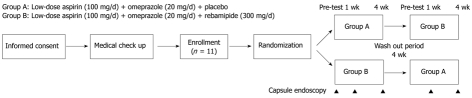
Methods: This study was conducted as a single-center, randomized, double-blind, cross-over, placebo-controlled study. Eleven healthy male subjects were enrolled. Each subject underwent video capsule endoscopy after 1 and 4 wk of taking aspirin and omeprazole, along with either rebamipide or placebo therapy. The primary endpoint was to evaluate small bowel damage in healthy subjects before and after taking low-dose aspirin for 4 wk.
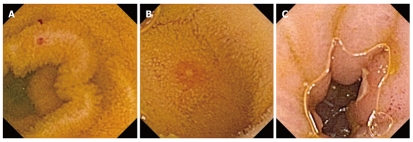
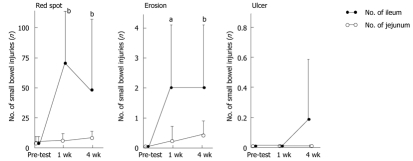
Results: The number of subjects with mucosal breaks (defined as multiple erosions and/or ulcers) were 1 at 1 wk and 1 at 4 wk on the jejunum, and 6 at 1 wk (P = 0.0061) and 7 at 4 wk on the ileum (P = 0.0019). Rebamipide significantly prevented mucosal breaks on the ileum compared with the placebo group (P = 0.0173 at 1 wk and P = 0.0266 at 4 wk).
Conclusion: Longer-term, low-dose aspirin administration induced damage in the small bowel. Rebamipide prevented this damage, and may be a candidate drug for treating aspirin-induced small bowel complications.
Keywords: Capsule endoscopy; Healthy subjects; Low-dose aspirin; Rebamipide; Small bowel injury.
Figures
References
-
- Iddan G, Meron G, Glukhovsky A, Swain P. Wireless capsule endoscopy. Nature. 2000;405:417. - PubMed
-
- Gong F, Swain P, Mills T. Wireless endoscopy. Gastrointest Endosc. 2000;51:725–729. - PubMed
-
- Graham DY, Opekun AR, Willingham FF, Qureshi WA. Visible small-intestinal mucosal injury in chronic NSAID users. Clin Gastroenterol Hepatol. 2005;3:55–59. - PubMed
-
- Mehta P. Aspirin in the prophylaxis of coronary artery disease. Curr Opin Cardiol. 2002;17:552–558. - PubMed
Publication types
MeSH terms
Substances
LinkOut - more resources
Full Text Sources
