Review
. 2012 Feb;22(1):80-7.
doi: 10.1016/j.sbi.2011.11.003. Epub 2011 Dec 13.

Recent advances in single molecule studies of nucleosomes

Affiliations
Review

Recent advances in single molecule studies of nucleosomes

Jessica L Killian et al. Curr Opin Struct Biol. 2012 Feb.

Abstract

As the fundamental packing units of DNA in eukaryotes, nucleosomes play a central role in governing DNA accessibility in a variety of cellular processes. Our understanding of the mechanisms underlying this complex regulation has been aided by unique structural and dynamic perspectives offered by single molecule techniques. Recent years have witnessed remarkable advances achieved using these techniques, including the generation of a detailed histone-DNA energy landscape, elucidation of nucleosome disassembly processes, and real-time monitoring of molecular motors interacting with nucleosomes. These and other highlights of single molecule nucleosome studies will be discussed in this review.


Figures

Figure 1
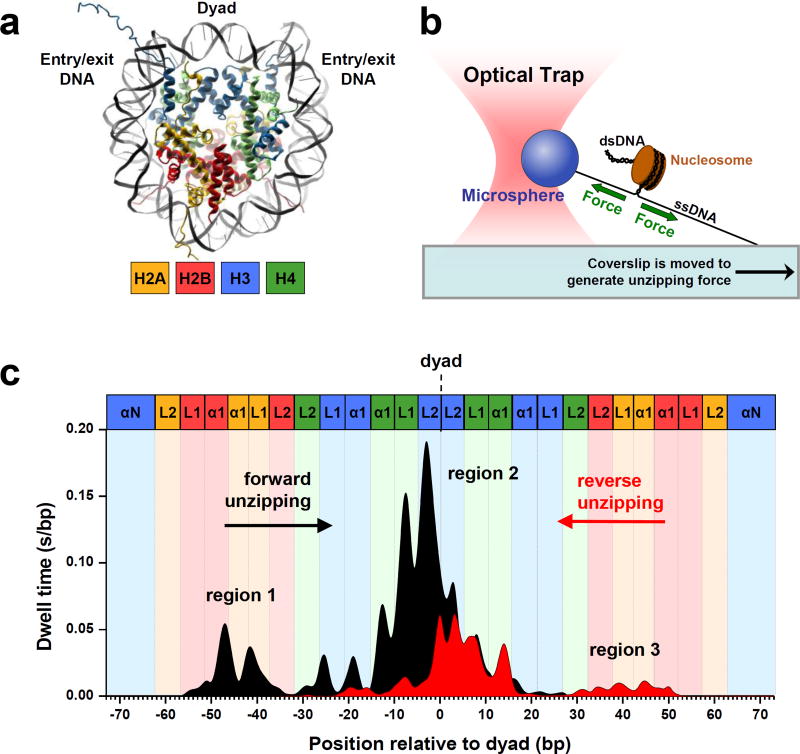
Figure 1. Dynamic mapping of histone-DNA interactions in a nucleosome
(a) The crystal structure [12] of the nucleosome core particle (NCP) revealed 147 (bp) of duplex DNA wrapped in 1.65 turns around an octameric histone core in a left-handed superhelix. The octameric core consists of two H2A/H2B dimers and one (H3/H4)2 tetramer. The tetramer and the dimers are arranged around a two-fold symmetry axis (the dyad). (b) Experimental configuration of the optical tweezers-based DNA unzipping technique [13]. An optical trap utilizes a highly focused laser beam to generate a gradient force to trap a micron-sized particle. The same laser beam can also be used to precisely measure the position of the particle in the trap. In this experiment, the nucleosomal template was suspended between the glass coverslip surface and a microsphere. An optical trap was used to apply a force necessary to unzip through the nucleosomal DNA as the coverslip was moved away from the trapped microsphere. (c) The histone-DNA interaction map within a nucleosome, generated from dwell time histograms of the unzipping fork held under a constant force of ~ 28 pN. The nucleosomal DNA was unzipped in both the forward (black) and reverse (red) unzipping directions. Each peak corresponds to an individual histone-DNA interaction and their heights are indicative of their relative strengths. Three regions of strong interactions are indicated: one located at the dyad (region 2) and two located ~40 bp away from the dyad (regions 1 and 3). Colored boxes indicate predictions from the crystal structure where individual histone binding motifs as shown in (a) are expected to interact with DNA. (Adapted from Hall et al. [13] with publisher’s permission)
Figure 2
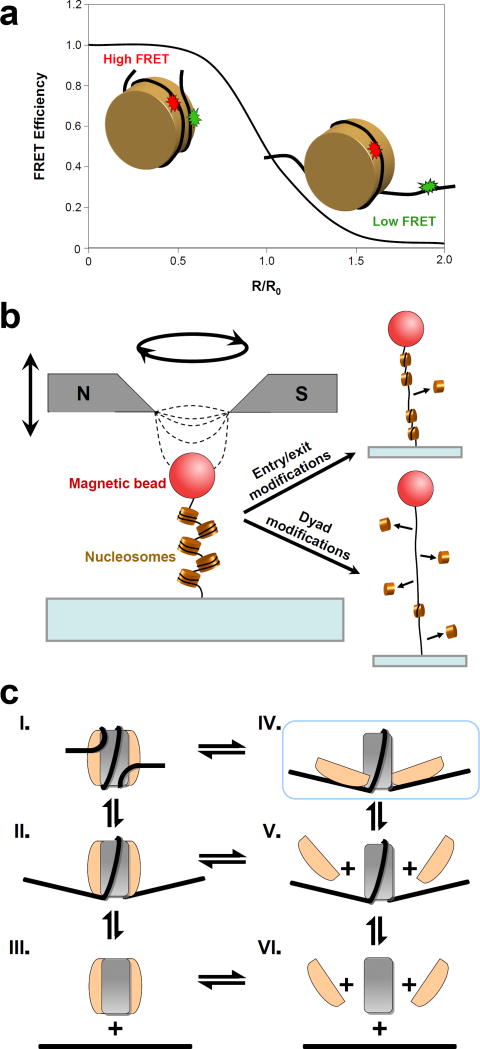
Figure 2. Single molecule studies of nucleosome stability and disassembly
(a) FRET efficiency is shown as a function of the relative distance between a donor (green) and an acceptor (red) dyes attached to a nucleosomal DNA. FRET is typically used as a molecular ruler on the scale of 1–10 nm, making it an ideal technique to detect and quantify nucleosome dynamics (nucleosome radius ~5 nm). As an example, increased DNA breathing in a nucleosome containing H3K56Ac from that of an unmodified nucleosome was manifested as a reduced FRET efficiency in experiments by Neumann et al. [ (b) Schematic of the magnetic tweezers experiments on a nucleosomal array. A pair of permanent magnets produces a gradient of the magnetic field, thus exerting a force on the super-paramagnetic bead. Magnetic tweezers are also potentially capable of inducing rotational motion. In the experiments by Simon et al. [26] the authors exerted forces up to 29 pN and observed partial dissociation of the nucleosomes that had been acetylated near the dyad location (lower right), while acetylation near the entry/exit site did not significantly impact nucleosome stability (upper right). (c) Pathways for nucleosome disassembly. The (H3/H4)2 tetramer is shown in grey and the H2A/H2B dimer is shown in beige. Disassembly has been previously proposed [30, 31] to occur via the dissociation of the octamer as a whole (III-VI) or H2A/H2B dissociation followed by the loss of the tetramer (V-VI). Böhm et al. [32] have additionally found evidence for a novel intermediate (IV, highlighted in blue) in which dimer-tetramer interactions are partially disrupted, while dimer-DNA contacts are maintained. The authors suggest that nucleosome disassembly proceeds sequentially through this intermediate (I-IV-V-VI). Future studies are necessary to differentiate between these possible pathways of disassembly. (Adapted from Böhm et al. [32] with publisher’s permission)
Figure 3
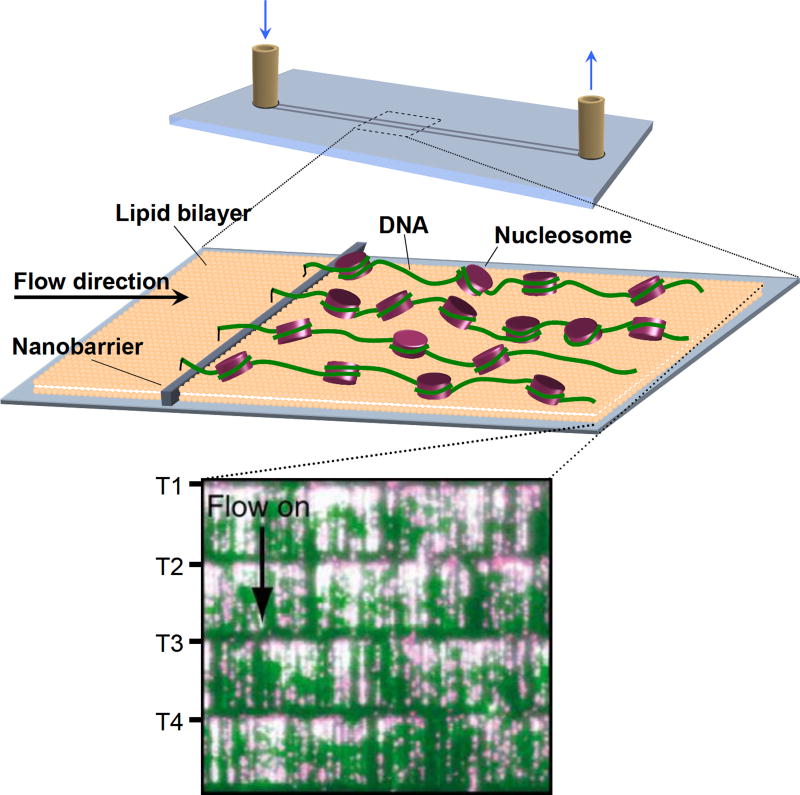
Figure 3. High-throughput single molecule visualization through DNA curtains [38]
Nucleosome arrays are anchored to a lipid bilayer on the surface of a fused silica microfluidic sample chamber. A hydrodynamic force is applied to direct the molecules towards the leading edges of nanofabricated barriers. The alignment of nucleosomal arrays produced by these barriers makes it possible to visualize thousands of individual molecules simultaneously in real time using total internal reflection fluorescence microscopy (TIRFM). (Inset) A TIRFM image of DNA curtains. DNA molecules were stained with the YOYO1 intercalating dye (green) and nucleosomes were labeled with fluorescent quantum dots (magenta). Four curtains are shown, with T1-T4 indicating the tethered ends of the curtains and the arrow indicating the direction of the flow used to apply the hydrodynamic force. (Adapted from Visnapuu et al. [38] with publisher’s permission)
Figure 4
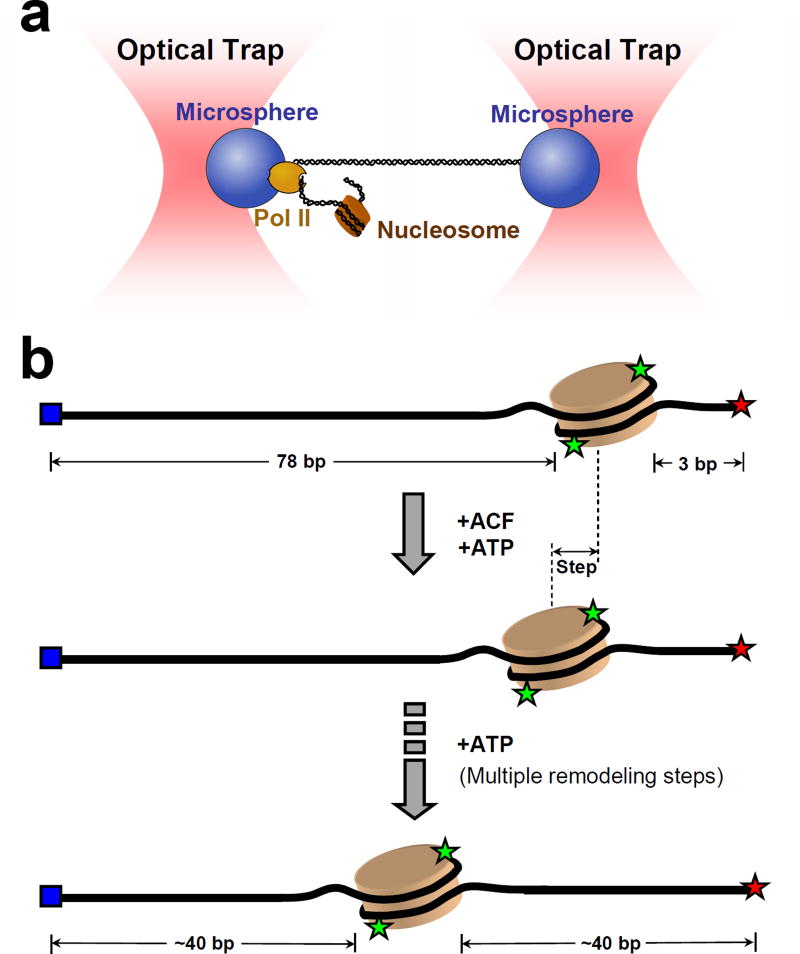
Figure 4. Single molecule studies of nucleosome interactions with molecular motors
(a) Ultra-stable dual-beam optical tweezers setup to monitor Pol II transcription through the nucleosome [52]. DNA was attached to one bead via digoxigenin-antidigoxygenin linkage and to the other bead via a stalled Pol II. Addition of NTPs restarted Pol II movement in the direction of the downstream nucleosome. (b) Schematic of the ACF-catalyzed nucleosome remodeling monitored by single molecule FRET [60]. The nucleosome is assembled close to the end of a 228 bp DNA template. H2A histones are labeled with Cy3 (green). DNA is labeled with Cy5 (red) at one end and with a biotin (blue) at the other. Upon addition of ACF and ATP, the nucleosome is translocated from the end of the DNA towards the center in discrete steps. This process is monitored in real time by the change of the FRET efficiency between Cy3 and Cy5 using TIRFM.

References

    1. Luger K, Mader AW, Richmond RK, Sargent DF, Richmond TJ. Crystal structure of the nucleosome core particle at 2.8 A resolution. Nature. 1997;389:251–260. - PubMed
    1. Bell O, Tiwari VK, Thoma NH, Schubeler D. Determinants and dynamics of genome accessibility. Nat Rev Genet. 2011;12:554–564. - PubMed
    1. Andrews AJ, Luger K. Nucleosome structure(s) and stability: variations on a theme. Annu Rev Biophys. 2011;40:99–117. - PubMed
    1. Park YJ, Luger K. Histone chaperones in nucleosome eviction and histone exchange. Curr Opin Struct Biol. 2008;18:282–289. - PMC - PubMed
    1. Ransom M, Dennehey BK, Tyler JK. Chaperoning histones during DNA replication and repair. Cell. 2010;140:183–195. - PMC - PubMed

Publication types

LinkOut - more resources