


Assessment of automated disease detection in diabetic retinopathy screening using two-field photography
- PMID: 22174741
- PMCID: PMC3234241
- DOI: 10.1371/journal.pone.0027524
Assessment of automated disease detection in diabetic retinopathy screening using two-field photography
Abstract
Aim: To assess the performance of automated disease detection in diabetic retinopathy screening using two field mydriatic photography.
Methods: Images from 8,271 sequential patient screening episodes from a South London diabetic retinopathy screening service were processed by the Medalytix iGrading™ automated grading system. For each screening episode macular-centred and disc-centred images of both eyes were acquired and independently graded according to the English national grading scheme. Where discrepancies were found between the automated result and original manual grade, internal and external arbitration was used to determine the final study grades. Two versions of the software were used: one that detected microaneurysms alone, and one that detected blot haemorrhages and exudates in addition to microaneurysms. Results for each version were calculated once using both fields and once using the macula-centred field alone.
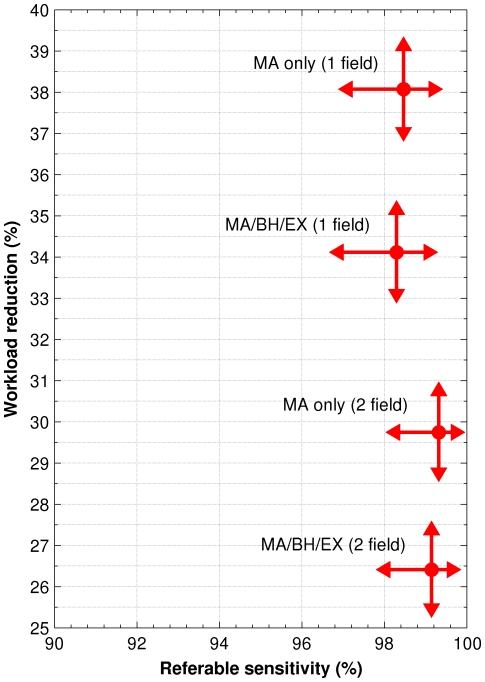
Results: Of the 8,271 episodes, 346 (4.2%) were considered unassessable. Referable disease was detected in 587 episodes (7.1%). The sensitivity of the automated system for detecting unassessable images ranged from 97.4% to 99.1% depending on configuration. The sensitivity of the automated system for referable episodes ranged from 98.3% to 99.3%. All the episodes that included proliferative or pre-proliferative retinopathy were detected by the automated system regardless of configuration (192/192, 95% confidence interval 98.0% to 100%). If implemented as the first step in grading, the automated system would have reduced the manual grading effort by between 2,183 and 3,147 patient episodes (26.4% to 38.1%).
Conclusion: Automated grading can safely reduce the workload of manual grading using two field, mydriatic photography in a routine screening service.
Conflict of interest statement
Figures
References
-
- Arun CS, Al-Bermani a, Stannard K, Taylor R. Long-term impact of retinal screening on significant diabetes-related visual impairment in the working age population. Diabetic medicine : a journal of the British Diabetic Association. 2009;26:489–492. Available: http://www.ncbi.nlm.nih.gov/pubmed/19646188. Accessed 17 May 2011. - PubMed
-
- Wild S, Roglic G, Green A, Sicree R, King H. Global prevalence of diabetes: estimates for the year 2000 and projections for 2030. Diabetes Care. 2004;27:1047–1053. - PubMed
-
- Philip S, Fleming AD, Goatman KA, Fonseca S, McNamee P, et al. The efficacy of automated “disease/no disease” grading for diabetic retinopathy in a systematic screening programme. The British journal of ophthalmology. 2007;91:1512–1517. Available: http://www.ncbi.nlm.nih.gov/pubmed/17504851. - PMC - PubMed
-
- Fleming AD, Goatman KA, Philip S, Williams GJ, Prescott GJ, et al. The role of haemorrhage and exudate detection in automated grading of diabetic retinopathy. The British journal of ophthalmology. 2010;94:706–711. Available: http://www.ncbi.nlm.nih.gov/pubmed/19661069. Accessed 16 May 2011. - PubMed
-
- Fleming AD, Goatman K a, Philip S, Prescott GJ, Sharp PF, et al. Automated grading for diabetic retinopathy: a large-scale audit using arbitration by clinical experts. The British journal of ophthalmology. 2010:1–5. Available: http://www.ncbi.nlm.nih.gov/pubmed/20858722. Accessed 4 October 2010. - PubMed
Publication types
MeSH terms
LinkOut - more resources
Full Text Sources
Other Literature Sources
Medical
