Randomized Controlled Trial
. 2011;6(12):e28460.
doi: 10.1371/journal.pone.0028460. Epub 2011 Dec 8.

Pleiotropic benefit of monomeric and oligomeric flavanols on vascular health--a randomized controlled clinical pilot study

Affiliations
Randomized Controlled Trial

Pleiotropic benefit of monomeric and oligomeric flavanols on vascular health--a randomized controlled clinical pilot study

Antje R Weseler et al. PLoS One. 2011.

Abstract

Background: Cardiovascular diseases are expanding to a major social-economic burden in the Western World and undermine man's deep desire for healthy ageing. Epidemiological studies suggest that flavanol-rich foods (e.g. grapes, wine, chocolate) sustain cardiovascular health. For an evidenced-based application, however, sound clinical data on their efficacy are strongly demanded.

Methods: In a double-blind, randomized, placebo-controlled intervention study we supplemented 28 male smokers with 200 mg per day of monomeric and oligomeric flavanols (MOF) from grape seeds. At baseline, after 4 and 8 weeks we measured macro- and microvascular function and a cluster of systemic biomarkers for major pathological processes occurring in the vasculature: disturbances in lipid metabolism and cellular redox balance, and activation of inflammatory cells and platelets.

Results: In the MOF group serum total cholesterol and LDL decreased significantly (P ≤ 0.05) by 5% (n = 11) and 7% (n = 9), respectively in volunteers with elevated baseline levels. Additionally, after 8 weeks the ratio of glutathione to glutathione disulphide in erythrocytes rose from baseline by 22% (n = 15, P<0.05) in MOF supplemented subjects. We also observed that MOF supplementation exerts anti-inflammatory effects in blood towards ex vivo added bacterial endotoxin and significantly reduces expression of inflammatory genes in leukocytes. Conversely, alterations in macro- and microvascular function, platelet aggregation, plasma levels of nitric oxide surrogates, endothelin-1, C-reactive protein, fibrinogen, prostaglandin F2alpha, plasma antioxidant capacity and gene expression levels of antioxidant defense enzymes did not reach statistical significance after 8 weeks MOF supplementation. However, integrating all measured effects into a global, so-called vascular health index revealed a significant improvement of overall vascular health by MOF compared to placebo (P ≤ 0.05).

Conclusion: Our integrative multi-biomarker approach unveiled the pleiotropic vascular health benefit of an 8 weeks supplementation with 200 mg/d MOF in humans.

Trial registration: ClinicalTrials.gov NCT00742287.


Conflict of interest statement

Competing Interests: International Nutrition Company BV, Loosdrecht, The Netherlands, supplied the MOF containing test capsules and placebo capsules. This does not alter the authors' adherence to all the PLoS ONE policies on sharing data and materials. The authors declare that no other conflict of interest exists..

Figures

Figure 1
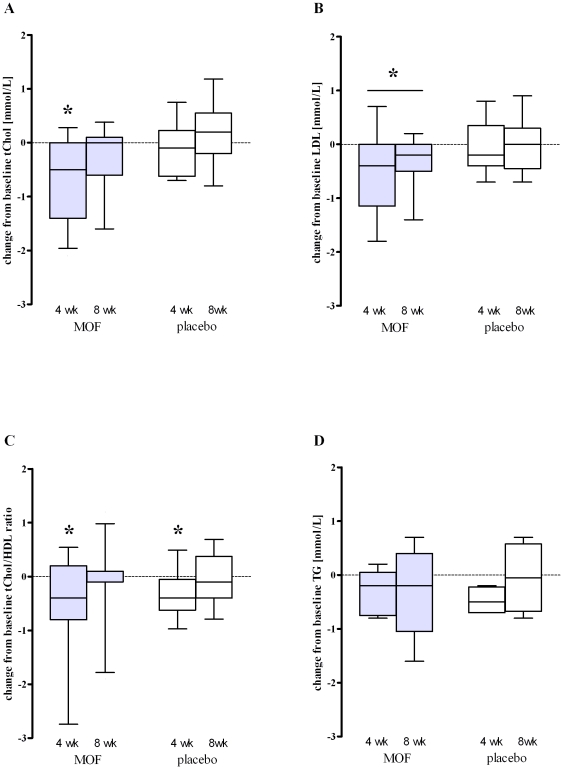
Figure 1. Changes from baseline in median (10th to 90th percentile) serum lipid concentrations after 4 and 8 wk supplementation with either 200 mg/d monomeric and oligomeric flavanols (MOF) or placebo: (A) total cholesterol (tChol) concentrations of subjects with tChol baseline concentrations >5.0 mmol/L (MOF group: n = 11, placebo group: n = 10); (B) low density lipoprotein (LDL) concentrations of subjects with LDL baseline concentrations >3.2 mmol/L (MOF group: n = 9, placebo group: n = 9); (C) ratio of tChol to high density lipoprotein (HDL) of subjects with tChol baseline concentrations >5.0 mmol/L (MOF group: n = 11, placebo group: n = 10); (D) triglycerides (TG) concentrations of subjects with TG baseline concentrations >1.7 mmol/L (MOF group: n = 5, placebo group: n = 4).
Within-group changes were appraised by Wilcoxon Signed Ranks test, between-group changes by Mann-Whitney U test; *Significantly different from baseline in the same group, P<0.05. There were no significant differences between the MOF and the placebo group at the same time points.
Figure 2
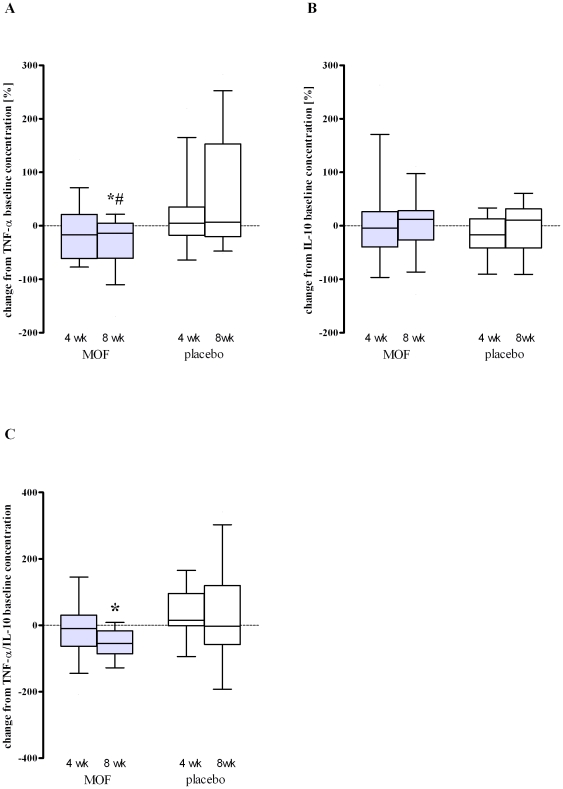
Figure 2. Changes from baseline in median (10th to 90th percentile) cytokine concentrations released upon LPS-addition (100 ng/mL) to subjects' blood ex vivo after 4 and 8 wk supplementation with either 200 mg/d monomeric and oligomeric flavanols (MOF, n = 15) or placebo (n = 13): (A) TNF-α, percentage change; (B) IL-10, percentage change; (C) ratio of TNF-α to IL-10, absolute change.
Within-group changes were appraised by Wilcoxon Signed Ranks test, between-group changes by Mann-Whitney U test; *Significantly different from baseline in the same group, P<0.05. #Significant difference between groups at the same time, P<0.05.
Figure 3
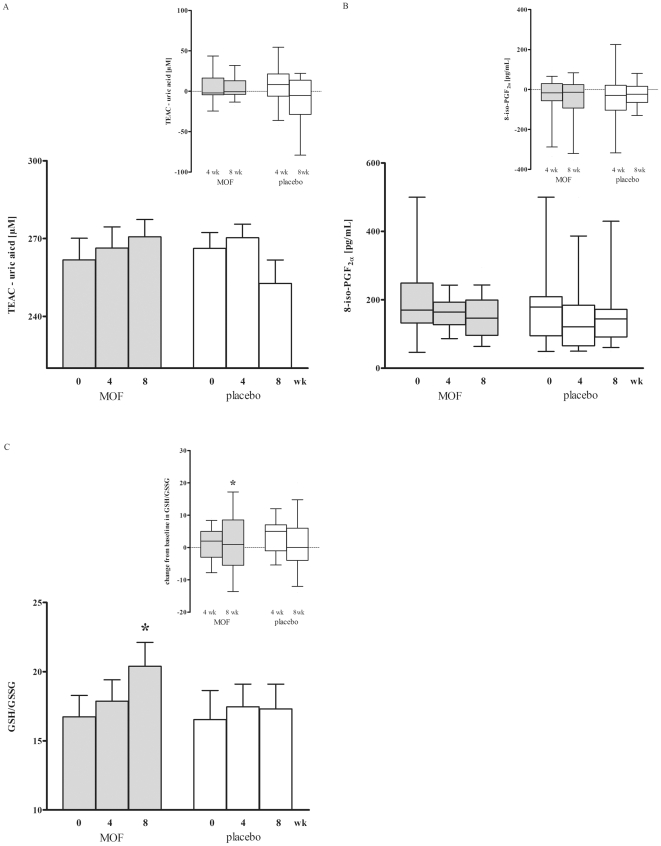
Figure 3. Mean ± SEM (bars) or median (10th and 90th percentile) (box and whiskers) antioxidant capacity of plasma measured as trolox equivalent antioxidant capacity (TEAC) and corrected for uric acid plasma concentrations (A), ratio of glutathione (GSH) to glutathione disulphide (GSSG) in erythrocytes (B) and 8-isoprostaglandine F (8-iso-PGF) plasma concentrations of subjects at baseline (0 wk) and after 4 and 8 wk supplementation with either 200 mg/d monomeric and oligomeric flavanols (MOF, n = 15) or placebo (n = 13).
The insert displays for each of the parameter the changes from baseline after 4 and 8 weeks intervention. Within-group changes were appraised by either one-tailed paired-samples t-test (bar plots) or Wilcoxon Signed Ranks test (box and whiskers plots), between-group changes by either two-tailed independent samples t-test (bar plots) or Mann-Whitney U test (box and whiskers plots); *Significantly different from baseline in the same group, P<0.05. There were no significant differences between the MOF and the placebo group at the same time points.
Figure 4
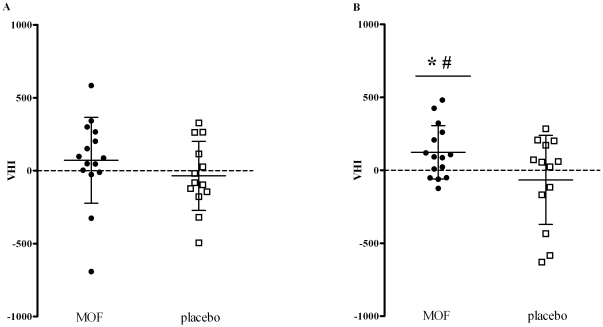
Figure 4. Mean ± SD vascular health index (VHI) of individual subjects after 4 (A) and 8 wk (B) supplementation with either 200 mg/d monomeric and oligomeric flavanols (MOF, n = 15) or placebo (n = 13).
Within-group changes were appraised by one-tailed paired-samples t-test, between-group changes by two-tailed independent samples t-test; *Significantly different from baseline in the same group, P<0.05. #Significant difference between groups at the same time, P<0.05.

References

    1. World Health Organization (WHO), Cardiovascular diseases (CVDs), Fact sheet Nr. 317, January 2011. Available: http://www.who.int/mediacentre/factsheets/fs317/en/index.html via the Internet. Accessed 2011 Aug 26.
    1. European Heart Network, Cardiovascular disease statistics 2008. Available: http://www.ehnheart.org/cvd-statistics.html via the Internet. Accessed 2011 Aug 26.
    1. Mallika V, Goswami B, Rajappa M. Atherosclerosis pathophysiology and the role of novel risk factors: a clinicobiochemical perspective. Angiology. 2007;58:513–522. - PubMed
    1. Yanbaeva DG, Dentener MA, Creutzberg EC, Wesseling G, Wouters EFM. Systemic Effects of Smoking. Chest. 2007;131:1557–1566. - PubMed
    1. Pryor WA, Stone K. Oxidants in cigarette smoke. Radicals, hydrogen peroxide, peroxynitrate, and peroxynitrite. Ann N Y Acad Sci. 1993;686:12–27; discussion 27–18. - PubMed

Publication types

Associated data