. 2011;6(12):e28781.
doi: 10.1371/journal.pone.0028781. Epub 2011 Dec 12.

Distribution and regulation of the mobile genetic element-encoded phenol-soluble modulin PSM-mec in methicillin-resistant Staphylococcus aureus

Affiliations

Distribution and regulation of the mobile genetic element-encoded phenol-soluble modulin PSM-mec in methicillin-resistant Staphylococcus aureus

Som S Chatterjee et al. PLoS One. 2011.

Abstract

The phenol-soluble modulin PSM-mec is the only known staphylococcal toxin that is encoded on a mobile antibiotic resistance determinant, namely the staphylococcal cassette chromosome (SCC) element mec encoding resistance to methicillin. Here we show that the psm-mec gene is found frequently among methicillin-resistant Staphylococcus aureus (MRSA) strains of SCCmec types II, III, and VIII, and is a conserved part of the class A mec gene complex. Controlled expression of AgrA versus RNAIII in agr mutants of all 3 psm-mec-positive SCCmec types demonstrated that expression of psm-mec, which is highly variable, is controlled by AgrA in an RNAIII-independent manner. Furthermore, psm-mec isogenic deletion mutants showed only minor changes in PSMα peptide production and unchanged (or, as previously described, diminished) virulence compared to the corresponding wild-type strains in a mouse model of skin infection. This indicates that the recently reported regulatory impact of the psm-mec locus on MRSA virulence, which is opposite to that of the PSM-mec peptide and likely mediated by a regulatory RNA, is minor when analyzed in the original strain background. Our study gives new insight in the distribution, regulation, and role in virulence of the PSM-mec peptide and the psm-mec gene locus.


Conflict of interest statement

Competing Interests: The authors have declared that no competing interests exist.

Figures

Figure 1
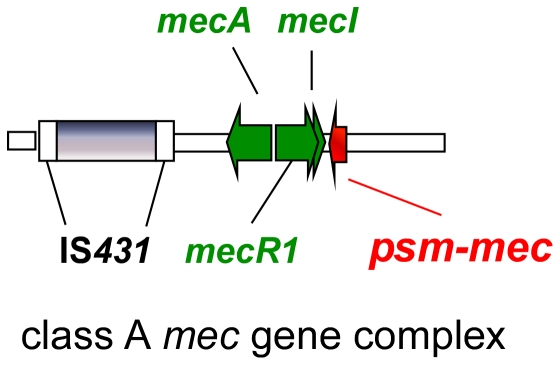
Figure 1. Conserved location of the psm-mec gene in the class A mec gene complex.
The class A mec gene complex contains the core genes of the SCCmec element in the order IS431-mecA-mecR-mecI. Downstream of mecI, the psm-mec gene is encoded in opposite direction as a conserved part of this complex.
Figure 2
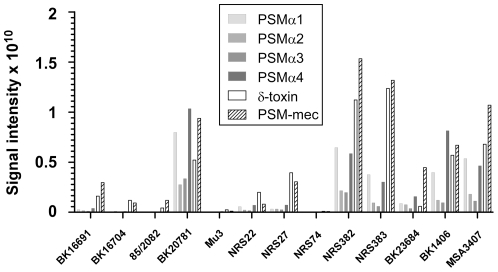
Figure 2. PSM production in psm-mec-positive MRSA strains.
All MRSA strains that were determined to be psm-mec-positive in this study were analyzed for production of all S. aureus PSM peptides (α1, α2, α3, α4, β1, β2, δ-toxin, mec) by RP-HPLC/MS. Production levels are shown for all peptides except for β1 and β2, for which production levels were in general very low. The previously analyzed MRSA strain MSA3407 is shown as reference.
Figure 3
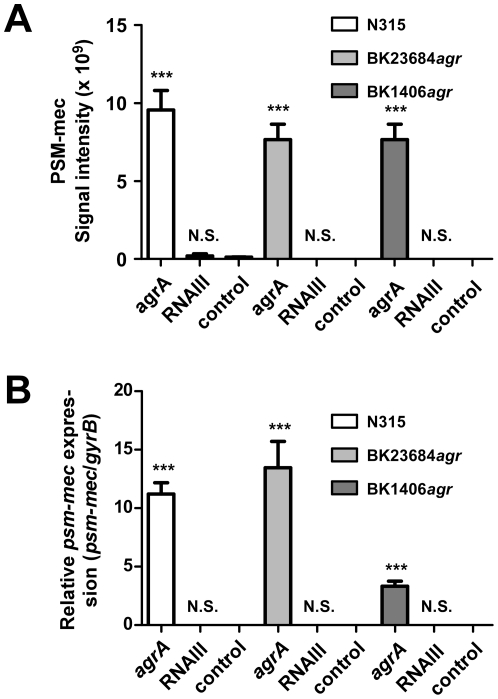
Figure 3. Mechanism of Agr-dependent regulation of psm-mec.
Expression of psm-mec on the protein (A) and transcript (B) levels was analyzed in the psm-mec-positive, Agr-dysfunctional MRSA strains N315 (SCCmec type II), BK1406agr (SCCmec type III), and BK23684agr (SCCmec type VIII), in which the agrA gene or RNAIII were constitutively over-expressed using plasmid pTXΔ (in strain N315) or expressed using induction with 0.5% xylose in a pKX background (in the other 2 strains). Control, containing the empty plasmid pTXΔ16 or pKX16, respectively. (A) Protein level analysis. (B) Transcript level analysis. Relative expression of the psm-mec transcript is shown, relative to expression of the housekeeping gene gyrB. N.S., not significant; ***, p<0.0001; One-way analysis of variance with Dunnett post tests compared to the control sample.
Figure 4
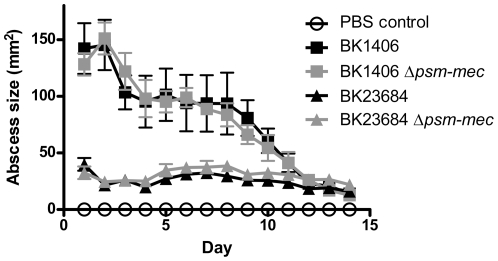
Figure 4. Mouse abscess model.
Isogenic psm-mec deletion mutants of strains BK1406 (SCCmec type III) and BK23684 (SCCmec type VIII) were compared to their corresponding wild-type strains in a mouse abscess model that was performed as previously described for strain MSA890 and its psm-mec deletion mutant . Abscesses formed by strain BK1406 usually presented with open lesions, whereas those formed by strain BK23684 did not. There were no significant differences (using t-tests) between corresponding wild-type and psm-mec deletion mutant strain abscess sizes.
Figure 5
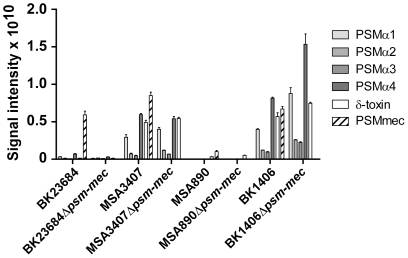
Figure 5. Impact of the psm-mec locus on the production of genome-encoded PSMs.
Four MRSA strains of 3 different SCCmec types and their isogenic psm-mec deletion mutants were analyzed for production of all S. aureus PSM peptides (α1, α2, α3, α4, β1, β2, δ-toxin, mec) by RP-HPLC/MS. Production levels are shown for all peptides except for β1 and β2, for which production levels were in general very low.

References

    1. Lowy FD. Staphylococcus aureus infections. N Engl J Med. 1998;339:520–532. - PubMed
    1. Lowy FD. Antimicrobial resistance: the example of Staphylococcus aureus. J Clin Invest. 2003;111:1265–1273. - PMC - PubMed
    1. DeLeo FR, Otto M, Kreiswirth BN, Chambers HF. Community-associated meticillin-resistant Staphylococcus aureus. Lancet. 2010;375:1557–68. - PMC - PubMed
    1. Hiramatsu K, Cui L, Kuroda M, Ito T. The emergence and evolution of methicillin-resistant Staphylococcus aureus. Trends Microbiol. 2001;9:486–493. - PubMed
    1. Novick RP, Schlievert P, Ruzin A. Pathogenicity and resistance islands of staphylococci. Microbes Infect. 2001;3:585–594. - PubMed

Publication types