. 2012 Feb;89(2):408-15.
doi: 10.1016/j.biopsycho.2011.12.003. Epub 2011 Dec 15.

Psychopathic tendencies and mesolimbic recruitment by cues for instrumental and passively obtained rewards

Affiliations

Psychopathic tendencies and mesolimbic recruitment by cues for instrumental and passively obtained rewards

James M Bjork et al. Biol Psychol. 2012 Feb.

Abstract

Psychopathy is a constellation of self-serving attitudes and antisocial behaviors with little regard to cost to self and others. Might this symptomatology arise in part from an exaggerated response of brain motivational circuitry to prospective rewards? We examined whether psychopathic tendencies are associated with increased recruitment of incentive neurocircuitry during anticipation of instrumental and conditioned rewards. Healthy controls completed the Psychopathic Personality Inventory (PPI), then were presented with response-contingent and passively delivered rewards during functional MRI. PPI scores correlated negatively with reaction time to incentivized targets, but not with reaction time to non-incentivized targets. PPI scores also correlated positively with recruitment of ventral striatum and anterior cingulate cortex during instrumental reward anticipation. PPI scores also correlated with middle frontal cortex recruitment during anticipation of passively received rewards. These data indicate that in psychiatrically healthy controls, individuals with greater endorsement of psychopathic tendencies show more robust neurophysiological and behavioral signatures of incentive motivation.


Figures

Figure 1
Figure 1
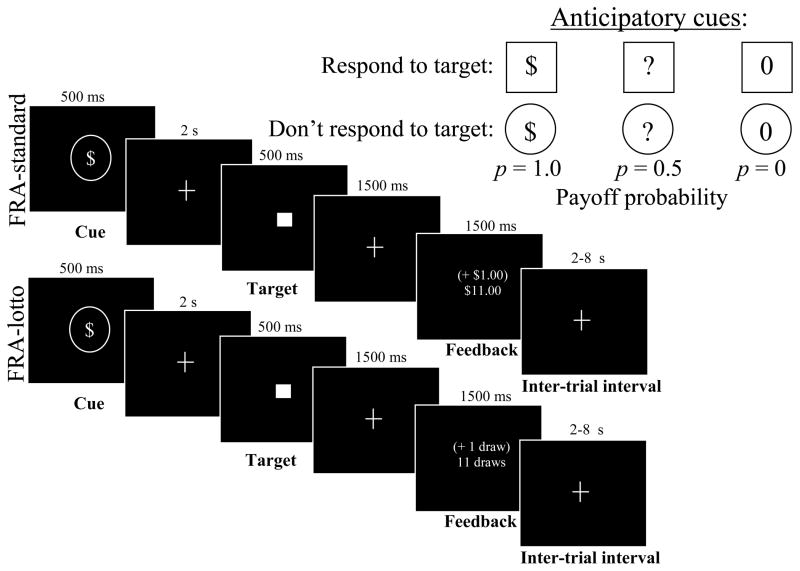
Factorial Reward Anticipation (FRA) task variants. Trials lasted 6 s, and were separated by jittered intervals of 2–8 s. Subjects first saw one of six cues indicating whether the subject needed to respond (squares) or to not respond (circles) to the target that followed, and what the consequences of the trial could be. In response trials, subjects were required to respond to the target during its 500 ms presentation. In the standard task variant (top panel series), the cue signaled a certain gain of $1 (square-$), a 50% chance of a $1 gain (square-?), or no gain (square-0) for hitting the target. In non-response trials, subjects were not to respond to the targets, but anticipated the identical range of signaled gain probabilities. Each trial concluded with 1.5 s of feedback of gain or non-gain. The FRA-UP variant of this task was identical, except that subjects were not told the exact probability of the uncertain (?-cue) payoffs. In the FRA-lotto variant (bottom panel series), the fixed $1 reward was replaced by a random marble draw worth a mean value of ~$1.
Figure 2
Figure 2
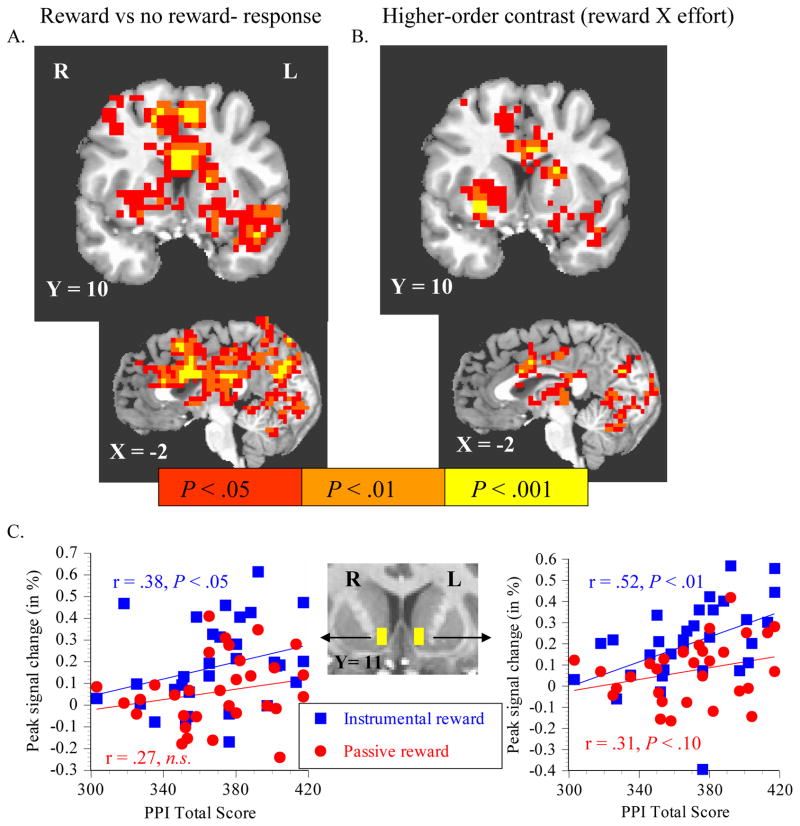
Correlation between PPI total scores and brain activation. Across all FRA task variants, there was a positive voxelwise correlation between PPI-total scores and activation by anticipation of potential reward (p = 1.0 and p = 0.5) versus nonreward (p = 0) (A). PPI-total scores also correlated with activation by the higher-order combination of instrumental reward versus nonreward anticipation, where passive reward versus nonreward anticipation was masked out (B). Peak modeled signal change (~6 s lag) during anticipation of certain (p =1.0) reward for a successful instrumental response directly correlated with PPI-scores in the nucleus accumbens (NAcc) (C), with a trend for a correlation during passive anticipation of certain reward in left NAcc. All statistical maps are overlaid on a T1-weighted image at the indicated Taliarach coordinate.
Figure 3
Figure 3
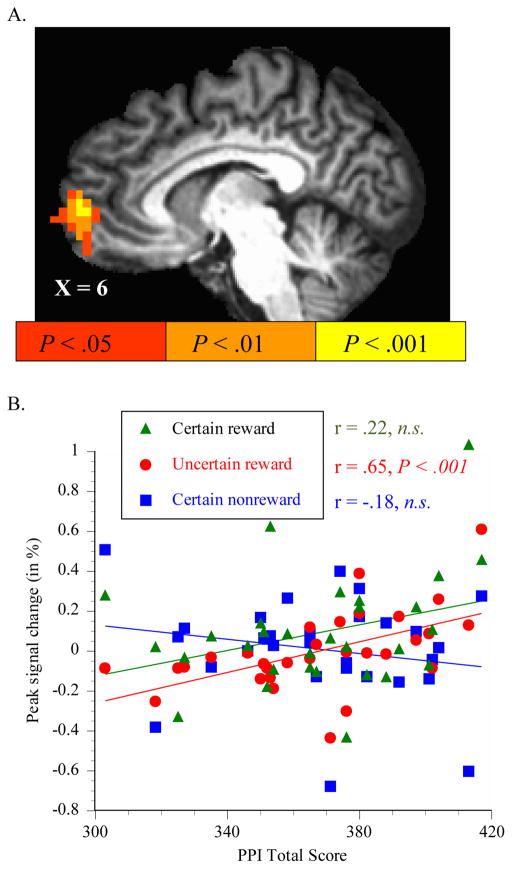
Correlation between PPI total scores and anterior mesofrontal cortex (mFC) recruitment during anticipation of passively-delivered rewards. PPI-total scores correlated positively with anterior mFC recruitment by the contrast between anticipation of certain (p = 1.0) and uncertain (p = 0.5) delivery of rewards with no response requirement (A). A post hoc investigation of peak modeled hemodynamic responses to each nonresponse trial type singly indicated that this contrast was primarily driven by higher mFC responses to uncertain potential rewards in high PPI scorers (B).

References

    1. Babiak P, Neumann CS, Hare RD. Corporate psychopathy: Talking the walk. Behav Sci Law. 2010;28(2):174–193. - PubMed
    1. Baliki MN, Geha PY, Fields HL, Apkarian AV. Predicting value of pain and analgesia: nucleus accumbens response to noxious stimuli changes in the presence of chronic pain. Neuron. 2010;66(1):149–160. - PMC - PubMed
    1. Bechara A, Damasio H, Tranel D, Damasio AR. Deciding advantageously before knowing the advantageous strategy. Science. 1997;275(5304):1293–1295. - PubMed
    1. Bechara A, Dolan S, Hindes A. Decision-making and addiction (part II): myopia for the future or hypersensitivity to reward? Neuropsychologia. 2002;40(10):1690–1705. - PubMed
    1. Benning SD, Patrick CJ, Hicks BM, Blonigen DM, Krueger RF. Factor structure of the psychopathic personality inventory: validity and implications for clinical assessment. Psychol Assess. 2003;15(3):340–350. - PubMed

Publication types

LinkOut - more resources