. 2012 Apr;83(3):441-60.
doi: 10.1016/j.fitote.2011.12.006. Epub 2011 Dec 9.

Mass spectrometric dereplication of nitrogen-containing constituents of black cohosh (Cimicifuga racemosa L.)

Affiliations

Mass spectrometric dereplication of nitrogen-containing constituents of black cohosh (Cimicifuga racemosa L.)

Dejan Nikolić et al. Fitoterapia. 2012 Apr.

Abstract

Black cohosh preparations are popular dietary supplements among women seeking alternative treatments for menopausal complaints. For decades, triterpene glycosides and phenolic acids have dominated the phytochemical and biomedical research on this plant. In this study, we provide evidence that black cohosh contains an unexpected and highly diverse group of secondary nitrogenous metabolites previously unknown to exist in this plant. Using a dereplication approach that combines accurate mass measurements, database searches and general knowledge of biosynthetic pathways of natural products, we identified or tentatively identified 73 nitrogen-containing metabolites, many of which are new natural products. The identified compounds belong to several structural groups including alkaloids, amides or esters of hydroxycinnamic acids and betains. Among the alkaloids, several classes such as guanidino alkaloids, isoquinolines and β-carbolines were identified. Fragmentation patterns for major compound classes are discussed, which provides a framework for the discovery of these compounds from other sources. Identification of alkaloids as a well-known group of bioactive natural products represents an important advance in better understanding of the pharmacological profile of black cohosh.


Figures

Figure 1
Figure 1
Positive ion electrospray LC-MS chromatograms of black cohosh fractions: (a) HILIC separation of XAD water fraction. This fraction contained primarily small, highly polar primary and secondary metabolites; (b) Reversed phase separation of FCPC fraction 6.
Figure 2
Figure 2
Chemical structures of the nitrogenous metabolites from black cohosh identified ot tentatively identified in the present study. Structures of some compounds not shown here appear in the corresponding tandem mass spectra. For clarity, structures of well-known primary metabolites are omitted.
Figure 2
Figure 2
Chemical structures of the nitrogenous metabolites from black cohosh identified ot tentatively identified in the present study. Structures of some compounds not shown here appear in the corresponding tandem mass spectra. For clarity, structures of well-known primary metabolites are omitted.
Figure 3
Figure 3
Product ion tandem mass spectra of (a) arginine, (b) N-acetyl arginine, and (c) N-formyl arginine.
Figure 4
Figure 4
Product ion tandem mass spectra of (a) γ-guanidino butyric acid, (b) γ-guanidino butanal, and (c) γ-guanidino butanol.
Figure 5
Figure 5
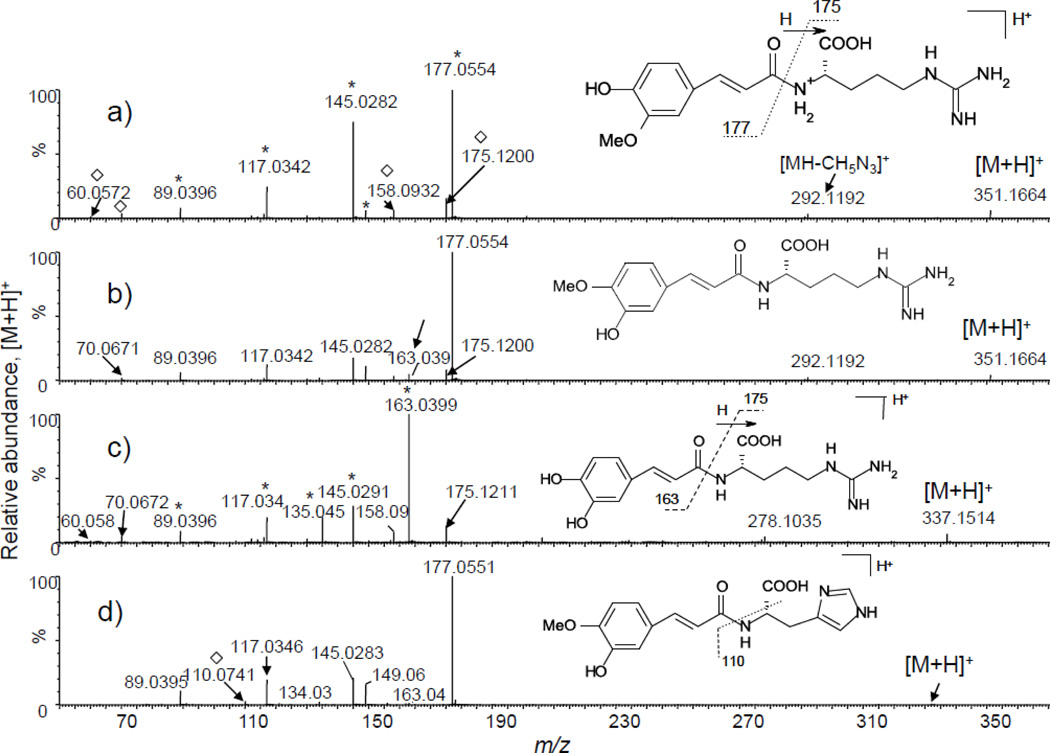
Product ion tandem mass spectra of amides of hydroxycinnamic acids amides with amino acids; (a) feruloyl arginine, (b) isoferuloyl arginine, (c) caffeoyl arginine, and (d) isoferuloyl histidine. Ion series corresponding to the acid portion of the amide are labeled “*” for ferulic and caffeic acid in (a) and (c), respectively, while those corresponding to the amine portion are labeled “◊” for arginine and histidine in (a) and (d), respectively. Note the diagnostic but low abundance fragment ion of m/z 163 [(b) and (d)], which is formed by amides of isoferulic acid but not ferulic acid.
Figure 6
Figure 6
Product ion tandem mass spectra of glycosidated amides of ferulic acid with (a) tyramine, (b) O-methyldopamine, (c) dopamine, and (d) and phenylalanine. The position of glycosidation could be determined based on the presence of a fragment ion corresponding to the glycosidated ferulic acid (m/z 321). Note the absence of the diagnostic ion of m/z 163, strongly suggesting that these are amides of ferulic acid and not isoferulic acid.
Figure 7
Figure 7
Product ion tandem mass spectra of aporphine alkaloids (a) laurolitsine and (b) laurotetanine. Loss of ammonia from these compounds indicates a secondary nitrogen in the aporphine ring.
Figure 8
Figure 8
Product ion tandem mass spectra of Pictet-Spengler adducts of Nω-methylserotonin and formaldehyde. Scheme 3 provides the proposed mechanism of formation of these compounds.
Scheme 1
Scheme 1
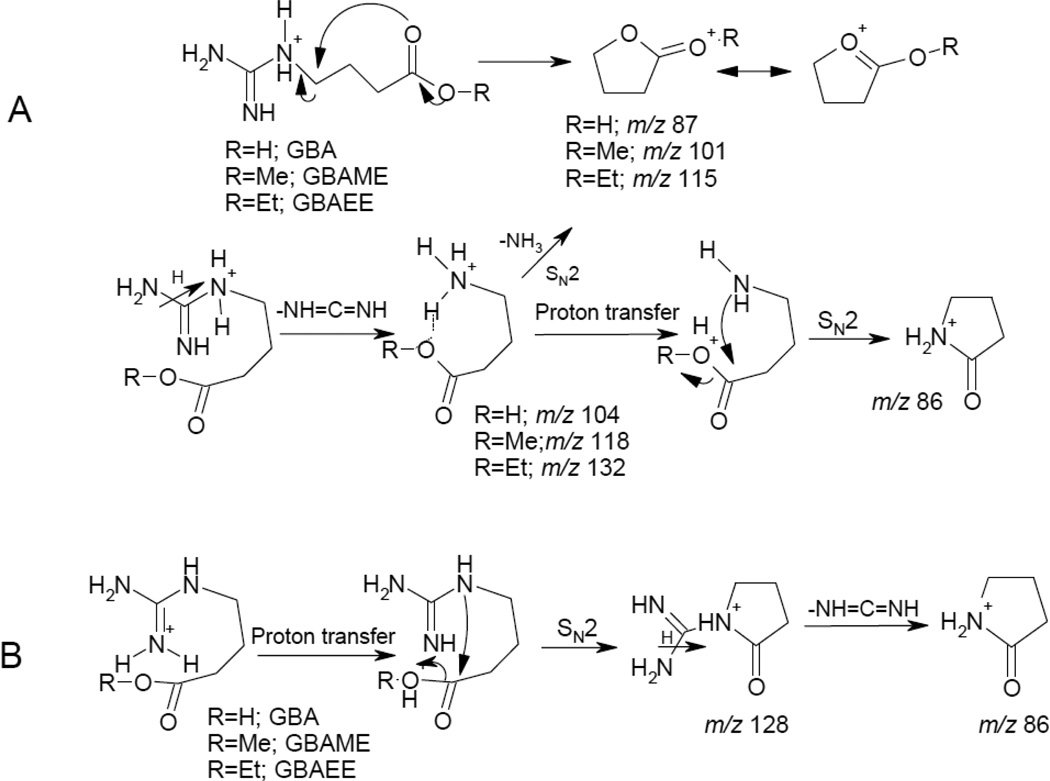
Proposed fragmentation pathways for γ -guanidino butyric acid and its esters.
Scheme 2
Scheme 2
Proposed fragmentation pathways for γ-guanidinobutanal and γ-guanidinobutanol.
Scheme 3
Scheme 3
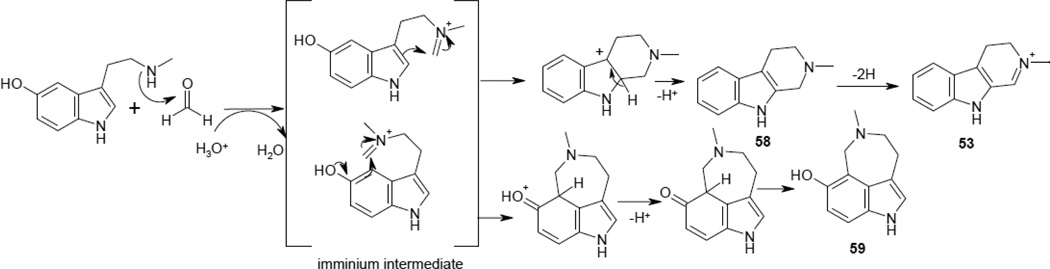
Proposed mechanism of formation of compounds 53, 58 and 59. An imminium ion intermediate can attack possible nucleophilic sites on the indole ring to form 58 and 59. 53 is likely formed by dehydrogenation of 58.
Scheme 4
Scheme 4
Proposed fragmentation pathways of unusual secondary metabolites 52 and 57.

References

    1. McKenna DJ, Jones K, Humphrey S, Hughes K. Black cohosh: efficacy, safety, and use in clinical and preclinical applications. Altern Ther Health Med. 2001;7:93–100. - PubMed
    1. Mahady GB, Parrot J, Lee C, Yun GS, Dan A. Botanical dietary supplement use in peri- and postmenopausal women. Menopause. 2003;10:65–72. - PubMed
    1. Borrelli F, Ernst E. Black cohosh (Cimicifuga racemosa) for menopausal symptoms: a systematic review of its efficacy. Pharmacol Res. 2008;58:8–14. - PubMed
    1. Osmers R, Friede M, Liske E, Schnitker J, Freudenstein J, Henneicke-von Zepelin HH. Efficacy and safety of isopropanolic black cohosh extract for climacteric symptoms. Obstet Gynecol. 2005;105:1074–1083. - PubMed
    1. Wuttke W, Seidlova-Wuttke D, Gorkow C. The Cimicifuga preparation BNO 1055 vs. conjugated estrogens in a double-blind placebo-controlled study: effects on menopause symptoms and bone markers. Maturitas. 2003;44(1):S67–S77. - PubMed

Publication types

LinkOut - more resources