. 2012 Mar;194(5):1216-25.
doi: 10.1128/JB.06521-11. Epub 2011 Dec 16.

Nature and intensity of selection pressure on CRISPR-associated genes

Affiliations

Nature and intensity of selection pressure on CRISPR-associated genes

Nobuto Takeuchi et al. J Bacteriol. 2012 Mar.

Abstract

The recently discovered CRISPR-Cas adaptive immune system is present in almost all archaea and many bacteria. It consists of cassettes of CRISPR repeats that incorporate spacers homologous to fragments of viral or plasmid genomes that are employed as guide RNAs in the immune response, along with numerous CRISPR-associated (cas) genes that encode proteins possessing diverse, only partially characterized activities required for the action of the system. Here, we investigate the evolution of the cas genes and show that they evolve under purifying selection that is typically much weaker than the median strength of purifying selection affecting genes in the respective genomes. The exceptions are the cas1 and cas2 genes that typically evolve at levels of purifying selection close to the genomic median. Thus, although these genes are implicated in the acquisition of spacers from alien genomes, they do not appear to be directly involved in an arms race between bacterial and archaeal hosts and infectious agents. These genes might possess functions distinct from and additional to their role in the CRISPR-Cas-mediated immune response. Taken together with evidence of the frequent horizontal transfer of cas genes reported previously and with the wide-spread microscale recombination within these genes detected in this work, these findings reveal the highly dynamic evolution of cas genes. This conclusion is in line with the involvement of CRISPR-Cas in antiviral immunity that is likely to entail a coevolutionary arms race with rapidly evolving viruses. However, we failed to detect evidence of strong positive selection in any of the cas genes.


Figures
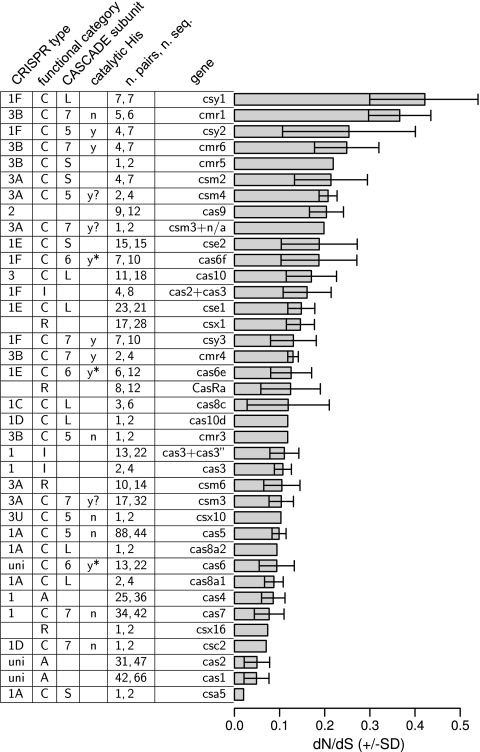
Fig 1
Fig 1
dN/dS ratios of various cas genes. The table next to the bar plot shows various types of information about the genes. The first column (CRISPR type) describes the CRISPR-Cas type and subtypes in which the respective cas genes are represented. uni refers to the genes present in all types of CRISPR-Cas systems. The second column (functional category) describes the functional categories to which the respective cas genes belong: adaptation (A), CASCADE subunits (C), interference (I), and regulation (R). The third column (CASCADE subunit) describes the groups of CASCADE genes to which the respective cas genes belong: the large subunit (L), small subunit (S), cas5 (5), cas6 (6), and cas7 (7). The fourth column (catalytic His) describes the presence or absence of predicted catalytic histidine: y* (a site is present and a gene has been demonstrated as a nuclease), y (a site is present but a gene has not been demonstrated as an enzyme), y? (a site was detected to be present by Makarova et al. [35] but was not detected in the current data set), and n (a site is absent). The fifth column (n. pairs, n. seq) shows the number of estimated dN/dS ratios and the total number of sequences from which the ratios were estimated. The sixth column (gene) shows the names of the cas genes according to Makarova et al. (35). Plus signs indicate concatenated genes.
Fig 2
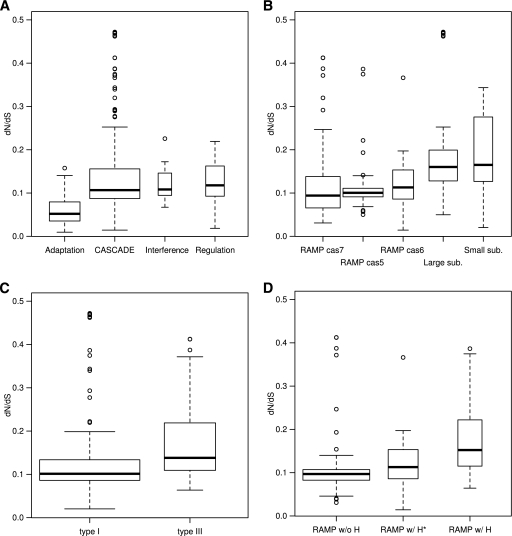
Fig 2
dN/dS ratios of the cas genes classified in four different manners (the classification is described in Fig. 1). The widths of bars are proportional to the square roots of the sample sizes (i.e., the number of estimates). (A) The genes were classified into four functional categories: genes involved in the adaptation stage of the CRISPR-Cas immune processes, those involved in the interference stage, predicted transcription regulators (denoted Regulation), and genes encoding the subunits of the CASCADE complex. (B) The CASCADE group of the genes was further divided into five groups: the cas5, cas6, and cas7 families of RAMPs and the large and small subunits of the CASCADE complex. (C) The CASCADE group of genes was classified according to the CRISPR-Cas types in which the genes were represented. The cas6 family of RAMPs (namely, cas6, cas6e, and cas6f) was excluded because a member of this family (cas6) is represented in both type I and type III systems. (D) The RAMP genes were classified according to the presence and absence of a predicted catalytic histidine: the genes that have a predicted catalytic histidine site and encode an experimentally characterized nuclease (RAMP w/H*), those that had a conserved histidine site but have not been demonstrated to possess nuclease activity (RAMP w/H), and those that do not have a predicted catalytic histidine (RAMP w/o H) (csm3 and csm4 were excluded).
Fig 3
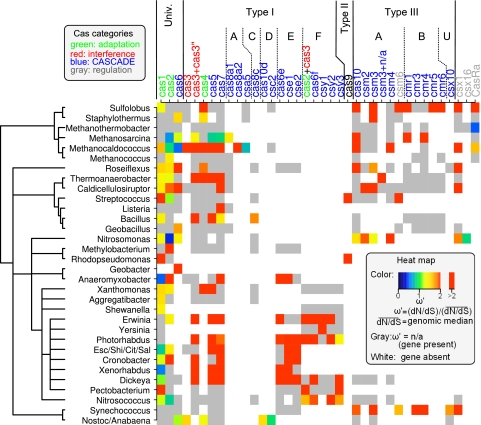
Fig 3
dN/dS ratios of cas genes scaled by the median dN/dS ratio of the respective genomes. The genes are categorized into four functional groups and also are grouped by the types of the CRISPR-Cas systems in which the genes are represented (the classification is described in Fig. 1). The genomes were grouped into genera according to the NCBI Taxonomy Database (54). The heat map indicates the scaled dN/dS ratios (the scale is shown in the inset). Gray indicates that the dN/dS ratios were unavailable because the dS values fell outside the acceptable range of 0.25 to 1.5. White indicates the absence of the respective gene in a given genome. Univ., universal; dN/dS, median of the genomic dN/dS ratio distribution of the respective genome; ω′, dN/dS ratio of a cas gene divided by the value of dN/dS in the respective genome.
Fig 4
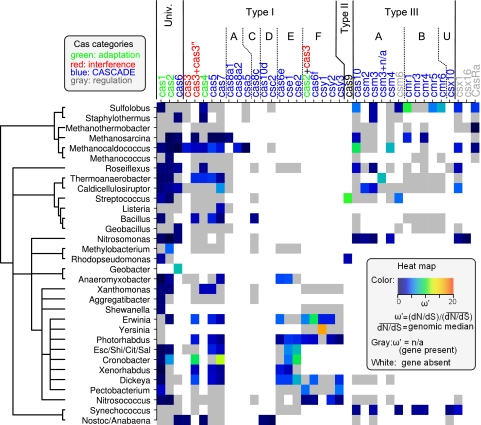
Fig 4
Heat map shown in Fig. 3 rescaled to facilitate comparison between different genomes. The scale is shown in the inset.

References

    1. Al-Attar S, Westra ER, van der Oost J, Brouns SJ. 2011. Clustered regularly interspaced short palindromic repeats (CRISPRs): the hallmark of an ingenious antiviral defense mechanism in prokaryotes. Biol. Chem. 392:277–289 - PubMed
    1. Altschul SF, Gish W, Miller W, Myers EW, Lipman DJ. 1990. Basic local alignment search tool. J. Mol. Biol. 215:403–410 - PubMed
    1. Altschul SF, et al. 1997. Gapped BLAST and PSI-BLAST: a new generation of protein database search programs. Nucleic Acids Res. 25:3389–3402 - PMC - PubMed
    1. Andersson AF, Banfield JF. 2008. Virus population dynamics and acquired virus resistance in natural microbial communities. Science 320:1047–1050 - PubMed
    1. Anisimova M, Nielsen R, Yang Z. 2003. Effect of recombination on the accuracy of the likelihood method for detecting positive selection at amino acid sites. Genetics 164:1229–1236 - PMC - PubMed

Publication types

LinkOut - more resources