. 2012 Feb;78(4):1113-22.
doi: 10.1128/AEM.06376-11. Epub 2011 Dec 16.

An agr quorum sensing system that regulates granulose formation and sporulation in Clostridium acetobutylicum

Affiliations

An agr quorum sensing system that regulates granulose formation and sporulation in Clostridium acetobutylicum

Elisabeth Steiner et al. Appl Environ Microbiol. 2012 Feb.

Abstract

The Gram-positive, anaerobic, endospore-forming bacterium Clostridium acetobutylicum has considerable biotechnological potential due to its ability to produce solvents as fermentation products, in particular the biofuel butanol. Its genome contains a putative agr locus, agrBDCA, known in staphylococci to constitute a cyclic peptide-based quorum sensing system. In staphylococci, agrBD is required for the generation of a peptide signal that, upon extracellular accumulation, is sensed by an agrCA-encoded two-component system. Using ClosTron technology, agrB, agrC, and agrA mutants of C. acetobutylicum ATCC 824 were generated and phenotypically characterized. Mutants and wild type displayed similar growth kinetics and no apparent differences in solvent formation under the conditions tested. However, the number of heat-resistant endospores formed by the mutants in liquid culture was reduced by about one order of magnitude. On agar-solidified medium, spore formation was more strongly affected, particularly in agrA and agrC mutants. Similarly, accumulation of the starch-like storage compound granulose was almost undetectable in colonies of agrB, agrA, and agrC mutants. Importantly, these defects could be genetically complemented, demonstrating that they were directly linked to agr inactivation. A diffusible factor produced by agrBD-expressing strains was found to restore granulose and spore formation in the agrB mutant. Furthermore, a synthetic cyclic peptide, designed on the basis of the C. acetobutylicum AgrD sequence, was also capable of complementing the defects of the agrB mutant when added exogenously to the culture. Together, these findings support the hypothesis that agr-dependent quorum sensing is involved in the regulation of sporulation and granulose formation in C. acetobutylicum.


Figures
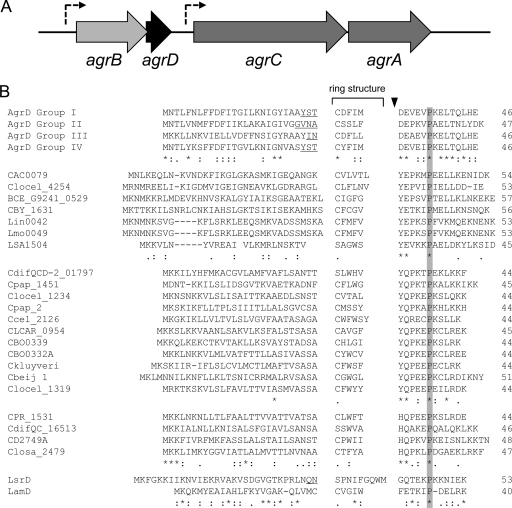
Fig 1
Fig 1
Schematic representation of the C. acetobutylicum agrBDCA cluster (A) and alignment of confirmed and putative AgrD sequences (B). (A) The C. acetobutylicum agrBDCA cluster is predicted to comprise two independent transcriptional units (indicated by the dashed arrows), agrBD and agrCA. (B) The alignment shows the experimentally confirmed AgrD proteins from S. aureus (AgrD group I to IV), E. faecalis (LsrD), and L. plantarum (LamD), as well as selected putative AgrD sequences from other species. The latter included the following (locus tags are given in parentheses, if available, and identify the respective sequence in the alignment): C. acetobutylicum (CAC0079), Clostridium cellulovorans 743B (Clocel_1234, Clocel_1319, and Clocel_4254), Bacillus cereus G9241 (BCE_G9241_0529), Listeria innocua Clip11262 (Lin0042), Listeria monocytogenes EGD-e (Lmo0049), Clostridium butyricum 5521 (CBY_1631), Lactobacillus sakei subsp. sakei 23K (LSA1504), Clostridium difficile QCD-23m63 (CdifQCD-2_01797), Clostridium papyrosolvens DSM 2782 (Cpap_1451 and Cpap 2, the latter not annotated), Clostridium cellulolyticum H10 (Ccel_2126), Clostridium carboxidivorans P7 (CLCAR_0954), Clostridium botulinum ATCC 3502 (CBO0332A and CBO0339), Clostridium kluyveri (Ckluyveri; not annotated), C. beijerninckii NCIMB 8052 (Cbeij 1; not annotated), Clostridium perfringens SM101 (CPR_1531), C. difficile QCD-66c26 (CdifQC_16513), C. difficile 630 (CD2749A), Clostridium saccharolyticum WM1 (Closa_2479). The black triangle indicates confirmed and proposed processing sites downstream of the ring-encoding part of AgrD. A highly conserved proline, present in all sequences, is shaded gray. Note the sequence conservation immediately downstream of the proposed cleavage site and upstream of the conserved proline. For each AIP group, identities (*), conserved (:), and semiconserved substitutions (.) are displayed. Amino acids constituting the N-terminal tail of confirmed AIPs are underlined. Numbers indicate the total length of the AgrD sequence.
Fig 2
Fig 2
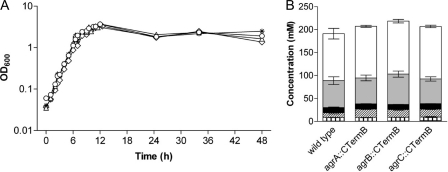
Growth and solvent formation of C. acetobutylicum agr mutants. Wild-type C. acetobutylicum and agr mutants were grown in CBM-S broth. (A) Growth was monitored by following the optical density at 600 nm: wild type (asterisks), agrA mutant (triangles), agrB mutant (circles), agrC mutant (diamonds). (B) After 72 h, culture supernatant samples were taken and analyzed for the produced acids (acetate, checks; butyrate, lines) and solvents (butanol, white; acetone, gray; ethanol, black). The values shown are the means ± standard errors of the means of results from six independent experiments. Product concentrations are not significantly different between the wild-type and the mutant strains, except for the difference between butyrate produced by the agrA mutant and the wild type (P = 0.02).
Fig 3
Fig 3
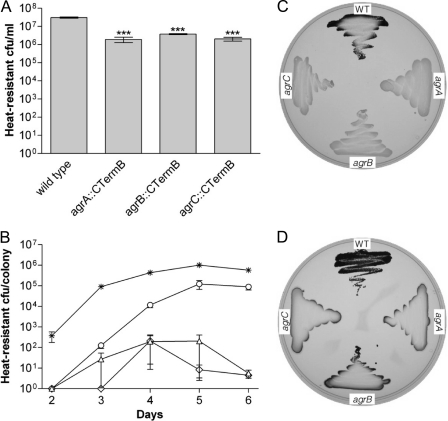
Sporulation and granulose accumulation in C. acetobutylicum agr mutants. (A) Sporulation assays of wild-type C. acetobutylicum and agr mutants cultured in CBM-S broth for 5 days. The values shown are the means ± standard errors of the means (SEM) of results from ≥3 clones of each strain (each clone representing an independently derived mutant). All values are significantly different from the wild-type strain (***, P < 0.001). (B) The number of heat-resistant endospores formed per colony was determined for C. acetobutylicum (asterisks) and the mutant strains agrA::CTermB (triangles), agrB::CTermB (circles), and agrC::CTermB (diamonds) over a time course of 6 days. The values shown are the means ± SEM of results from 10 colonies of each strain and time point. Mutant strains and wild type are significantly different in all given time points (P < 0.001). (C and D) Granulose assays. Wild-type C. acetobutylicum (WT), agrA::CTermB (agrA), agrB::CTermB (agrB), and agrC::CTermB (agrC) were grown on CBM-G plates and assayed for granulose formation after 24 h (C) and 48 h (D).
Fig 4
Fig 4
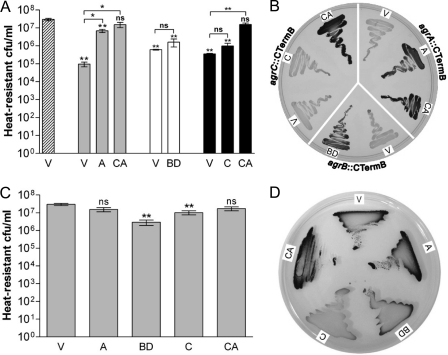
Complementation of C. acetobutylicum agr mutants and effect of overexpression of agr genes. (A and B) For complementation studies, strains agrA::CTermB (gray bars), agrB::CTermB (white bars), and agrC::CTermB (black bars) were transformed with the vector control (V) or the indicated complementation vectors carrying the agrA (A), agrBD (BD), agrC (C), and agrCA (CA) genes. As a control, the wild-type strain carrying the vector control (striped bar) was also included. Sporulation assays were performed after 5 days in CBM-S broth (A) and granulose accumulation was assayed on CBM-G plates after 24 h (B). The data obtained for mutant strains carrying either a complementation vector or the empty plasmid were compared to those for the wild-type strain harboring the empty vector; significance levels are indicated immediately above the bars. The significance levels of the differences between complemented mutants and the corresponding mutant strains transformed with empty vector are indicated above the brackets: **, P < 0.01; *, P < 0.05; ns, not significant. (C and D) Wild-type agr genes were introduced into the parent C. acetobutylicum strain to investigate the effect of overexpression of these genes on sporulation after 5 days (C) and granulose formation after 24 h (D). The values shown are the means ± standard errors of the means of results from ≥3 independent experiments. The data shown in panel C were compared to those for the wild-type strain carrying the empty plasmid, and the significance levels are indicated: **, P < 0.01; ns, not significant.
Fig 5
Fig 5
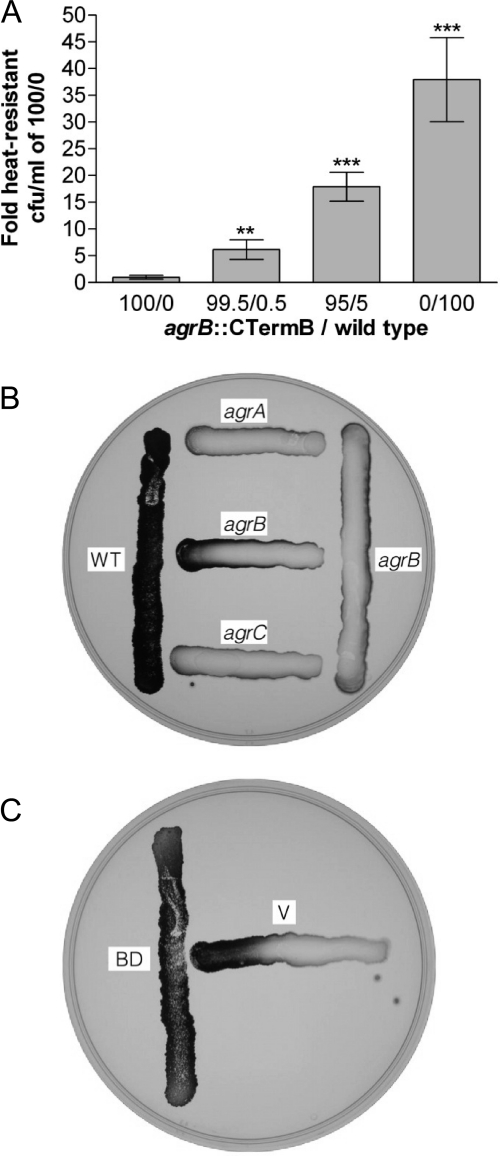
A diffusible factor produced by wild-type C. acetobutylicum restores sporulation and granulose formation in the agrB mutant. (A) Early-exponential-phase cultures of agrB::CTermB were mixed in the indicated ratios with the wild-type strain. Spore assays were performed after 5 days, and heat-treated spores were plated on erythromycin-supplemented CBM plates, which allowed only germintated agrB mutant spores to grow. Wild-type controls (0/100) were counted on nonselective medium. Shown is the fold increase in spore numbers compared to the agrB::CTermB single culture control (100/0). The values given are the means ± standard errors of the means of results from three independent experiments. All values are significantly different from the control 100/0 (***, P < 0.001; **, P < 0.01). (B) agrA::CTermB (agrA), agrB::CTermB (agrB), and agrC::CTermB (agrC) were cross-streaked with wild-type C. acetobutylicum (WT) on CBM-G plates and assayed for granulose accumulation after 48 h. (C) Shown is the granulose stain of a cross-streak of the complemented agrB::CTermB strain (BD) and agrB::CTermB carrying the vector control (V) after 48 h.
Fig 6
Fig 6
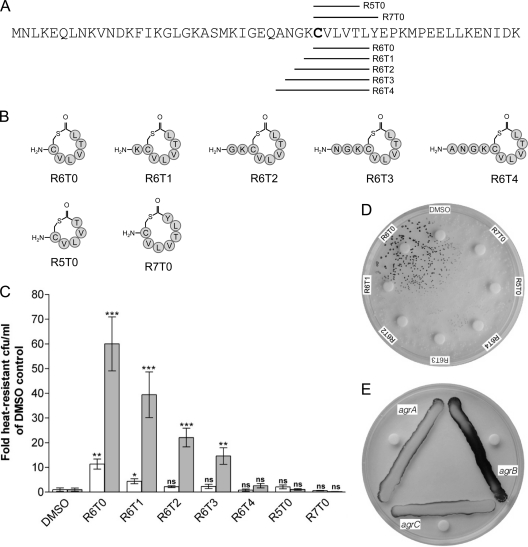
Effect of synthetic cyclic peptides on sporulation and granulose formation. (A) C. acetobutylicum AgrD sequence displaying the position of peptide stretches (horizontal lines) that were used to design the synthetic, cyclic AIPs shown schematically in panel B. The bold C indicates the conserved cysteine required for thiolactone bond formation. (C) The number of heat-resistant endospores formed by the C. acetobutylicum agrB::CTermB strain was analyzed after 5 days of growth in CBM-S broth in the presence of 2 μM (white bars) and 20 μM (gray bars) concentrations of the indicated peptides and compared to a DMSO control. The values shown are the means ± standard errors of the means of results from three independent experiments. Significance levels of differences between AIP-supplemented cultures and corresponding DMSO controls are indicated above the bars: ***, P < 0.001; **, P < 0.01; *, P < 0.05; ns, not significant. (D) Granulose stain of agrB::CTermB grown on CBM-G plates supplemented with the indicated AIPs on filter discs and assayed after 48 h. (E) Granulose stain of agrA::CTermB (agrA), agrB::CTermB (agrB), and agrC::CTermB (agrC) grown next to filter discs impregnated with R6T0 AIP stock solution.

References

    1. Alsaker KV, Papoutsakis ET. 2005. Transcriptional program of early sporulation and stationary-phase events in Clostridium acetobutylicum. J. Bacteriol. 187:7103–7118 - PMC - PubMed
    1. Bi C, Jones SW, Hess DR, Tracy BP, Papoutsakis ET. 2011. SpoIIE is necessary for asymmetric division, sporulation, and expression of σF, σE, and σG but does not control solvent production in Clostridium acetobutylicum ATCC 824. J. Bacteriol. 193:5130–5137 - PMC - PubMed
    1. Cooksley C, et al. 2010. Regulation of neurotoxin production and sporulation by a putative agrBD signaling system in proteolytic Clostridium botulinum. Appl. Environ. Microbiol. 76:4448–4460 - PMC - PubMed
    1. Dürre P, Hollergschwandner C. 2004. Initiation of endospore formation in Clostridium acetobutylicum. Anaerobe 10:69–74 - PubMed
    1. Dürre P. 2005. Formation of solvents in clostridia, p 671–693 In Dürre P. (ed), Handbook on clostridia. CRC Press, Boca Raton, FL

Publication types

MeSH terms