


Age-related decline of peripheral visual processing: the role of eye movements
- PMID: 22179529
- PMCID: PMC3279647
- DOI: 10.1007/s00221-011-2978-3
Age-related decline of peripheral visual processing: the role of eye movements
Abstract
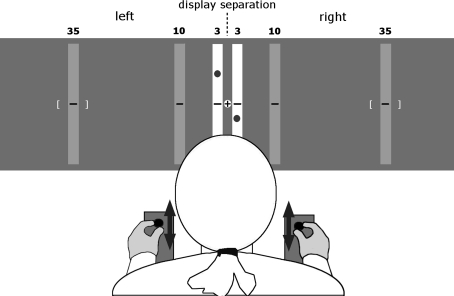
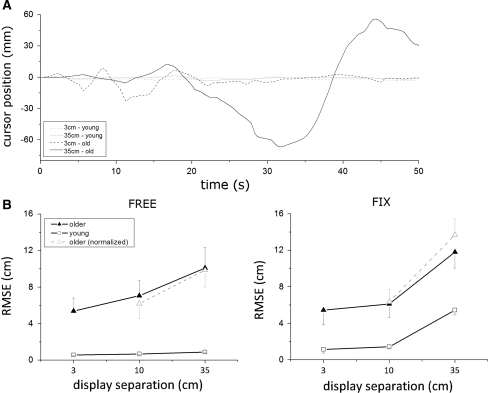
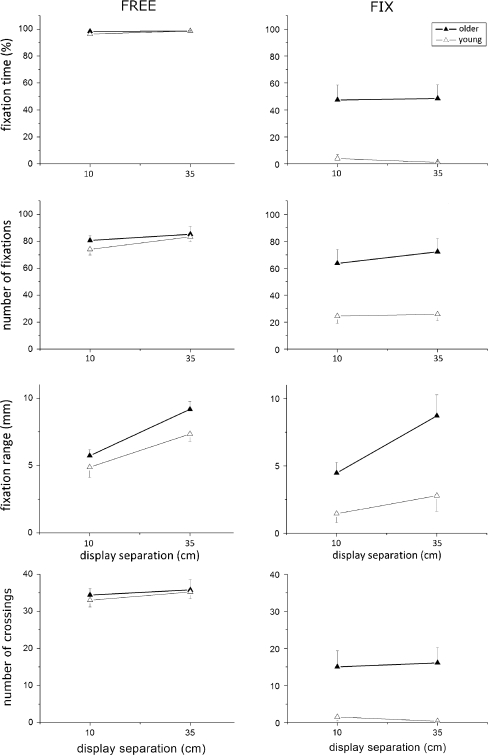
Earlier work suggests that the area of space from which useful visual information can be extracted (useful field of view, UFoV) shrinks in old age. We investigated whether this shrinkage, documented previously with a visual search task, extends to a bimanual tracking task. Young and elderly subjects executed two concurrent tracking tasks with their right and left arms. The separation between tracking displays varied from 3 to 35 cm. Subjects were asked to fixate straight ahead (condition FIX) or were free to move their eyes (condition FREE). Eye position was registered. In FREE, young subjects tracked equally well at all display separations. Elderly subjects produced higher tracking errors, and the difference between age groups increased with display separation. Eye movements were comparable across age groups. In FIX, elderly and young subjects tracked less well at large display separations. Seniors again produced higher tracking errors in FIX, but the difference between age groups did not increase reliably with display separation. However, older subjects produced a substantial number of illicit saccades, and when the effect of those saccades was factored out, the difference between young and older subjects' tracking did increase significantly with display separation in FIX. We conclude that the age-related shrinkage of UFoV, previously documented with a visual search task, is observable with a manual tracking task as well. Older subjects seem to partly compensate their deficit by illicit saccades. Since the deficit is similar in both conditions, it may be located downstream from the convergence of retinal and oculomotor signals.
Figures
References
-
- Ball K, Owsley C, Sloane M, Roenker D, Bruni J. Visual attention problems as a predictor of vehicle crashes in older drivers. Invest Ophthalmol Vis Sci. 1993;34:3110–3123. - PubMed
MeSH terms
LinkOut - more resources
Full Text Sources
Medical
