Review
. 2012 Mar;11(3):R111.014027.
doi: 10.1074/mcp.R111.014027. Epub 2011 Dec 16.

Joining forces: integrating proteomics and cross-linking with the mass spectrometry of intact complexes

Affiliations
Review

Joining forces: integrating proteomics and cross-linking with the mass spectrometry of intact complexes

Florian Stengel et al. Mol Cell Proteomics. 2012 Mar.

Abstract

Protein assemblies are critical for cellular function and understanding their physical organization is the key aim of structural biology. However, applying conventional structural biology approaches is challenging for transient, dynamic, or polydisperse assemblies. There is therefore a growing demand for hybrid technologies that are able to complement classical structural biology methods and thereby broaden our arsenal for the study of these important complexes. Exciting new developments in the field of mass spectrometry and proteomics have added a new dimension to the study of protein-protein interactions and protein complex architecture. In this review, we focus on how complementary mass spectrometry-based techniques can greatly facilitate structural understanding of protein assemblies.


Figures

Fig. 1.
Fig. 1.
Hybrid approach combining MS of intact assemblies with quantitative proteomics used for the structural characterization of intermediates en route to the assembly of the proteasome. Here the proteasome is used as an example, although the approach is generic. Different aliquots of the same complex-containing purification are assessed by MS of intact complexes and quantitative proteomics. These data, in combination with information gained from in solution disruption experiments, are then used to generate a subunit interactome map. Information from the proteomics experiment is also used to aid the assignment of the spectra of intact complexes. Additional biochemical and molecular biology experiments can add functional information. The combined data shed light on the assembly pathway of the proteasome. This figure is reproduced from Ref. with permission.
Fig. 2.
Fig. 2.
Quantitative interaction proteomics. A, quantitative representation of a PP2A protein interaction network. The thickness and color of the edges corresponds to the amount of prey protein normalized to the amount of the respective bait protein. Each arrow represents an average of two purifications. PPP2CA and PPP2CB cannot be distinguished in the quantification calculations because they have 97.7% identical amino acid sequence. B, average abundance of proteins interacting with PPP2R1A from two purifications normalized to the abundance of the bait in untreated cells or those treated for 3 h with 100 nm okadaic acid. C, abundance of canonical PPP2C-PPP2R1A/PPP2R2A complexes compared with hybrid PPP4C-PPP2R1A/PPP2R2A complexes. The estimation relied on the stoichiometry data from the PPP2R1A and PPP2R2A purifications. This figure is reproduced from Ref. with permission.
Fig. 3.
Fig. 3.
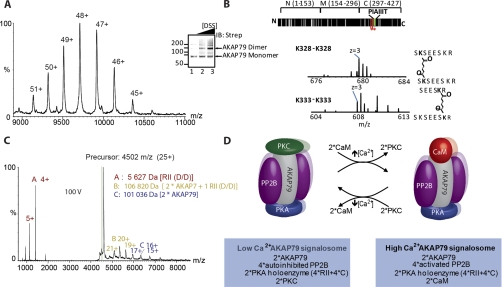
Combining MS of protein assemblies with CXMS. A, mass spectrometry of intact complexes reveals the stoichiometry of the intact AKAP complex: 2 × [AKAP79 + PP2B (A+B) + 2RII D/D + CaM] and demonstrates the dimerization of AKAP 79. B and C, confirmation of the AKAP dimer by chemical cross-linking and MS also suggests that the dimer is aligned in parallel. D, a proposed model for the architecture and dynamics of the core AKAP79 signaling complex, in conditions of both high and low [Ca2+]. The second AKAP79 monomer and associated proteins are in the background. These figures are reproduced from Ref. with permission.
Fig. 4.
Fig. 4.
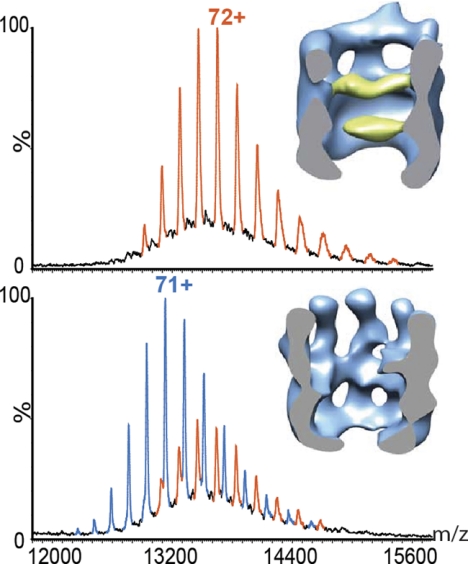
Binding of tubulin inside the central cavity of bovine Tric complex revealed by mass spectrometry. Comparison of nondenaturing MS spectra of intact bovine Tric complex before (upper panel) and after (lower panel) ATP incubation and SEC purification shows that the complex has one molecule of substrate bound. The two series are measured as 947.5 (blue) and 997.7 kDa (orange), respectively. Insets across the cryo-EM three-dimensional reconstitution at 30A of the purified complex (blue) also show additional EM density (yellow), in line with the MS data. These figures are reproduced from Ref. with permission.
Fig. 5.
Fig. 5.
Combining multiple MS-based methods for the analysis of protein complexes. A, after purification of the complex/assembly, usually by affinity purification in combination with one or more biochemical fractionation techniques, the sample is analyzed using the following methods. B–H, quantitative proteomics (B) to assess the subunit content assists the process in C, the assignment of the absolute stoichiometry of the intact complex and subcomplexes by MS of intact assemblies. Additional protein-protein interaction data are generated by AP-MS (D) and CXMS (E). Combining the data will give a complete and validated map of the subunit interactome (F). Topological information from CXMS and IM-MS (G) can be used to provide additional local and global restraints that can be used to together with the protein-protein interaction data to guide molecular modeling of the complex (H).

References

    1. Aebersold R., Mann M. (2003) Mass spectrometry-based proteomics. Nature 422, 198–207 - PubMed
    1. Gstaiger M., Aebersold R. (2009) Applying mass spectrometry-based proteomics to genetics, genomics and network biology. Nat. Rev. 10, 617–627 - PubMed
    1. Walther T. C., Mann M. (2010) Mass spectrometry-based proteomics in cell biology. J. Cell Biol. 190, 491–500 - PMC - PubMed
    1. Cox J., Mann M. (2011) Quantitative, high-resolution proteomics for data-driven systems biology. Annu. Rev. Biochem. 80, 273–299 - PubMed
    1. Gingras A. C., Gstaiger M., Raught B., Aebersold R. (2007) Analysis of protein complexes using mass spectrometry. Nat. Rev. Mol. Cell Biol. 8, 645–654 - PubMed

Publication types

LinkOut - more resources