. 2011;6(12):e28427.
doi: 10.1371/journal.pone.0028427. Epub 2011 Dec 13.

Lactate produced by glycogenolysis in astrocytes regulates memory processing

Affiliations

Lactate produced by glycogenolysis in astrocytes regulates memory processing

Lori A Newman et al. PLoS One. 2011.

Abstract

When administered either systemically or centrally, glucose is a potent enhancer of memory processes. Measures of glucose levels in extracellular fluid in the rat hippocampus during memory tests reveal that these levels are dynamic, decreasing in response to memory tasks and loads; exogenous glucose blocks these decreases and enhances memory. The present experiments test the hypothesis that glucose enhancement of memory is mediated by glycogen storage and then metabolism to lactate in astrocytes, which provide lactate to neurons as an energy substrate. Sensitive bioprobes were used to measure brain glucose and lactate levels in 1-sec samples. Extracellular glucose decreased and lactate increased while rats performed a spatial working memory task. Intrahippocampal infusions of lactate enhanced memory in this task. In addition, pharmacological inhibition of astrocytic glycogenolysis impaired memory and this impairment was reversed by administration of lactate or glucose, both of which can provide lactate to neurons in the absence of glycogenolysis. Pharmacological block of the monocarboxylate transporter responsible for lactate uptake into neurons also impaired memory and this impairment was not reversed by either glucose or lactate. These findings support the view that astrocytes regulate memory formation by controlling the provision of lactate to support neuronal functions.


Conflict of interest statement

Competing Interests: The authors have declared that no competing interests exist.

Figures

Figure 1
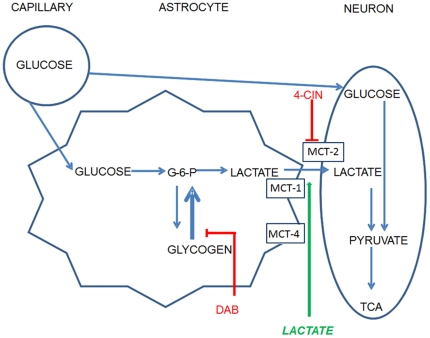
Figure 1. Model of astrocytic contribution of lactate to memory processing.
Pharmacological tests and measures of many aspects of this figure were tested in the present experiments. DAB: 1,4-dideoxy = 1,4-imino-D-aribinitol, 4-CIN: α-cyano-4-hydroxycinnamate, MCT: monocarboxylate transporter.
Figure 2
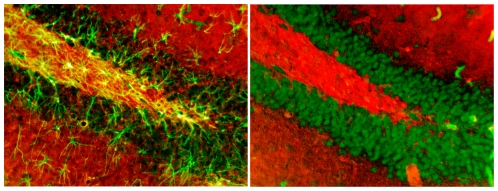
Figure 2. Immunolabeling of astrocytes using GFAP and staining for glycogen using a Periodic Acid Schiff's Reaction (PAS) demonstrated colocalization (in yellow) of glycogen and astrocytes (left).
Immunolabeling of neurons using NeuN and glycogen with PAS showed no colocalization (in yellow) of glycogen in neurons (right).
Figure 3
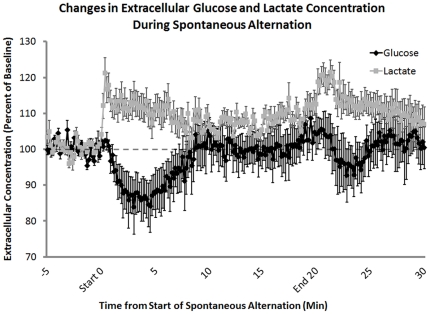
Figure 3. Extracellular lactate and glucose levels in the hippocampus, measured before, during, and after behavioral testing.
Using lactate- and glucose-specific biosensors, extracellular concentrations of both lactate and glucose were measured during spontaneous alternation testing. Lactate concentrations significantly increased at the beginning of behavioral testing (n = 4; t3 = 4.77, p<0.02; MEAN ± SEM: 112.50%±3.15%). In contrast, glucose concentrations decreased after 5 minutes on the task (n = 3; t2 = 3.58, p<0.05; MEAN ± SEM: 86.19%±7.73%). The increase in extracellular glucose seen 5–10 min after the start of memory testing corresponds to an increase in blood glucose levels (baseline vs. 10 min: p = 0.47, 10 min MEAN ± SEM: 103.68%±6.29%). After the rat was removed from the maze there was a significant increase in lactate compared to baseline levels (t3 = 4.77, p<0.02; MEAN ± SEM: 117.9%±2.87%) most likely due to handling.
Figure 4
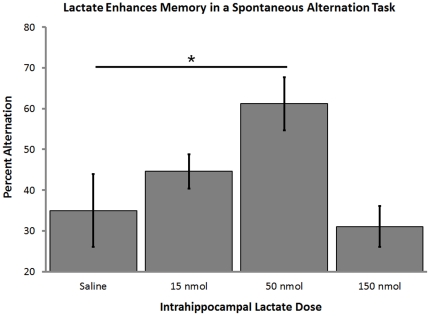
Figure 4. Enhancement of memory with intrahippocampal injections of lactate.
Lactate injected into the ventral hippocampus 5 min before testing improved the percent alternation scores on a 4-arm delayed spontaneous alternation task at the 50 nmol dose (n = 10; F3,27 = 4.04, p<0.02; Percent Alternation ± SEM: Saline = 34.5%±8.9% vs. 50 nmol Lactate = 61.2%±6.5%). Higher and lower doses of lactate did not significantly improve alternation scores.
Figure 5
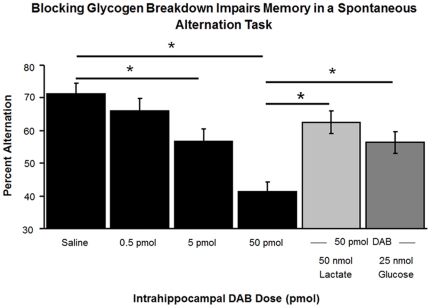
Figure 5. Impairment of memory by DAB injections, used to inhibit glycogenolysis.
The impairment was reversed by lactate or glucose, which can act downstream of glycogenolysis. 1,4-dideoxy-1,4-imino-D-arabinitol (DAB) injected into the ventral hippocampus 5 min prior to testing significantly impaired scores on a 4-arm spontaneous alternation task (n = 12; Percent Alternation ± SEM: Saline = 71%±3.7% vs. 5 pmol DAB = 58.8%±3.6%, p<0.02 and vs. 50 pmol DAB = 41.6%±3.2%, p<0.001). The performance deficit created by 100 µM of DAB was significantly reversed by the co-administration of 100 mM lactate or 50 mM glucose (Percent Alternation ± SEM: 50 pmol DAB = 41.6%±3.2% vs. 25 nmol of glucose and 50 pmol DAB = 62.6%±3.1%, p<0.001 and 50 nmol of lactate and 50 pmol DAB = 56.2%±2.9%, p<0.01).
Figure 6
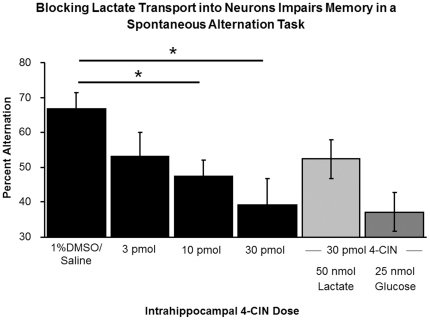
Figure 6. Impairment of memory by 4-CIN injections, used to block MCT2.
The impairment was not reversed by either lactate or glucose. Blockade of the MCT-2 with 4-CIN impaired working memory in a dose-dependent manner (n = 6; Percent Alternation ± SEM: 1% DMSO in Saline = 65.2%±4.9% vs. 10 pmol 4-CIN = 47.4%±4.7%, p<0.05 and 30 pmol 4-CIN = 39.8%±3.3%, p<0.05). This impairment was not significantly reversed with the addition of either lactate or glucose (ps>0.1).
Figure 7
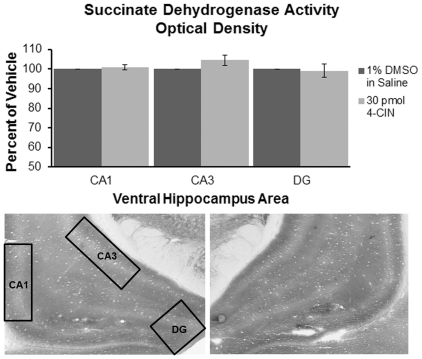
Figure 7. Representative histology showing SDH activity in the ventral hippocampus.
In this example, the left hemisphere received infusions of 1% DMSO in saline (left) and the right hemisphere received infusions of 30 pmol 4-CIN. There were no significant differences in optical density between ventral hippocampal areas receiving 30 pmol of 4-CIN or 1% DMSO in saline in CA1, CA3, or dentate gyrus (n = 6; p>0.1).

References

    1. Messier C. Glucose improvement of memory: a review. European Journal of Pharmacology. 2004;490:33–57. - PubMed
    1. Gold PE. The many faces of amnesia. Learning & Memory. 2006;13:506–514. - PubMed
    1. Korol DL, Gold PE. Epinephrine converts long-term potentiation from transient to durable form in awake rats. Hippocampus. 2008;18:81–91. - PubMed
    1. Benton D, Owens D. Blood glucose and human memory. Psychopharmacology. 1993;113:83–88. - PubMed
    1. Benton D, Owens DS, Parker PY. Blood glucose influences memory and attention in young adults. Neuropsychologia. 1994;32:595–607. - PubMed

Publication types

MeSH terms