


The a"MAZE"ing world of lung-specific transgenic mice
- PMID: 22180870
- PMCID: PMC3785140
- DOI: 10.1165/rcmb.2011-0372PS
The a"MAZE"ing world of lung-specific transgenic mice
Abstract
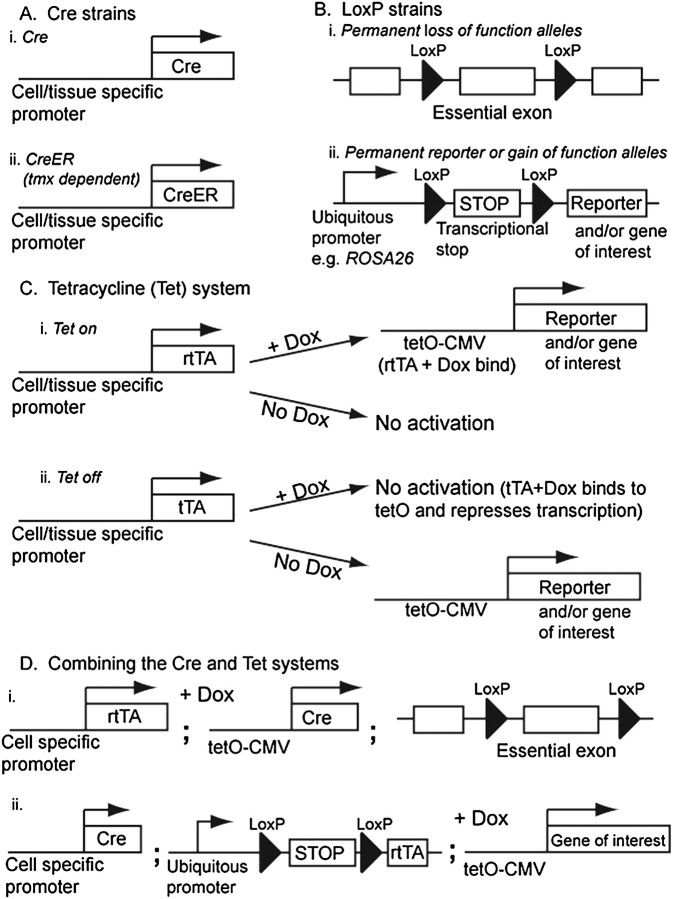
The purpose of this review is to give a comprehensive overview of transgenic mouse lines suitable for studying gene function and cellular lineage relationships in lung development, homeostasis, injury, and repair. Many of the mouse strains reviewed in this Perspective have been widely shared within the lung research community, and new strains are continuously being developed. There are many transgenic lines that target subsets of lung cells, but it remains a challenge for investigators to select the correct transgenic modules for their experiment. This review covers the tetracycline- and tamoxifen-inducible systems and focuses on conditional lines that target the epithelial cells. We point out the limitations of each strain so investigators can choose the system that will work best for their scientific question. Current mesenchymal and endothelial lines are limited by the fact that they are not lung specific. These lines are summarized in a brief overview. In addition, useful transgenic reporter mice for studying lineage relationships, promoter activity, and signaling pathways will complete our lung-specific conditional transgenic mouse shopping list.
Figures
Similar articles
-
Use of a new-generation reverse tetracycline transactivator system for quantitative control of conditional gene expression in the murine lung.Am J Respir Cell Mol Biol. 2011 Feb;44(2):244-54. doi: 10.1165/rcmb.2009-0115OC. Epub 2010 Apr 15. Am J Respir Cell Mol Biol. 2011. PMID: 20395635
-
Practical use of advanced mouse models for lung cancer.Methods Mol Biol. 2015;1267:93-124. doi: 10.1007/978-1-4939-2297-0_5. Methods Mol Biol. 2015. PMID: 25636466
-
Effect of low VEGF on lung development and function.Transgenic Res. 2021 Feb;30(1):35-50. doi: 10.1007/s11248-020-00223-w. Epub 2021 Jan 4. Transgenic Res. 2021. PMID: 33394314
-
Shared epithelial pathways to lung repair and disease.Eur Respir Rev. 2017 Jun 28;26(144):170048. doi: 10.1183/16000617.0048-2017. Print 2017 Jun 30. Eur Respir Rev. 2017. PMID: 28659498 Free PMC article. Review.
-
Recent advances in inducible expression in transgenic mice.Semin Cell Dev Biol. 2002 Apr;13(2):129-41. doi: 10.1016/s1084-9521(02)00021-6. Semin Cell Dev Biol. 2002. PMID: 12240598 Review.
Cited by
-
Heterochronic regulation of lung development via the Lin28-Let-7 pathway.FASEB J. 2019 Nov;33(11):12008-12018. doi: 10.1096/fj.201802702R. Epub 2019 Aug 7. FASEB J. 2019. PMID: 31373834 Free PMC article.
-
Regulation of hypoxia-induced pulmonary hypertension by vascular smooth muscle hypoxia-inducible factor-1α.Am J Respir Crit Care Med. 2014 Feb 1;189(3):314-24. doi: 10.1164/rccm.201302-0302OC. Am J Respir Crit Care Med. 2014. PMID: 24251580 Free PMC article.
-
Phenotypic Diversity Caused by Differential Expression of SFTPC-Cre-Transgenic Alleles.Am J Respir Cell Mol Biol. 2020 Jun;62(6):692-698. doi: 10.1165/rcmb.2019-0416MA. Am J Respir Cell Mol Biol. 2020. PMID: 32208105 Free PMC article.
-
Tamoxifen administration induces histopathologic changes within the lungs of Cre-recombinase-negative mice: A case report.Lab Anim. 2022 Jun;56(3):297-303. doi: 10.1177/00236772211042968. Epub 2021 Sep 22. Lab Anim. 2022. PMID: 34551640 Free PMC article.
-
Resident interstitial lung fibroblasts and their role in alveolar stem cell niche development, homeostasis, injury, and regeneration.Stem Cells Transl Med. 2021 Jul;10(7):1021-1032. doi: 10.1002/sctm.20-0526. Epub 2021 Feb 24. Stem Cells Transl Med. 2021. PMID: 33624948 Free PMC article. Review.
References
-
- Stripp BR, Sawaya PL, Luse DS, Wikenheiser KA, Wert SE, Huffman JA, Lattier DL, Singh G, Katyal SL, Whitsett JA. cis-acting elements that confer lung epithelial cell expression of the CC10 gene. J Biol Chem 1992;267:14703–14712. - PubMed
-
- Stripp BR, Huffman JA, Bohinski RJ. Structure and regulation of the murine Clara cell secretory protein gene. Genomics 1994;20:27–35. - PubMed
-
- Wert SE, Glasser SW, Korfhagen TR, Whitsett JA. Transcriptional elements from the human SP-C gene direct expression in the primordial respiratory epithelium of transgenic mice. Dev Biol 1993;156:426–443. - PubMed
-
- Sternberg N, Hamilton D. Bacteriophage P1 site-specific recombination: I. Recombination between loxP sites. J Mol Biol 1981;150:467–486. - PubMed
Publication types
MeSH terms
Substances
Grants and funding
LinkOut - more resources
Full Text Sources
Other Literature Sources
Medical
