


Post-operative critical care management of patients undergoing cytoreductive surgery and heated intraperitoneal chemotherapy (HIPEC)
- PMID: 22182345
- PMCID: PMC3261105
- DOI: 10.1186/1477-7819-9-169
Post-operative critical care management of patients undergoing cytoreductive surgery and heated intraperitoneal chemotherapy (HIPEC)
Abstract
Background: Cytoreductive surgery (CRS) and Heated Intraperitoneal Chemotherapy (HIPEC) results in a number of physiological changes with effects on the cardiovascular system, oxygen consumption and coagulation. The Critical Care interventions required by this cohort of patients have not yet been quantified.
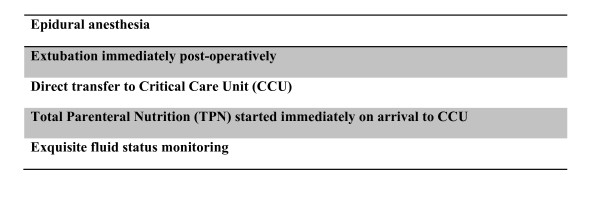
Methods: This retrospective audit examines the experience of a Specialist Tertiary Centre in England over an 18 month period (January 2009-June 2010) during which 69 patients underwent CRS and HIPEC. All patients were extubated in the operating theatre and transferred to the Critical Care Unit (CCU) for initial post-operative management.
Results: Patients needed to remain on the CCU for 2.4 days (0.8-7.8). There were no 30 day mortalities. The majority of patients (70.1%) did not require post-operative organ support. 2 patients who developed pneumonia post-operatively required respiratory support. 18 (26.1%) patients required vasopressor support with norepinephrine with a mean duration of 13.94 hours (5-51 hours) and mean dose of 0.04 mcg/kg/min. Post-operative coagulopathy peaked at 24 hours. A significant drop in serum albumin was observed.
Conclusion: The degree of organ support required post-operatively is minimal. Early extubation is efficacious with the aid of epidural analgesia. Critical Care monitoring for 48 hours is desirable in view of the post-operative challenges.
Figures
References
MeSH terms
LinkOut - more resources
Full Text Sources
Medical
