. 2012 Apr;22(4):297-305.
doi: 10.1016/j.nmd.2011.10.007. Epub 2011 Dec 17.

Multiple exon skipping strategies to by-pass dystrophin mutations

Affiliations

Multiple exon skipping strategies to by-pass dystrophin mutations

Carl F Adkin et al. Neuromuscul Disord. 2012 Apr.

Abstract

Manipulation of dystrophin pre-mRNA processing offers the potential to overcome mutations in the dystrophin gene that would otherwise lead to Duchenne muscular dystrophy. Dystrophin mutations will require the removal of one or more exons to restore the reading frame and in some cases, multiple exon skipping strategies exist to restore dystrophin expression. However, for some small intra-exonic mutations, a third strategy, not applicable to whole exon deletions, may be possible. The removal of only one frame-shifting exon flanking the mutation-carrying exon may restore the reading frame and allow synthesis of a functional dystrophin isoform, providing that no premature termination codons are encountered. For these mutations, the removal of only one exon offers a simpler, cheaper and more feasible alternative approach to the dual exon skipping that would otherwise be considered. We present strategies to by-pass intra-exonic dystrophin mutations that clearly demonstrate the importance of tailoring exon skipping strategies to specific patient mutations.


Figures

Supplementary Figure 1
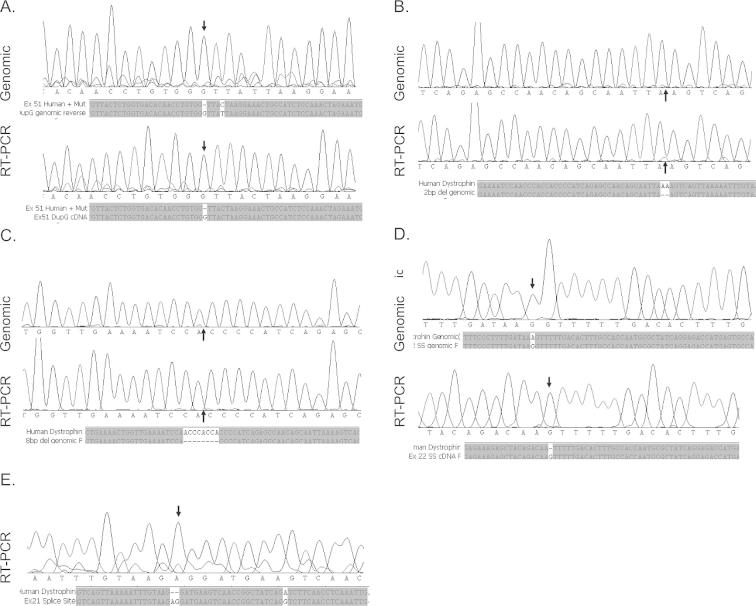
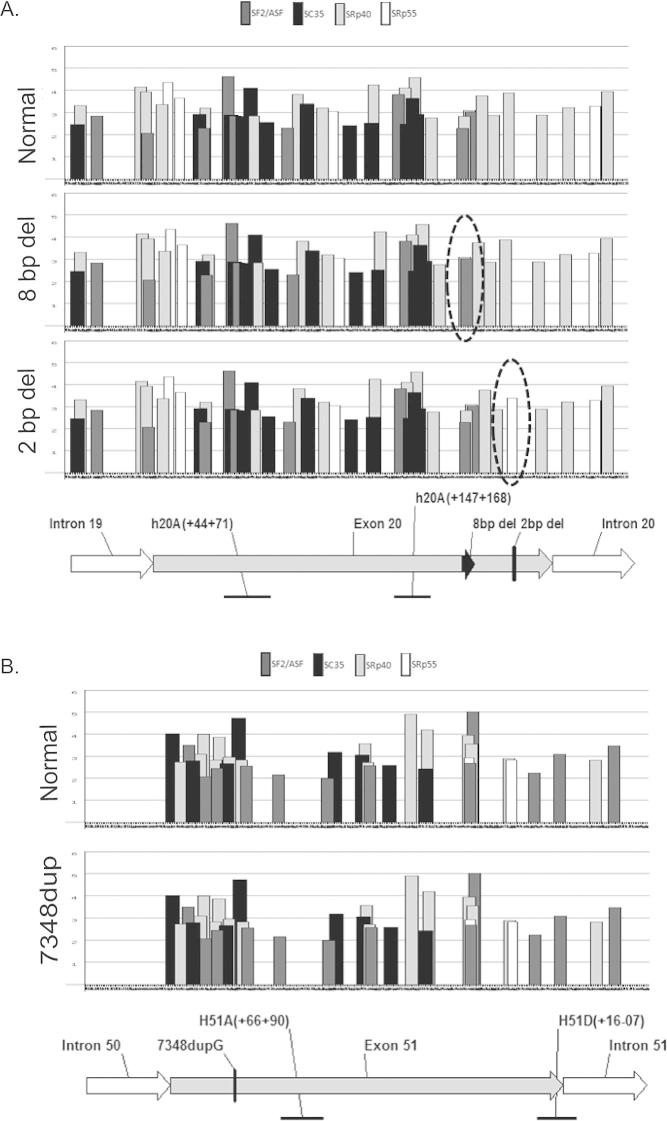
Exonic splice enhancers (ESEs) in dystrophin exon 20 and 51 predicted by ESE finder 3. (A) ESEs in exon 20 with normal dystrophin sequence and with 8bp deletion and 2bp deletions. ESEs affected by the mutations are circled. (B) ESEs in exon 51 with normal and mutated (7348DupG) dystrophin sequence. No effect on ESEs was observed with this mutation.
Supplementary Figure 2
Exonic splice enhancers (ESEs) in dystrophin exon 20 and 51 predicted by ESE finder 3. (A) ESEs in exon 20 with normal dystrophin sequence and with 8bp deletion and 2bp deletions. ESEs affected by the mutations are circled. (B) ESEs in exon 51 with normal and mutated (7348DupG) dystrophin sequence. No effect on ESEs was observed with this mutation.
Fig. 1
Fig. 1
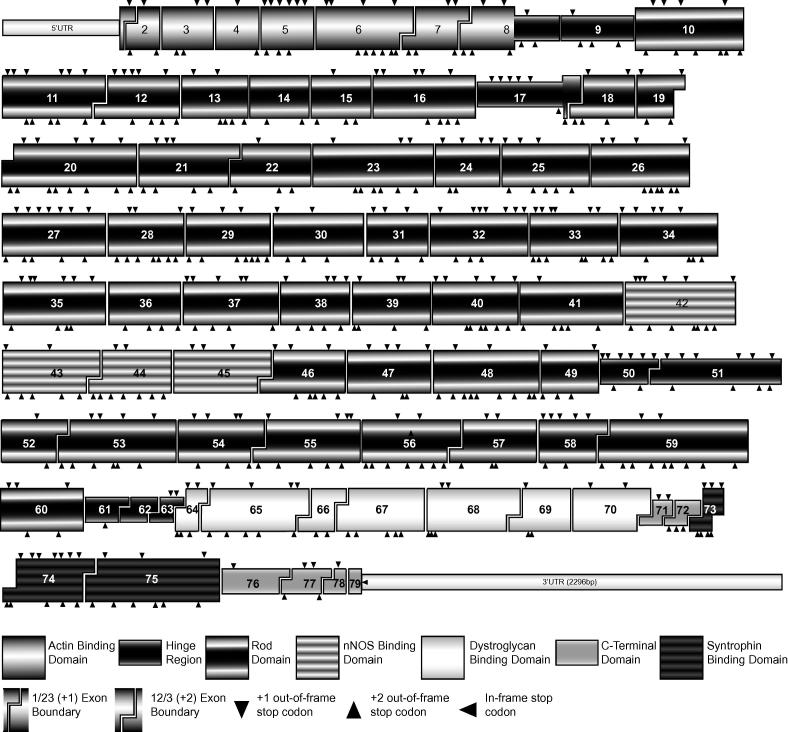
Exon arrangement and functional domains of the dystrophin transcript. Exons and functional domains are approximately to scale and in-frame/out of frame exon boundaries are indicated. Arrow heads on the top of the exon indicate locations of stop codons induced by a 1 base shift in the reading frame, stop codons induced by a 2 base shift are shown by an arrow head below the exon.
Fig. 2
Fig. 2
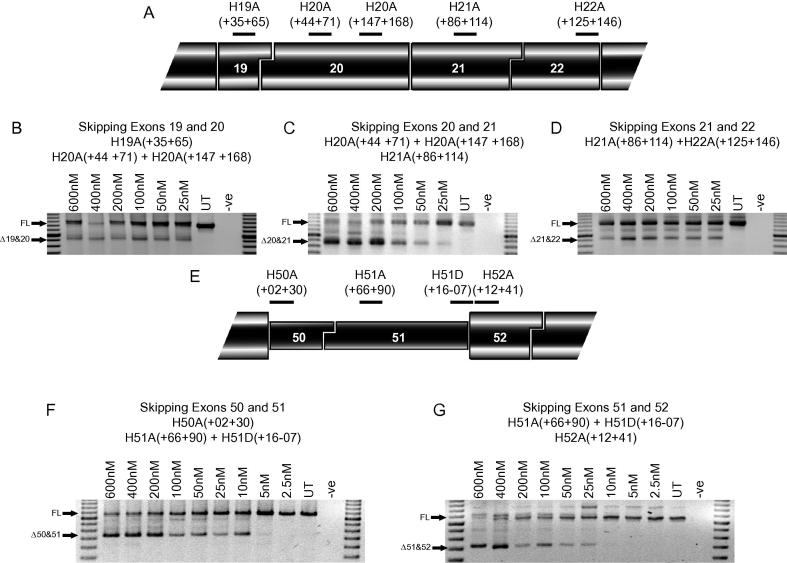
Skipping of exon pairs in normal human myogenic cultures. (A) Locations of AO annealing sites in human dystrophin exons 19, 20, 21 and 22. Nested RT-PCR across exons 17–25 showing skipping of pairs of exons with AO cocktails targeted to exons (B) 19&20, (C) 20&21, and (D) 21&22 at total AO concentrations of 600–25 nM. Marker is a 100 bp ladder. Full-length (FL) transcript is 1255 bp, Δ19&20 transcript is 925 bp, Δ20&21 transcript is 832 bp and Δ21&22 transcript is 928 bp. (E) Locations of AO annealing sites in human dystrophin exons 50, 51 and 52. Nested RT-PCR across exons 48–55 showing skipping of pairs of exons with AO cocktails targeted to exons (F) 50&51 and (G) 51&52 at total AO concentrations of 600–2.5 nM. Marker is a 100 bp ladder. Full length (FL) transcript is 1087 bp, Δ50&51 transcript is 745 bp and Δ51&52 transcript is 736 bp.
Fig. 3
Fig. 3
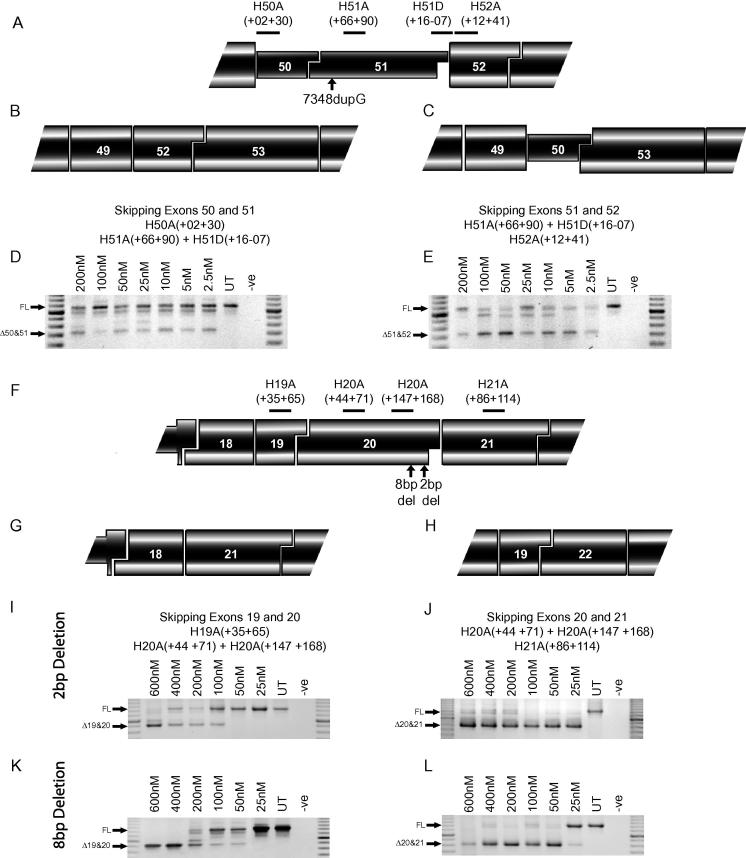
Alternative strategies for intra-exonic mutations. (A) Locations of AO annealing sites in human dystrophin exons 50, 51 and 52, the location of the 7348DupG mutation and the two options to correct a frame-shifting mutation in exon 51 are indicated: (B) skipping exons 50&51 and (C) skipping exons 51&52. Nested RT-PCR across exons 48–55 showing skipping of exons (D) 50&51 and (E) 51&52 in MyoD transformed patient fibroblasts. Full-length (FL) transcript is 1088 bp, Δ50&51 transcript is 745 bp and Δ51&52 transcript is 736 bp. (F) Locations of AO annealing sites in human dystrophin exons 19, 20 and 21, and the location of the 2 and 8 base deletions. Two options to correct these frame-shifting mutations in exon 20: (G) skipping exons 19&20 and (H) skipping exons 20&21. Nested RT-PCR across exons 17–25 shows skipping of exons 19&20 in (I) 2 base deletion cells and (K) 8 base deletion cells, and skipping of exons 20&21 in (J) in 2 base deletion cells and (L) 8 base deletion cells. Marker is a 100 bp ladder. Full-length (FL) transcript is 1255 bp, Δ19&20 transcript is 925 bp, Δ20&21 transcript is 832 bp and Δ21&22 transcript is 928 bp.
Fig. 4
Fig. 4
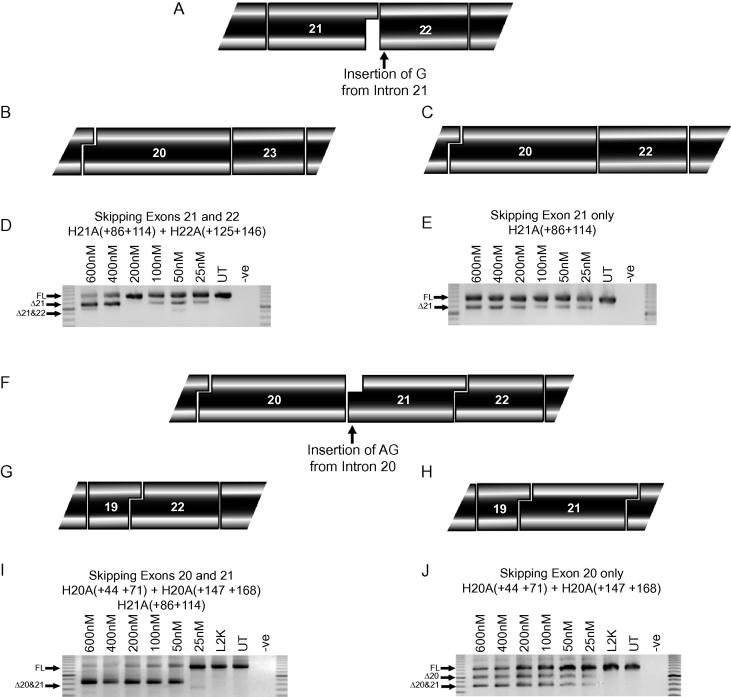
Alternative strategies for exon 21 and 22 splice site mutations. (A) A single A>G mutation at the exon 22 acceptor splice site induces retention of a single G nucleotide from intron 21. The reading frame is restored by (B) excision of exons 21&22 or (C) excision of exon 21 only. Nested RT-PCR across exons 17–25 showing (D) skipping of exons 21&22 or (E) exon 21 only in MyoD transformed patient fibroblasts with total AO concentrations of 600–25 nM. (F) A single C>G mutation at the exon 21 acceptor splice site allows retention of 2 nucleotides from intron 20. The reading frame is restored by exclusion of (G) skipping of exons 20&21, or (H) exon 20 alone. Nested RT-PCR across exons 17–25 showing skipping of (I) exons 20&21 and (J) exon 20 only, at total AO concentrations of 600–25 nM. Marker is a 100 bp ladder. Full-length (FL) transcript is 1255 bp, Δ20 transcript is 1013 bp, Δ21 transcript is 1074 bp and Δ20&21 is 832 bp.

References

    1. Alter J., Lou F., Rabinowitz A. Systemic delivery of morpholino oligonucleotide restores dystrophin expression bodywide and improves dystrophic pathology. Nat Med. 2006;12:175–177. - PubMed
    1. Fletcher S., Honeyman K., Fall A.M. Morpholino oligomer-mediated exon skipping averts the onset of dystrophic pathology in the mdx mouse. Mol Ther. 2007;15:1587–1592. - PubMed
    1. McClorey G., Moulton H.M., Iversen P.L. Antisense oligonucleotide-induced exon skipping restores dystrophin expression in vitro in a canine model of DMD. Gene Ther. 2006;13:1373–1381. - PubMed
    1. Goyenvalle A., Babbs A., Powell D. Prevention of dystrophic pathology in severely affected dystrophin/utrophin-deficient mice by morpholino-oligomer-mediated exon-skipping. Mol Ther. 2010;18:198–205. - PMC - PubMed
    1. van Deutekom J.C., Janson A.A., Ginjaar I.B. Local dystrophin restoration with antisense oligonucleotide PRO051. N Engl J Med. 2007;357:2677–2686. - PubMed

Publication types