. 2012 Feb;93(2):305-308.
doi: 10.1016/j.antiviral.2011.12.001. Epub 2011 Dec 11.

Inhibition of cowpox virus and monkeypox virus infection by mitoxantrone

Affiliations

Inhibition of cowpox virus and monkeypox virus infection by mitoxantrone

Sharon E Altmann et al. Antiviral Res. 2012 Feb.

Abstract

Mitoxantrone, an FDA-approved therapeutic for the treatment of cancer and multiple sclerosis, was previously reported to exhibit antiviral activity against vaccinia virus. To determine whether this activity extends to other orthopoxviruses, mitoxantrone was tested against cowpox and monkeypox. Mitoxantrone demonstrated an EC(50) of 0.25 μM against cowpox and 0.8 μM against monkeypox. Intraperitoneal treatment of cowpox virus-challenged C57Bl/6 mice with 0.5 mg/kg mitoxantrone resulted in 25% survival and a significant increase in survival time. In an effort to improve its efficacy, mitoxantrone was tested for synergistic activity with cidofovir. In vitro tests demonstrated significant synergy between the two drugs against cowpox; however, no synergistic effect on animal survival or median time-to-death was seen in intranasally-infected BALB/c mice. Significantly fewer animals survived when treated with a combination of 0.5 mg/kg mitoxantrone and 100 mg/kg cidofovir than with 100 mg/kg cidofovir alone. This is, to our knowledge, the first report of limited anti-orthopoxvirus activity by mitoxantrone in an animal model.


Figures

Fig. 1
Fig. 1
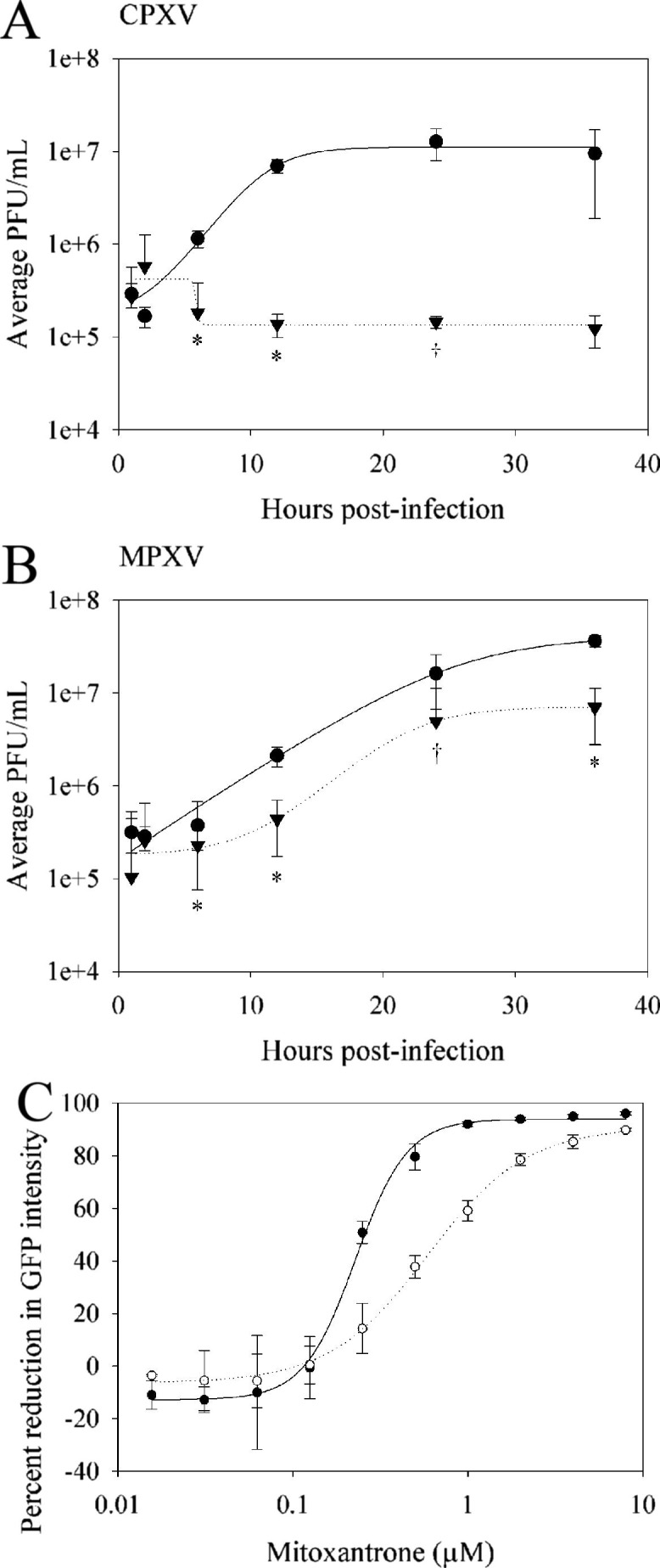
In vitro activity of mitoxantrone against cowpox and monkeypox. Mitoxantrone was tested for efficacy against CPXV (A and C) and MPXV (B and C). (A and B) One step growth curves on BSC-1 cells in the presence (dotted lines) and absence (solid lines) of 1 μM MXN. Cells were treated with MXN for 12 h prior to infection at a multiplicity of infection (MOI) of 3. Cell lysates were harvested at the indicated times post-infection and titered for virus by serial 10-fold dilution on BSC-1 cells. Virus yield in the presence of MXN was significantly reduced compared to untreated samples (†, p < 0.01; *, p < 0.001). (C) EC50 curves for CPXV-GFP (closed circles) and MPXV-GFP (open circles). Fluorescent intensity was read at 520 nm using a SpectraMax M microplate reader (Molecular Devices, Sunnyvale, CA). Data are representative of three independent experiments. Error bars represent the standard deviation of the mean for one experiment.
Fig. 2
Fig. 2
Mitoxantrone prolongs survival in CPXV-infected C57Bl/6 mice. Female C57Bl/6 mice were inoculated intraperitoneally with 1 × 106 PFU CPXV. One day post-inoculation, animals (n = 20) received 0.5 mL of MXN at the indicated dosage or saline solution intraperitoneally. Data are a compilation of two independent experiments. Kaplan–Meier survival curves plot the survival times by dose. The lower dose of MXN significantly improved the survival time of infected animals, with the median day-of-death (MDD) in infected animals increasing from day 7 to day 9 (p = 0.0015; log-rank test), while 0.5 mg/kg of MXN improved the MDD to 12.5 (p = 0.0005; log-rank test). All animal procedures were approved by the NIAID Animal Care and Use Committee and adhered to National Institutes of Health policies.
Fig. 3
Fig. 3
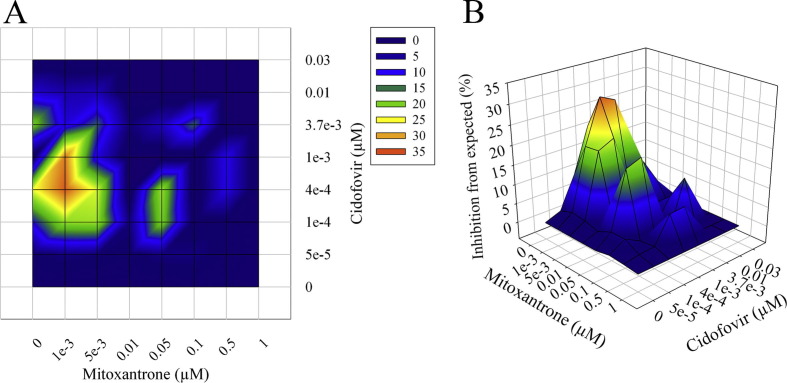
In vitro synergistic activity of mitoxantrone and cidofovir against cowpox. Mitoxantrone was tested for synergistic activity with cidofovir against CPXV. Triplicate plates of BSC-1 cells were infected at an m.o.i. of one with CPXV-GFP in the presence of increasing concentrations of both drugs, either independently or in combination. The intensity of the GFP signal was measured 24 hrs post-infection, and data were analyzed using the MacSynergy™ II software. (A) Isobologram. (B) 3D representation of inhibition curves. Data are representative of three independent experiments. Peak volume of synergy was 324.06 μM2%; volumes above 100 μM2% are considered to be highly predictive of in vivo efficacy.

References

    1. Altmann S., Brandt C.R., Murphy C.J., Patnaikuni R., Takla T., Toomey M., Nesbit B., McIntyre K., Covert J., Dubielzig R., Leatherberry G., Adkins E., Kodihalli S. Evaluation of therapeutic interventions for vaccinia virus keratitis. J. Infect. Dis. 2011;203:683–690. - PMC - PubMed
    1. Americo J.L., Moss B., Earl P.L. Identification of wild-derived inbred mouse strains highly susceptible to monkeypox virus infection for use as small animal models. J. Virol. 2010;84:8172–8180. - PMC - PubMed
    1. Buller R.M., Owens G., Schriewer J., Melman L., Beadle J.R., Hostetler K.Y. Efficacy of oral active ether lipid analogs of cidofovir in a lethal mousepox model. Virology. 2004;318:474–481. - PubMed
    1. Chaudhri G., Panchanathan V., Bluethmann H., Karupiah G. Obligatory requirement for antibody in recovery from a primary poxvirus infection. J. Virol. 2006;80:6339–6344. - PMC - PubMed
    1. Chaudhri G., Panchanathan V., Buller R.M.L., van den Eertwegh A.J.M., Claassen E., Zhou J., de Chazal R., Laman J.D., Karupiah G. Polarized type 1 cytokine response and cell-mediated immunity determine genetic resistance to mousepox. Proc. Natl Acad. Sci. USA. 2004;101:9057–9062. - PMC - PubMed

Publication types