Review
. 2012 Mar;44(3):431-4.
doi: 10.1016/j.biocel.2011.12.002. Epub 2011 Dec 13.

Frog skin epithelium: electrolyte transport and chytridiomycosis

Affiliations
Review

Frog skin epithelium: electrolyte transport and chytridiomycosis

Craig R Campbell et al. Int J Biochem Cell Biol. 2012 Mar.

Abstract

One unique physiological characteristic of frogs is that their main route for intake of water is across the skin. In these animals, the skin acts in concert with the kidney and urinary bladder to maintain electrolyte homeostasis. Water absorption across the skin is driven by the osmotic gradient that develops as a consequence of solute transport. Our recent study demonstrated that chytridiomycosis, an infection of amphibian skin by the fungal pathogen, Batrachochytrium dendrobatidis, inhibits epithelial Na(+) channels, attenuating Na(+) absorption through the skin. In frogs that become severely affected by this fungus, systemic depletion of Na(+), K(+) and Cl(-) is thought to cause deterioration of cardiac electrical function, leading to cardiac arrest. Here we review the ion transport mechanisms of frog skin, and discuss the effect of chytridiomycosis on these mechanisms.


Figures

Figure 1
Figure 1
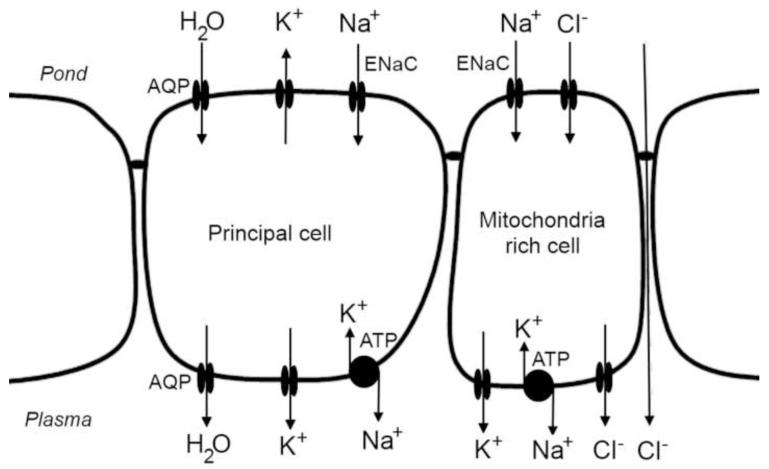
Transport model of the principal and mitochondria-rich cells of the frog skin epithelium. Na+ is moved from the pond solution via epithelial Na+ channels (ENaC) in the apical membrane and extruded via the Na+/K+ ATPase in the basolateral membrane. Excess cytosolic K+ generated by activity of the Na+/K+ ATPase is recycled to the plasma via K+ channels in the basolateral membrane. The transepithelial potential difference generated by this mechanism drives absorption of Cl through mitochondria-rich cells and through paracellular pathways. NaCl absorption generates an osmotic gradient that drives absorption of water via aquaporin channels (AQP).
Figure 2
Figure 2
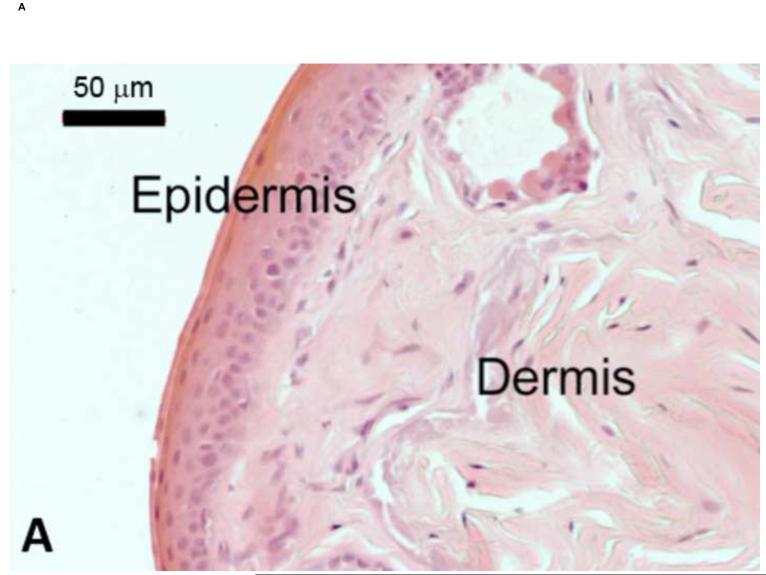
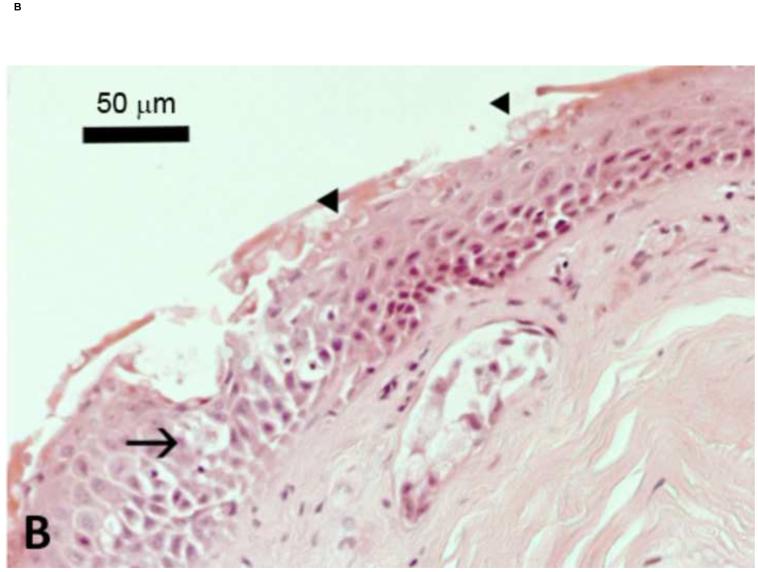
Skin of Litoria caerulea. A) Histological section through the epithelium of frog skin from a healthy animal. The epidermis consists of multiple layers of cells overlying the dermis. In uninfected frogs, the epidermal surface is smooth with regular epithelial cell layers. B) Histological section of epithelium collected from an experimentally infected frog showing hyperkeratosis, characteristic of the pathology of chytridiomycosis. Sporangia of Batrachochytrium dendrobatidis are indicated by arrowheads. The arrow shows cellular vacuolation. Scale bars represent 50 μm. Figure modified from Voyles et al. (2009).
Figure 2
Figure 2
Skin of Litoria caerulea. A) Histological section through the epithelium of frog skin from a healthy animal. The epidermis consists of multiple layers of cells overlying the dermis. In uninfected frogs, the epidermal surface is smooth with regular epithelial cell layers. B) Histological section of epithelium collected from an experimentally infected frog showing hyperkeratosis, characteristic of the pathology of chytridiomycosis. Sporangia of Batrachochytrium dendrobatidis are indicated by arrowheads. The arrow shows cellular vacuolation. Scale bars represent 50 μm. Figure modified from Voyles et al. (2009).

References

    1. Berger L, Marantelli G, Skerratt LF, Speare R. Virulence of the amphibian chytrid fungus Batrachochytium dendrobatidis varies with the strain. Dis Aquat Organ. 2005a;68:47–50. - PubMed
    1. Berger L, Speare R, Daszak P, Green DE, Cunningham AA, Goggin CL, et al. Chytridiomycosis causes amphibian mortality associated with population declines in the rain forests of Australia and Central America. Proc Natl Acad Sci U S A. 1998;95:9031–6. - PMC - PubMed
    1. Berger L, Speare R, Skerratt LF. Distribution of Batrachochytrium dendrobatidis and pathology in the skin of green tree frogs Litoria caerulea with severe chytridiomycosis. Dis Aquat Organ. 2005b;68:65–70. - PubMed
    1. Canessa CM, Schild L, Buell G, Thorens B, Gautschi I, Horisberger JD, et al. Amiloride-sensitive epithelial Na+ channel is made of three homologous subunits. Nature. 1994;367:463–7. - PubMed
    1. Carver S, Bell BD, Waldman B. Does chytridiomycosis disrupt amphibian skin function? Copeia. 2010;2010:487–95.

Publication types