Optimal cut-off score for diagnosing depression with the Patient Health Questionnaire (PHQ-9): a meta-analysis
- PMID: 22184363
- PMCID: PMC3281183
- DOI: 10.1503/cmaj.110829
Optimal cut-off score for diagnosing depression with the Patient Health Questionnaire (PHQ-9): a meta-analysis
Abstract
Background: The brief Patient Health Questionnaire (PHQ-9) is commonly used to screen for depression with 10 often recommended as the cut-off score. We summarized the psychometric properties of the PHQ-9 across a range of studies and cut-off scores to select the optimal cut-off for detecting depression.
Methods: We searched Embase, MEDLINE and PsycINFO from 1999 to August 2010 for studies that reported the diagnostic accuracy of PHQ-9 to diagnose major depressive disorders. We calculated summary sensitivity, specificity, likelihood ratios and diagnostic odds ratios for detecting major depressive disorder at different cut-off scores and in different settings. We used random-effects bivariate meta-analysis at cutoff points between 7 and 15 to produce summary receiver operating characteristic curves.
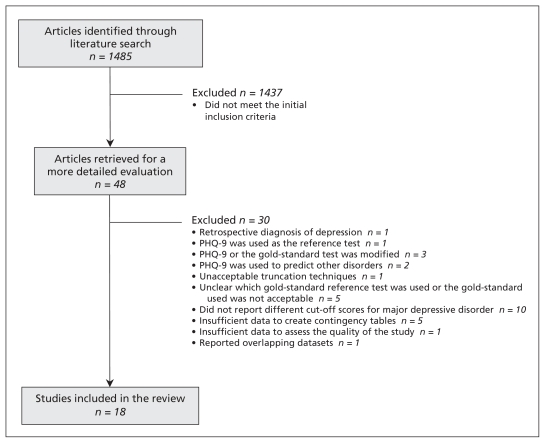
Results: We identified 18 validation studies (n = 7180) conducted in various clinical settings. Eleven studies provided details about the diagnostic properties of the questionnaire at more than one cut-off score (including 10), four studies reported a cut-off score of 10, and three studies reported cut-off scores other than 10. The pooled specificity results ranged from 0.73 (95% confidence interval [CI] 0.63-0.82) for a cut-off score of 7 to 0.96 (95% CI 0.94-0.97) for a cut-off score of 15. There was major variability in sensitivity for cut-off scores between 7 and 15. There were no substantial differences in the pooled sensitivity and specificity for a range of cut-off scores (8-11).
Interpretation: The PHQ-9 was found to have acceptable diagnostic properties for detecting major depressive disorder for cut-off scores between 8 and 11. Authors of future validation studies should consistently report the outcomes for different cut-off scores.
Figures
Comment in
-
Enhancing the clinical utility of depression screening.CMAJ. 2012 Feb 21;184(3):281-2. doi: 10.1503/cmaj.112004. Epub 2012 Jan 9. CMAJ. 2012. PMID: 22231681 Free PMC article. No abstract available.
References
-
- Kroenke K, Spitzer RL, Williams JBW, et al. The Patient Health Questionnaire Somatic, Anxiety, and Depressive Symptom Scales: a systematic review. Gen Hosp Psychiatry 2010;32:345–59 - PubMed
-
- Kendrick T, Dowrick C, McBride A, et al. Management of depression in UK general practice in relation to scores on depression severity questionnaires: analysis of medical record data. BMJ 2009;338:b750. - PubMed
Publication types
MeSH terms
LinkOut - more resources
Full Text Sources
Other Literature Sources
Medical