. 2011 Dec 20;4(1):59.
doi: 10.1186/1754-6834-4-59.

Selective suppression of bacterial contaminants by process conditions during lignocellulose based yeast fermentations

Affiliations

Selective suppression of bacterial contaminants by process conditions during lignocellulose based yeast fermentations

Eva Albers et al. Biotechnol Biofuels. .

Abstract

Background: Contamination of bacteria in large-scale yeast fermentations is a serious problem and a threat to the development of successful biofuel production plants. Huge research efforts have been spent in order to solve this problem, but additional ways must still be found to keep bacterial contaminants from thriving in these environments. The aim of this project was to develop process conditions that would inhibit bacterial growth while giving yeast a competitive advantage.

Results: Lactic acid bacteria are usually considered to be the most common contaminants in industrial yeast fermentations. Our observations support this view but also suggest that acetic acid bacteria, although not so numerous, could be a much more problematic obstacle to overcome. Acetic acid bacteria showed a capacity to drastically reduce the viability of yeast. In addition, they consumed the previously formed ethanol. Lactic acid bacteria did not show this detrimental effect on yeast viability. It was possible to combat both types of bacteria by a combined addition of NaCl and ethanol to the wood hydrolysate medium used. As a result of NaCl + ethanol additions the amount of viable bacteria decreased and yeast viability was enhanced concomitantly with an increase in ethanol concentration. The successful result obtained via addition of NaCl and ethanol was also confirmed in a real industrial ethanol production plant with its natural inherent yeast/bacterial community.

Conclusions: It is possible to reduce the number of bacteria and offer a selective advantage to yeast by a combined addition of NaCl and ethanol when cultivated in lignocellulosic medium such as wood hydrolysate. However, for optimal results, the concentrations of NaCl + ethanol must be adjusted to suit the challenges offered by each hydrolysate.


Figures
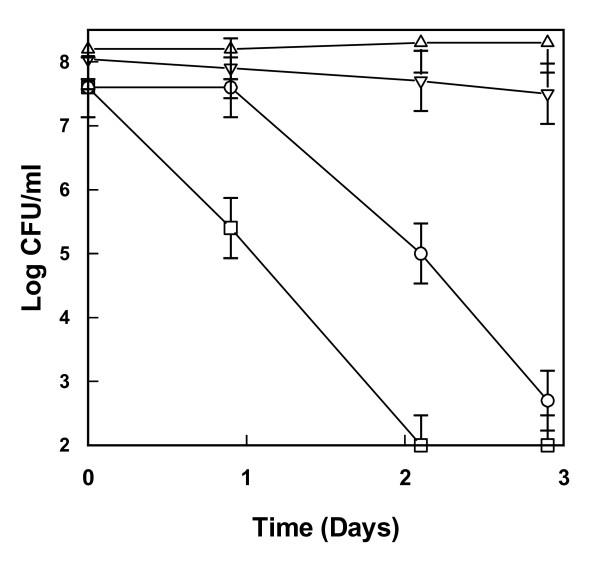
Figure 1
Figure 1
Viability of bacteria in lignocellulosic medium. Viability of Lactobacillus buchneri (circles), Lactobacillus fermentum (squares), Acetobacter syzygii (upward triangles) and Acetobacter tropicalis (downward triangles) inoculated into a lignocellulosic medium from chips of spruce hydrolyzed with dilute acid. The composition of the medium is described in [14]. Values represent duplicate cultures performed in falcon tubes and the error bars indicate mean and standard deviation.
Figure 2
Figure 2
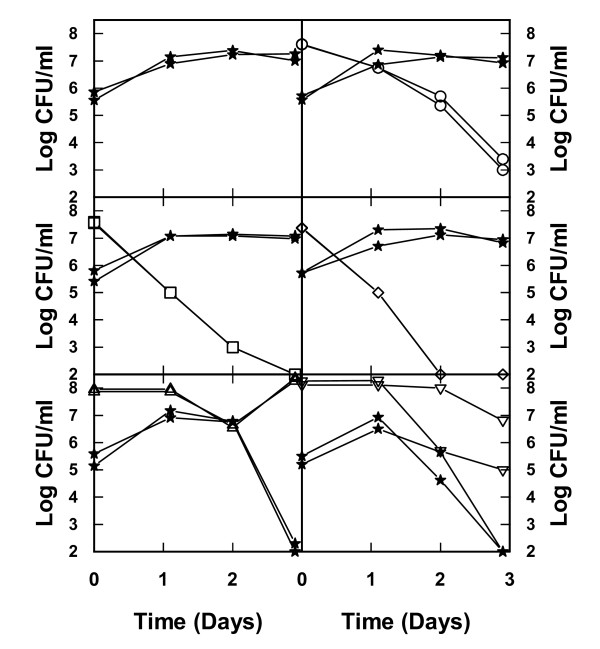
Viability of bacteria when cocultured with yeast in lignocellulosic medium. Viability was determined during batch cultures of the yeast Saccharomyces cerevisiae (filled stars) alone and in coculture with Lactobacillus buchneri (open circles), Lactobacillus fermentum (open squares), Lactobacillus plantarum (diamonds) Acetobacter syzygii (upwards triangles), and Acetobacter tropicalis (downwards triangles) on a lignocellulosic medium from chips of spruce hydrolyzed with dilute acid. The composition of the medium is described in [14]. In each case, results from two independent cultures performed in falcon tubes are shown.
Figure 3
Figure 3
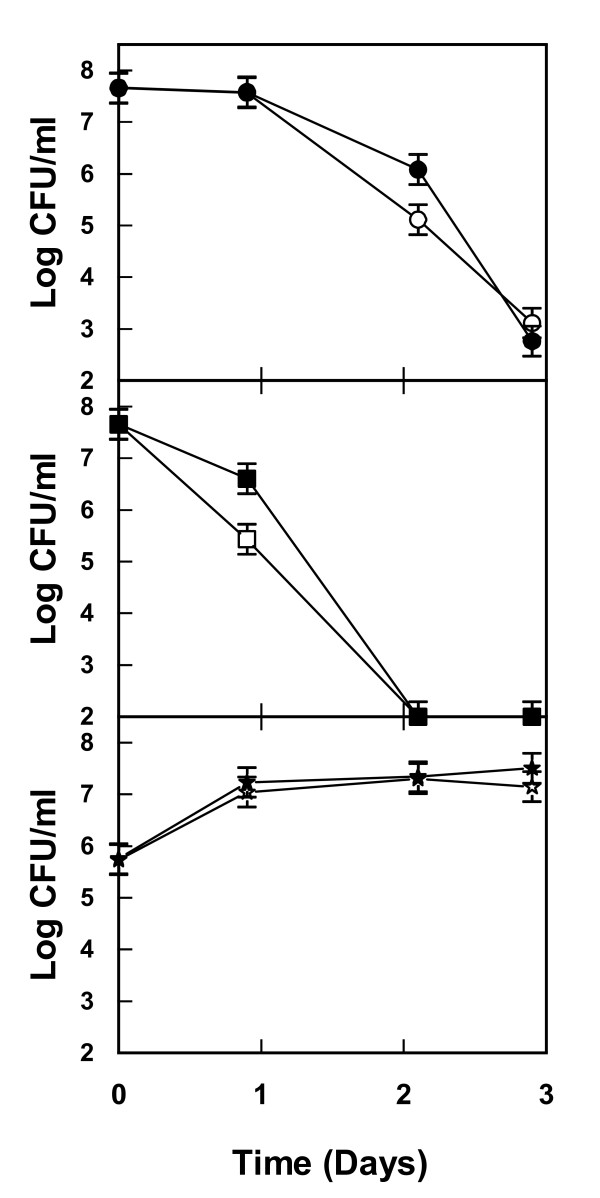
Viability of bacteria and yeast in lignocellulosic medium with and without addition of yeast extract. Viability of Lactobacillus buchneri (circles), Lactobacillus fermentum (squares), and Saccharomyces cerevisiae (stars) inoculated into lignocellulosic medium with (filled symbols) or without (open symbols) the addition of 1 g/l of yeast extract. The composition of the medium is described in [14]. Values represent duplicate cultures performed in falcon tubes and error bars indicate mean and standard deviation.
Figure 4
Figure 4
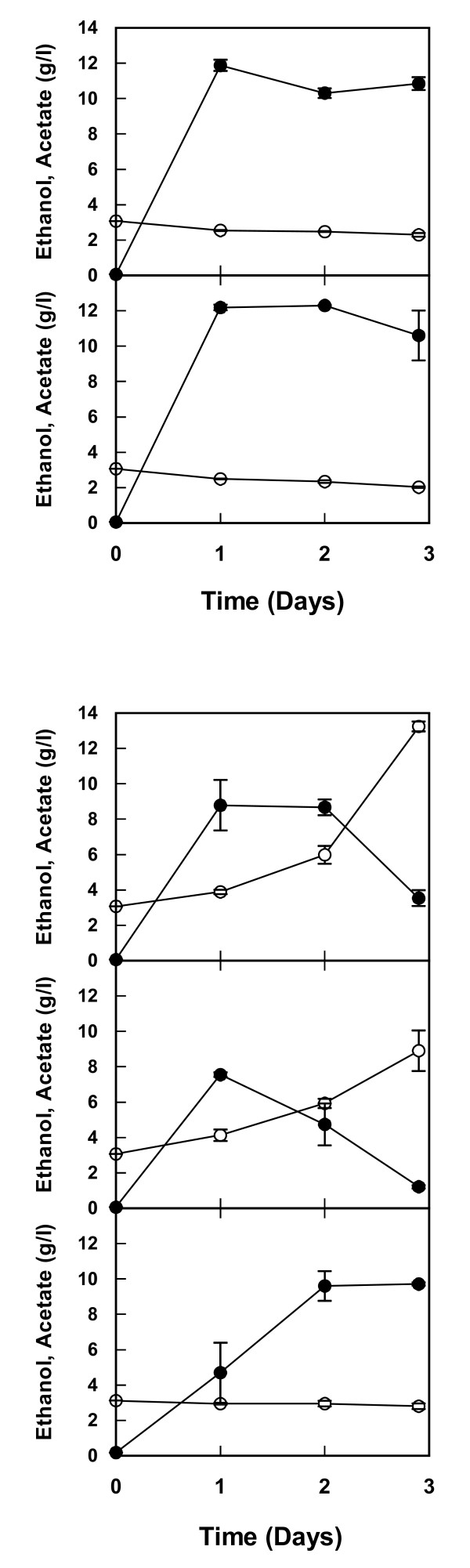
(a) Ethanol (filled circles) and acetate (open circles) concentrations in cocultures of yeast and lactic acid bacteria. Samples were taken from cocultures of Saccharomyces cerevisiae and Lactobacillus buchneri (upper panel) or S. cerevisiae and Lactobacillus fermentum (lower panel) inoculated in a lignocellulosic medium from chips of spruce hydrolyzed with dilute acid. The composition of the medium is described in [14]. Values represent duplicate cultures performed in falcon tubes and error bars indicate minimum/maximum values. (b) Ethanol (filled circles) and acetate (open circles) concentrations in cocultures of yeast and acetic acid bacteria. Samples were taken from cocultures of S. cerevisiae and Acetobacter syzygii (upper panel), S. cerevisiae and Acetobacter tropicalis (middle panel) or pure culture of S. cerevisiae (lower panel) inoculated in a lignocellulosic medium from chips of spruce hydrolyzed with dilute acid. The composition of the medium is described in [14]. Values represent duplicate cultures performed in falcon tubes and error bars indicate minimum/maximum values.
Figure 5
Figure 5
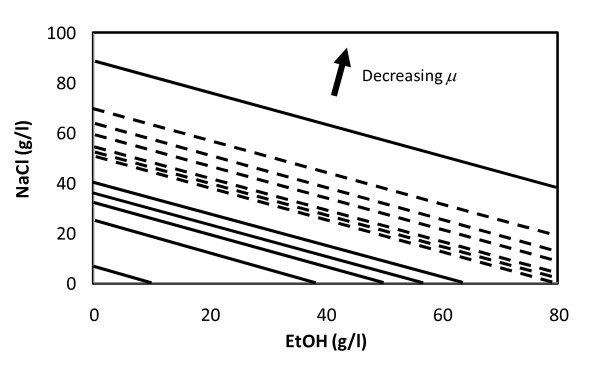
Predicted limits of ethanol and NaCl concentrations at which the specific growth rate equals 0.1 h-1 of yeasts (dashed lines) and lactic acid bacteria (solid lines). The area above each line indicate combinations of NaCl and ethanol concentrations leading to growth rates below 0.1 h-1 for (top to bottom) Lactobacillus plantarum ATCC14431, commercially available baker's yeast (Jästbolaget AB, Sollentuna, Sweden), Saccharomyces cerevisiae CCUG53310, diploid S. cerevisiae X2180aα, diploid S. cerevisiae CEN.PK122, haploid S. cerevisiae X2180-1A, haploid S. cerevisiae CEN.PK113-7D, Lactobacillus fermentum ATCC14931, Lactobacillus paracasei ATCC25598, and industrial isolates of Lactobacillus buchneri, Lactobacillus pantheris and L. plantarum from Domsjö Fabriker, Örnsköldsvik, Sweden. Growth rates were estimated by multiple regression analysis of results from 435 batch cultures on rich media (yeast extract/peptone/dextrose (YPD) for yeast, MRS for bacteria). Growth rates were predicted at T = 30°C, pH = 5, lactic acid concentration 4 g/l, and glucose concentration 100 g/l.
Figure 6
Figure 6
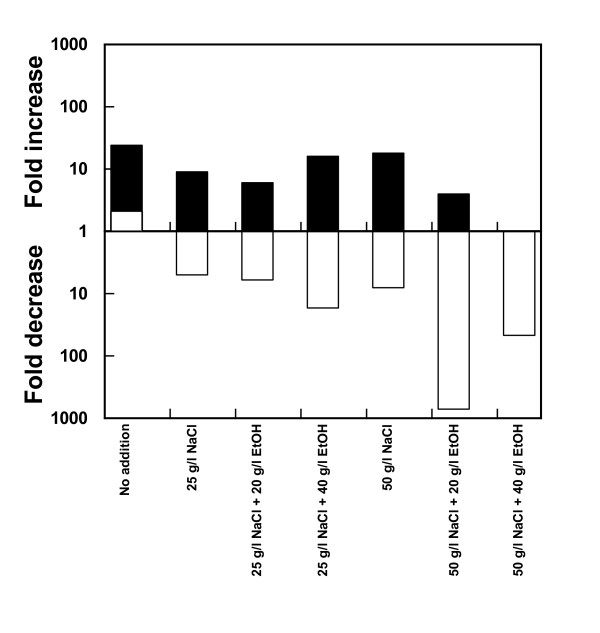
Fold change in viable yeast (closed bars) and viable bacteria (open bars) after 24 h incubation in lignocellulosic medium with and without additions of ethanol and/or NaCl. The fold change of viable yeast and bacteria was calculated after 24 h incubation in falcon tubes of a mixture of the yeast Saccharomyces cerevisiae and the bacteria Lactobacillus buchneri, Lactobacillus fermentum, Acetobacter syzygii and Acetobacter tropicalis inoculated into a dilute acid spruce hydrolysate medium with and without various additions of ethanol and/or NaCl. A missing bar means that the change is lower than onefold.
Figure 7
Figure 7
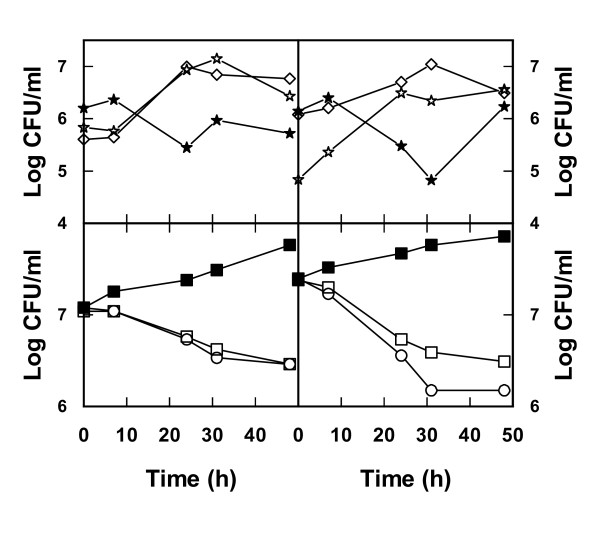
Viability of yeast (upper panels) and bacteria (lower panels) during incubation in lignocellulosic medium with and without addition of ethanol and NaCl. Lignocellulosic dilute acid spruce hydrolysate medium was inoculated with a mixture of the yeast Saccharomyces cerevisiae and the bacteria Lactobacillus buchneri, Lactobacillus plantarum, Acetobacter syzygii and Acetobacter tropicalis. Viability was measured without additions (filled stars, filled squares) and with addition of 40 g/l of ethanol and 25 g/l of NaCl (open stars, open squares) or 20 g/l of ethanol and 50 g/l of NaCl (open diamonds, open circles). Results from two independent bioreactor cultures are shown.
Figure 8
Figure 8
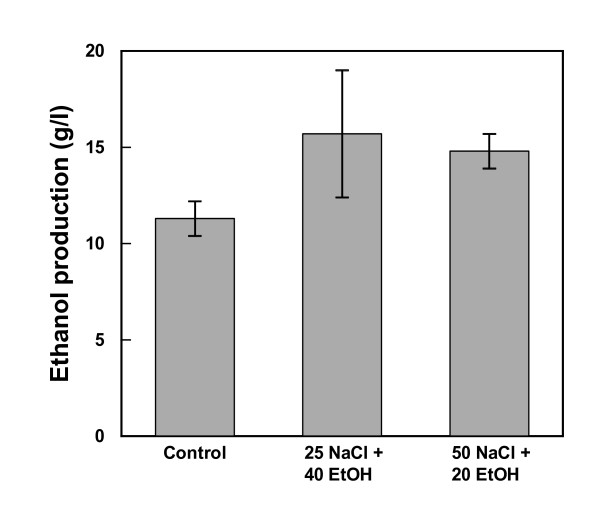
Ethanol production in cocultures of yeast and bacteria incubated in lignocellulosic medium with and without addition of ethanol and NaCl. Lignocellulosic dilute acid spruce hydrolysate medium without or with additions of 40 g/l of ethanol and 25 g/l of NaCl or 20 g/l of ethanol and 50 g/l of NaCl was inoculated with a mixture of the yeast Saccharomyces cerevisiae and the bacteria Lactobacillus buchneri, Lactobacillus plantarum, Acetobacter syzygii and Acetobacter tropicalis. The ethanol concentration was measured after glucose exhaustion. Values represent data from two separate bioreactor cultures each and error bars indicate minimum/maximum values.
Figure 9
Figure 9
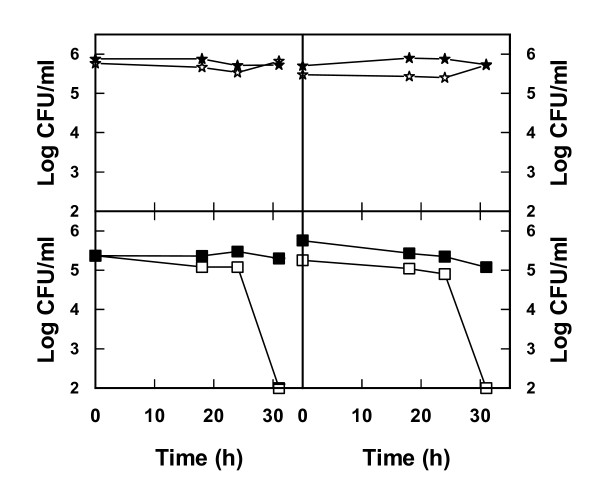
Viability of yeast (upper panels) and bacteria (lower panels) in a sludge obtained from an industrial ethanol production unit with and without additions of ethanol and NaCl. Sludge with its natural microbial flora of yeast and bacteria, obtained from an ethanol production plant (Domsjö Fabriker, Örnsköldsvik, Sweden), was used for inoculating spent sulfite liquor medium. Viability of yeast and bacteria was assessed for non-treated samples (closed symbols) and samples subjected to addition of 12.5 g/l of ethanol and 25 g/l of NaCl (open symbols). Results from two entirely different cultivations are shown.

References

    1. Bischoff KM, Skinner-Nemec KA, Leathers TD. Antimicrobial susceptibility of Lactobacillus species isolated from commercial ethanol plants. J Ind Microbiol Biotechnol. 2007;34:739–744. doi: 10.1007/s10295-007-0250-4. - DOI - PubMed
    1. Schell DJ, Dowe N, Ibsen KN, Riley CJ, Ruth MF, Lumpkin RE. Contaminant occurrence, identification and control in a pilot-scale corn fiber to ethanol conversion process. Bioresour Technol. 2007;98:2942–2948. doi: 10.1016/j.biortech.2006.10.002. - DOI - PubMed
    1. Skinner KA, Leathers TD. Bacterial contaminants of fuel ethanol production. J Ind Microbiol Biotechnol. 2004;31:401–408. doi: 10.1007/s10295-004-0159-0. - DOI - PubMed
    1. Priest FG, Campbell I. Brewing Microbiology. New York, NY: Kluwer Academic/Plenum Press; 2003.
    1. Gibson BR, Lawrence SJ, Leclaire JP, Powell CD, Smart KA. Yeast responses to stresses associated with industrial brewery handling. FEMS Microbiol Rev. 2007;31:535–569. doi: 10.1111/j.1574-6976.2007.00076.x. - DOI - PubMed