. 2011 Dec 20:2:10.
doi: 10.1186/2041-9414-2-10.

Direct detection and sequencing of damaged DNA bases

Affiliations

Direct detection and sequencing of damaged DNA bases

Tyson A Clark et al. Genome Integr. .

Abstract

Products of various forms of DNA damage have been implicated in a variety of important biological processes, such as aging, neurodegenerative diseases, and cancer. Therefore, there exists great interest to develop methods for interrogating damaged DNA in the context of sequencing. Here, we demonstrate that single-molecule, real-time (SMRT®) DNA sequencing can directly detect damaged DNA bases in the DNA template - as a by-product of the sequencing method - through an analysis of the DNA polymerase kinetics that are altered by the presence of a modified base. We demonstrate the sequencing of several DNA templates containing products of DNA damage, including 8-oxoguanine, 8-oxoadenine, O6-methylguanine, 1-methyladenine, O4-methylthymine, 5-hydroxycytosine, 5-hydroxyuracil, 5-hydroxymethyluracil, or thymine dimers, and show that these base modifications can be readily detected with single-modification resolution and DNA strand specificity. We characterize the distinct kinetic signatures generated by these DNA base modifications.


Figures

Figure 1
Figure 1
Kinetic effects of products of oxidative DNA damage in SMRT sequencing. Normalized IPD ratios (top panel) and PW ratios (bottom panel) between the modified and unmodified DNA templates are shown for (a) 8oxoG and (b) 8oxoA, with the DNA template sequence as the x axis. The two template positions carrying the base modifications are highlighted with red bars and underlined sequence labels. The direction of DNA polymerization (left to right, thus the DNA template sequence is 3' to 5') as well as the coordinate space relative to the modified sites as referred to in the text is indicated in (a) and omitted for clarity in the rest of the figures.
Figure 2
Figure 2
Kinetic effects of products of alkylation DNA damage in SMRT sequencing. Normalized IPD ratios (top panel) and PW ratios (bottom panel) between the modified and unmodified DNA templates are shown for (a) O6 mG, (b) 1 mA, and (c) O4 mT, with the DNA template sequence as the x axis. The two template positions carrying the base modifications are highlighted with red bars and underlined sequence labels.
Figure 3
Figure 3
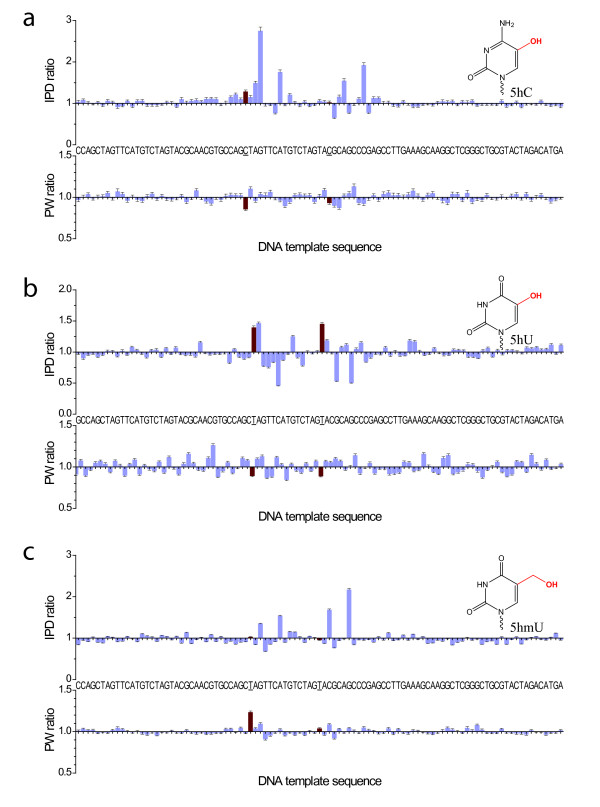
Kinetic effects of products of ionizing radiation DNA damage in SMRT sequencing. Normalized IPD ratios (top panel) and PW ratios (bottom panel) between the modified and unmodified DNA templates are shown for (a) 5 hC, (b) 5 hU, and (c) 5 hmU, with the DNA template sequence as the x axis. The two template positions carrying the base modifications are highlighted with red bars and underlined sequence labels.
Figure 4
Figure 4
Kinetic effects of products of UV radiation DNA damage in SMRT sequencing. (a) Example sequencing trace, showing very long pausing by the polymerase upon repeated encounters with a thymine dimer (arrows) on the SMRTbell DNA template. (b) Normalized IPD ratios between the thymine dimer containing and unmodified control DNA templates. The template sequence is given as the x axis. The two template positions constituting the thymine dimer are highlighted with red bars and underlined sequence labels. The inset shows the lack of sequencing coverage after the thymine dimer position because of the extremely long pauses by the polymerase induced by the lesion.

References

    1. Geacintov NE, Broyde S. The Chemical Biology of DNA Damage. Wiley-VCH Verlag GmbH & Co. KGaA; 2010.
    1. Kelley MR. DNA Repair in Cancer Therapy: Molecular Targets and Clinical Applications. Elsevier Science; 2011.
    1. Preston BD, Albertson TM, Herr AJ. DNA replication fidelity and cancer. Semin Cancer Biol. 2011;20:281–293. - PMC - PubMed
    1. Kumari S, Rastogi RP, Singh KL, Singh SP, Sinha RP. DNA Damage: Detection Strategies. EXCLI J. 2008;7:44–62.
    1. Flusberg BA, Webster DR, Lee JH, Travers KJ, Olivares EC, Clark TA, Korlach J, Turner SW. Direct detection of DNA methylation during single-molecule, real-time sequencing. Nat Methods. 2010;7:461–465. doi: 10.1038/nmeth.1459. - DOI - PMC - PubMed

LinkOut - more resources