


Coprological survey of alimentary tract parasites in dogs from Zambia and evaluation of a coproantigen assay for canine echinococcosis
- PMID: 22185947
- PMCID: PMC4100310
- DOI: 10.1179/atm.2011.105.7.07
Coprological survey of alimentary tract parasites in dogs from Zambia and evaluation of a coproantigen assay for canine echinococcosis
Abstract
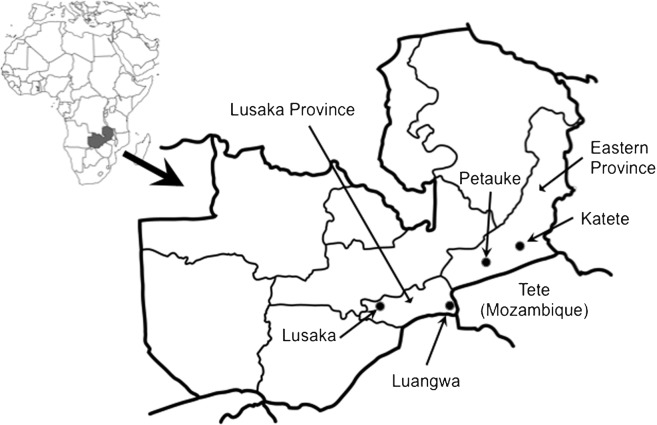
Faecal samples were collected from the rectum of 540 domestic dogs from four districts (Lusaka, Katete, Petauke and Luangwa) in Zambia between 2005 and 2006 and prevalences of canine alimentary tract parasites were determined by coprological examination. Thirteen different ova and parasites including strongyle (43.3%), Spirocerca lupi (18.7%), taeniid (13.1%), Toxocara canis (7.6%), Sarcocystis sp.* (7.5%), Isospora sp.* (5.7%), Physaloptera sp.* (4.6%), Capillaria sp.* (2.8%), Dipylidium caninum (2.2%), Mesocestoides sp.* (2.0%), Ascaris sp.* (1.7%), Trichuris vulpis* (0.4%) and Schistosoma mansoni* (0.4%) were detected, Ascaris and Schistosoma probably originating from coprophagy. The species with asterisks and later-described Taenia multiceps are for the first time reported from dogs in Zambia. A coproantigen enzyme-linked immunosorbent assay (CoproAg-ELISA) developed for Echinococcus spp. revealed 43 positive dogs and 37 of these harboured taeniid eggs. From 63 of the 71 taeniid egg-positive samples, eggs and DNA thereof were isolated and subjected to a multiplex polymerase chain reaction for differentiating E. granulosus sensu lato, E. multilocularis and Taenia spp. Amplicons indicative for Taenia spp. were obtained from 60 samples. Sequencing of amplicons spanning part of the mitochondrial cytochrome c oxidase subunit 1 gene, which was possible with 38 samples, revealed 35 infections with T. hydatigena and 3 with T. multiceps. Therefore, the CoproAg-ELISA showed some positives, but concrete evidence for the existence of canine E. granulosus infection could not be established. Comparison of the results of the CoproAg-ELISA and Taenia species identification indicated that the CoproAg-ELISA cross-reacts with patent infections of T. hydatigena (57%) and T. multiceps (33%).
References
-
- Benito A.&Carmena D.(2005)Double-antibody sandwich ELISA using biotinylated antibodies for the detection of Echinococcus granulosus coproantgens in dogs. Acta Tropica 959–15. - PubMed
-
- Benito A, Carmena D, Joseph L, Matinez J, Guisantes JA.(2006)Dog echinococcosis in northern Spain: comparison of coproantigen and serum antibody assays with coprological exam. Veterinary Parasitology 142102–111. - PubMed
-
- Bowman D D.(Ed).(2009)Georgis’ Parasitology for Veterinarians 9th EdnSt Louis, MO: Saunders Elsevier
-
- Bruzinskaite R, Sarkunas M, Torgerson PR, Mathis A, Deplazes P.(2009)Echinococcosis in pigs and intestinal infection with Echinococcus spp. in dogs in southwestern Lithuania. Veterinary Parasitology 160237–241. - PubMed
-
- Davidson RK, Oines O, Madslien K, Mathis A.(2009)Echinococcus multilocularis — adaptation of a worm egg isolation procedure coupled with a multiplex PCR assay to carry out large-scale screening of red foxes (Vulpes vulpes) in Norway. Parasitology Research 104509–514. - PubMed
Publication types
MeSH terms
Substances
LinkOut - more resources
Full Text Sources
Medical
Miscellaneous