Review
. 2012 Mar 1;18(5):1201-6.
doi: 10.1158/1078-0432.CCR-11-0641. Epub 2011 Dec 20.

Molecular pathways: beta-adrenergic signaling in cancer

Affiliations
Review

Molecular pathways: beta-adrenergic signaling in cancer

Steven W Cole et al. Clin Cancer Res. .

Abstract

Beta-adrenergic signaling has been found to regulate multiple cellular processes that contribute to the initiation and progression of cancer, including inflammation, angiogenesis, apoptosis/anoikis, cell motility and trafficking, activation of tumor-associated viruses, DNA damage repair, cellular immune response, and epithelial-mesenchymal transition. In several experimental cancer models, activation of the sympathetic nervous system promotes the metastasis of solid epithelial tumors and the dissemination of hematopoietic malignancies via β-adrenoreceptor-mediated activation of protein kinase A and exchange protein activated by adenylyl cyclase signaling pathways. Within the tumor microenvironment, β-adrenergic receptors on tumor and stromal cells are activated by catecholamines from local sympathetic nerve fibers (norepinephrine) and circulating blood (epinephrine). Tumor-associated macrophages are emerging as key targets of β-adrenergic regulation in several cancer contexts. Sympathetic nervous system regulation of cancer cell biology and the tumor microenvironment has clarified the molecular basis for long-suspected relationships between stress and cancer progression, and now suggests a highly leveraged target for therapeutic intervention. Epidemiologic studies have linked the use of β-blockers to reduced rates of progression for several solid tumors, and preclinical pharmacologic and biomarker studies are now laying the groundwork for translation of β-blockade as a novel adjuvant to existing therapeutic strategies in clinical oncology.


Figures
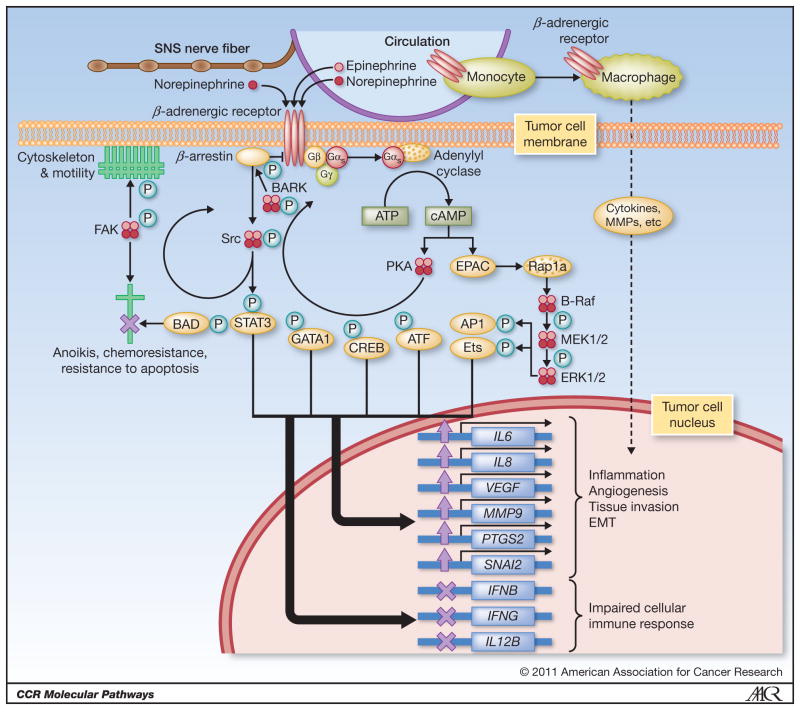
Figure 1
Figure 1. The β-adrenergic signaling pathway in cancer
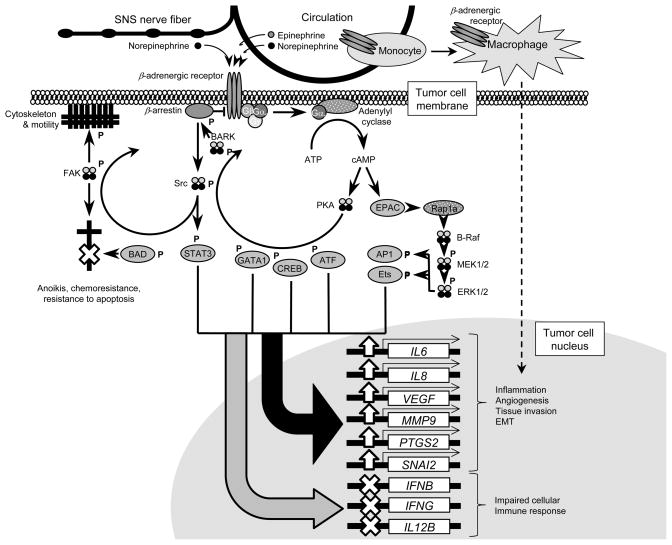
Sympathetic nervous system (SNS) fight-or-flight stress responses deliver epinephrine (E) and norepinephrine (NE) into the tumor microenvironment via circulating blood and NE release from local sympathetic nerve fibers. Both catecholamines bind to β-adrenergic receptors, resulting in Gαs-mediated activation of adenylyl cyclase, and subsequent conversion of adenosine triphosphate (ATP) into cyclic 3′–5′ adenosine monophosphate (cAMP). Transient flux of interacellular cAMP activates two major biochemical effector systems. (1) cAMP activates protein kinase A (PKA) to phosphorylate multiple target proteins including transcription factors of the CREB/ATF and GATA families, as well as the β-adrenergic receptor kinase (BARK). BARK recruitment of β-arrestin inhibits β-adrenergic receptor signaling and activates Src kinase, resulting in activation of transcription factors such as STAT3 and downstream kinases such as focal adhesion kinase (FAK). FAK activation modulates cell trafficking and motility via cytoskeletal dynamics, as well as cellular resistance to apoptosis (e.g., anoikis). PKA-dependent activation of Bcl-2 family member BAD can also render cancer cells resistant to chemotherapy-induced apoptosis. (2) In the second major effector pathway, cAMP activation of the Exchange Protein activated by Adenylyl Cyclase (EPAC) leads to Rap1A-mediated activation of the B-Raf/MAP kinase signaling pathway and downstream effects on diverse cellular processes including gene transcription mediated by AP-1 and Ets family transcription factors. The general pattern of transcriptional responses induced by β-adrenergic signaling includes up-regulated expression of metastasis-associated genes involved in inflammation, angiogenesis, tissue invasion, and epithelial-mesenchymal transition, and down-regulated expression of genes facilitating anti-tumor immune responses. In addition to direct effects on β-receptor-bearing tumor cells, SNS activation also modulates cancer biology by regulating the bone marrow generation and tumor recruitment and transcriptional activation of β-receptor-bearing monocyte/macrophages, as well as the growth and differentiation of vascular endothelial cells and pericytes. β-adrenergic effects on stromal cells in the tumor microenvironment generally synergize with direct effects on tumor cells in promoting cancer survival, growth, and metastatic dissemination.
Figure 1
Figure 1. The β-adrenergic signaling pathway in cancer
Sympathetic nervous system (SNS) fight-or-flight stress responses deliver epinephrine (E) and norepinephrine (NE) into the tumor microenvironment via circulating blood and NE release from local sympathetic nerve fibers. Both catecholamines bind to β-adrenergic receptors, resulting in Gαs-mediated activation of adenylyl cyclase, and subsequent conversion of adenosine triphosphate (ATP) into cyclic 3′–5′ adenosine monophosphate (cAMP). Transient flux of interacellular cAMP activates two major biochemical effector systems. (1) cAMP activates protein kinase A (PKA) to phosphorylate multiple target proteins including transcription factors of the CREB/ATF and GATA families, as well as the β-adrenergic receptor kinase (BARK). BARK recruitment of β-arrestin inhibits β-adrenergic receptor signaling and activates Src kinase, resulting in activation of transcription factors such as STAT3 and downstream kinases such as focal adhesion kinase (FAK). FAK activation modulates cell trafficking and motility via cytoskeletal dynamics, as well as cellular resistance to apoptosis (e.g., anoikis). PKA-dependent activation of Bcl-2 family member BAD can also render cancer cells resistant to chemotherapy-induced apoptosis. (2) In the second major effector pathway, cAMP activation of the Exchange Protein activated by Adenylyl Cyclase (EPAC) leads to Rap1A-mediated activation of the B-Raf/MAP kinase signaling pathway and downstream effects on diverse cellular processes including gene transcription mediated by AP-1 and Ets family transcription factors. The general pattern of transcriptional responses induced by β-adrenergic signaling includes up-regulated expression of metastasis-associated genes involved in inflammation, angiogenesis, tissue invasion, and epithelial-mesenchymal transition, and down-regulated expression of genes facilitating anti-tumor immune responses. In addition to direct effects on β-receptor-bearing tumor cells, SNS activation also modulates cancer biology by regulating the bone marrow generation and tumor recruitment and transcriptional activation of β-receptor-bearing monocyte/macrophages, as well as the growth and differentiation of vascular endothelial cells and pericytes. β-adrenergic effects on stromal cells in the tumor microenvironment generally synergize with direct effects on tumor cells in promoting cancer survival, growth, and metastatic dissemination.

References

    1. Weiner H. Perturbing the Organism: The Biology of Stressful Experience. Chicago: University of Chicago Press; 1992.
    1. Sapolsky RM. Why zebras don’t get ulcers: A guide to stress, stress-related diseases, and coping. New York: Freeman; 1994.
    1. Daly CJ, McGrath JC. Previously unsuspected widespread cellular and tissue distribution of beta-adrenoceptors and its relevance to drug action. Trends Pharmacol Sci. 2011;32:219–226. - PubMed
    1. Baker JG, Hill SJ, Summers RJ. Evolution of beta-blockers: from anti-anginal drugs to ligand-directed signalling. Trends Pharmacol Sci. 2011;32:227–234. - PMC - PubMed
    1. Montminy M. Transcriptional regulation by cyclic AMP. Annu Rev Biochem. 1997;66:807–822. - PubMed

Publication types

MeSH terms

Substances