


Associations between sleep architecture and sleep-disordered breathing and cognition in older community-dwelling men: the Osteoporotic Fractures in Men Sleep Study
- PMID: 22188071
- PMCID: PMC3245643
- DOI: 10.1111/j.1532-5415.2011.03731.x
Associations between sleep architecture and sleep-disordered breathing and cognition in older community-dwelling men: the Osteoporotic Fractures in Men Sleep Study
Abstract
Objectives: To examine the association between sleep architecture, sleep-disordered breathing, and cognition in older men.
Design: Population-based cross-sectional study.
Setting: Six clinical sites in the United States.
Participants: Two thousand nine hundred nine community-dwelling men aged 67 and older who were not selected on the basis of sleep problems or cognitive impairment.
Measurements: Predictors were measured using in-home polysomnography: sleep architecture, nocturnal hypoxemia (any sleep time with arterial oxygen saturation <80%), apnea-hypopnea index (AHI), and arousal index. Cognitive outcomes were measured using the modified Mini-Mental State Examination (3MS), Trail-Making Test Part B (TMT-B), and the Digit Vigilance Test (DVT).
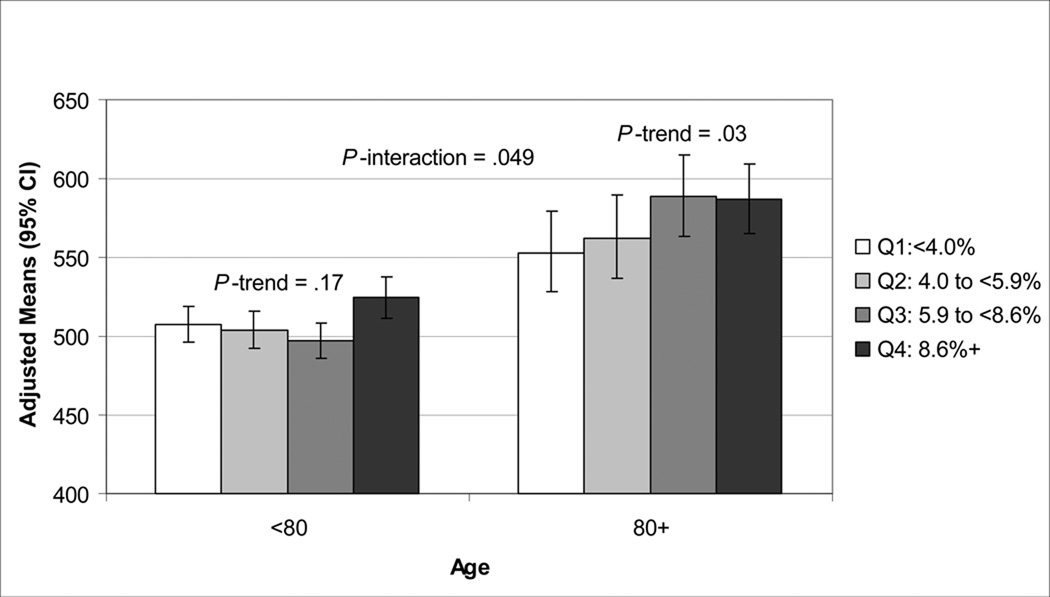
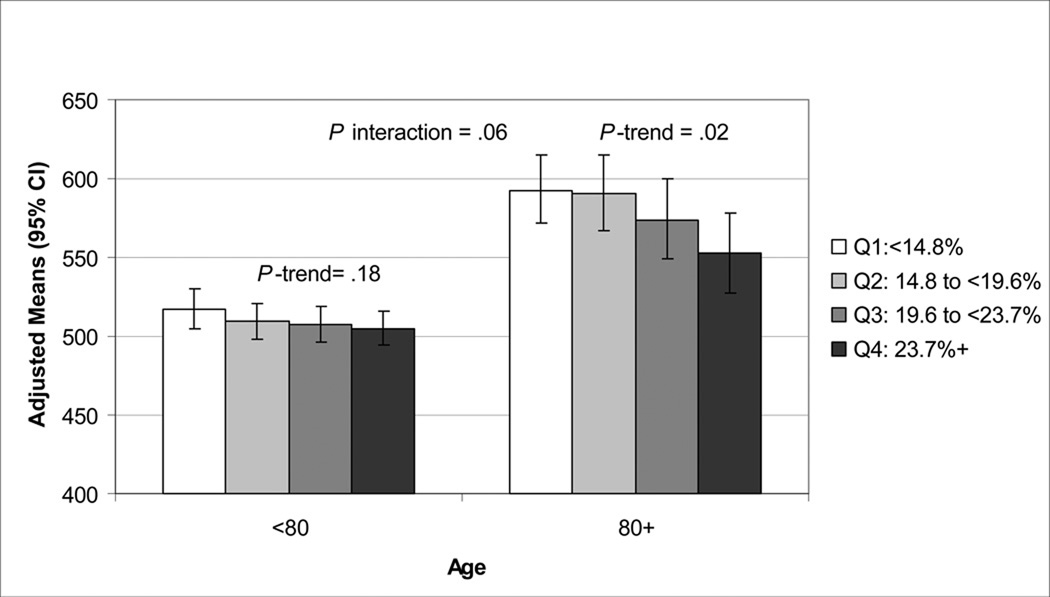
Results: Analyses adjusted for age, race, education, body mass index, lifestyle, comorbidities, and medication use showed that participants who spent less percentage of time in rapid eye movement (REM) sleep had lower levels of cognition; participants in the lowest quartile (<14.8%) took an average of 5.9 seconds longer on the TMT-B and 20.1 seconds longer on the DVT than those in the highest quartile (≥23.7%). Similarly, greater percentage of time spent in Stage 1 sleep was related to poorer cognitive function. Participants in the highest quartile of Stage 1 sleep (≥8.6%) had worse cognitive scores on average than those in the lowest quartile (<4.0%). Those with nocturnal hypoxemia took an average of 22.3 seconds longer to complete the DVT than those without, but no associations were found with 3MS or the TMT-B.
Conclusion: Spending less percentage of time in REM sleep and greater percentage of time in Stage 1 sleep and having higher levels of nocturnal hypoxemia were associated with poorer cognition in older men. Further studies are needed to clarify the direction of these associations and to explore potential mechanisms.
© 2011, Copyright the Authors Journal compilation © 2011, The American Geriatrics Society.
Figures
References
-
- Ott A, Breteler MM, van Harskamp F, et al. Incidence and risk of dementia. The Rotterdam Study. Am J Epidemiol. 1998;147:574–580. - PubMed
-
- Ohayon MM, Carskadon MA, Guilleminault C, Vitiello MV. Meta-analysis of quantitative sleep parameters from childhood to old age in healthy individuals: developing normative sleep values across the human lifespan. Sleep. 2004;27:1255–1273. - PubMed
-
- Empson JA, Clarke PR. Rapid eye movements and remembering. Nature. 1970;227:287–288. - PubMed
Publication types
MeSH terms
Grants and funding
- U01 AR45632/AR/NIAMS NIH HHS/United States
- R01 AG008415/AG/NIA NIH HHS/United States
- R01 HL070848/HL/NHLBI NIH HHS/United States
- R01 HL071194/HL/NHLBI NIH HHS/United States
- R01 HL070847/HL/NHLBI NIH HHS/United States
- U01 AR45647/AR/NIAMS NIH HHS/United States
- R01 HL070842/HL/NHLBI NIH HHS/United States
- U01 AR45614/AR/NIAMS NIH HHS/United States
- U01 AR045654/AR/NIAMS NIH HHS/United States
- U01-AG027810/AG/NIA NIH HHS/United States
- U01 AR45583/AR/NIAMS NIH HHS/United States
- R01 HL070839/HL/NHLBI NIH HHS/United States
- R01 HL070837/HL/NHLBI NIH HHS/United States
- U01 AR045614/AR/NIAMS NIH HHS/United States
- U01 AR45654/AR/NIAMS NIH HHS/United States
- K24 AG031155/AG/NIA NIH HHS/United States
- K 24 AG031155/AG/NIA NIH HHS/United States
- U01 AR045583/AR/NIAMS NIH HHS/United States
- R01 HL070841/HL/NHLBI NIH HHS/United States
- U01 AG042140/AG/NIA NIH HHS/United States
- R01 HL070838/HL/NHLBI NIH HHS/United States
- U01 AR045647/AR/NIAMS NIH HHS/United States
- U01 AR45580/AR/NIAMS NIH HHS/United States
- U01 AG027810/AG/NIA NIH HHS/United States
- AG08415/AG/NIA NIH HHS/United States
- UL1 RR024140/RR/NCRR NIH HHS/United States
- U01 AR045580/AR/NIAMS NIH HHS/United States
- U01 AG18197/AG/NIA NIH HHS/United States
- U01 AG018197/AG/NIA NIH HHS/United States
- U01 AR066160/AR/NIAMS NIH HHS/United States
- U01 AR045632/AR/NIAMS NIH HHS/United States
LinkOut - more resources
Full Text Sources
Medical
