


H2B ubiquitylation is part of chromatin architecture that marks exon-intron structure in budding yeast
- PMID: 22188810
- PMCID: PMC3274495
- DOI: 10.1186/1471-2164-12-627
H2B ubiquitylation is part of chromatin architecture that marks exon-intron structure in budding yeast
Abstract
Background: The packaging of DNA into chromatin regulates transcription from initiation through 3' end processing. One aspect of transcription in which chromatin plays a poorly understood role is the co-transcriptional splicing of pre-mRNA.
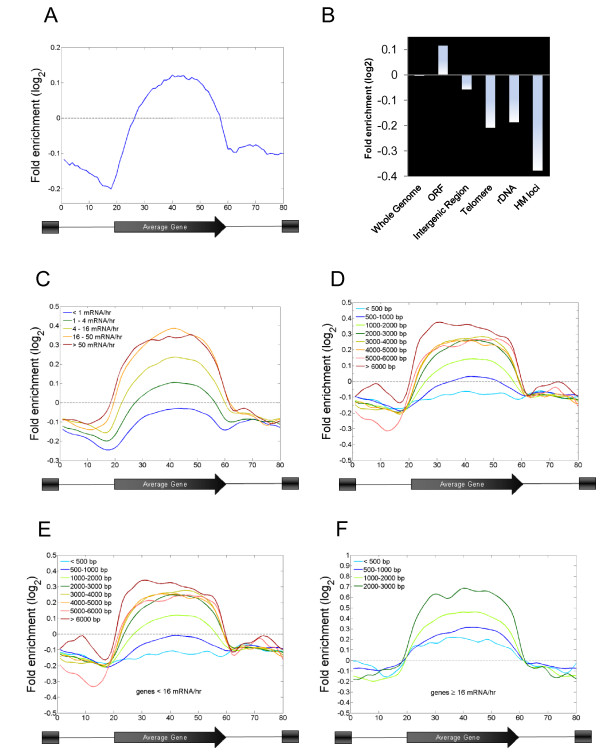
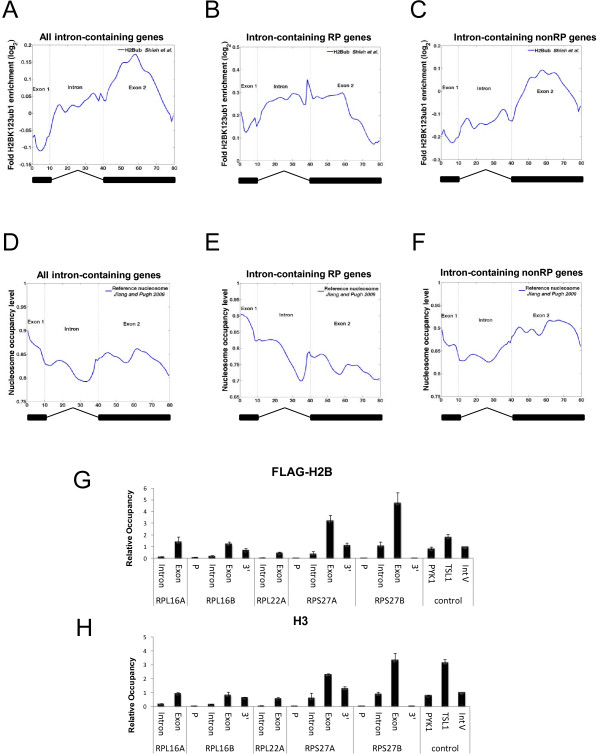
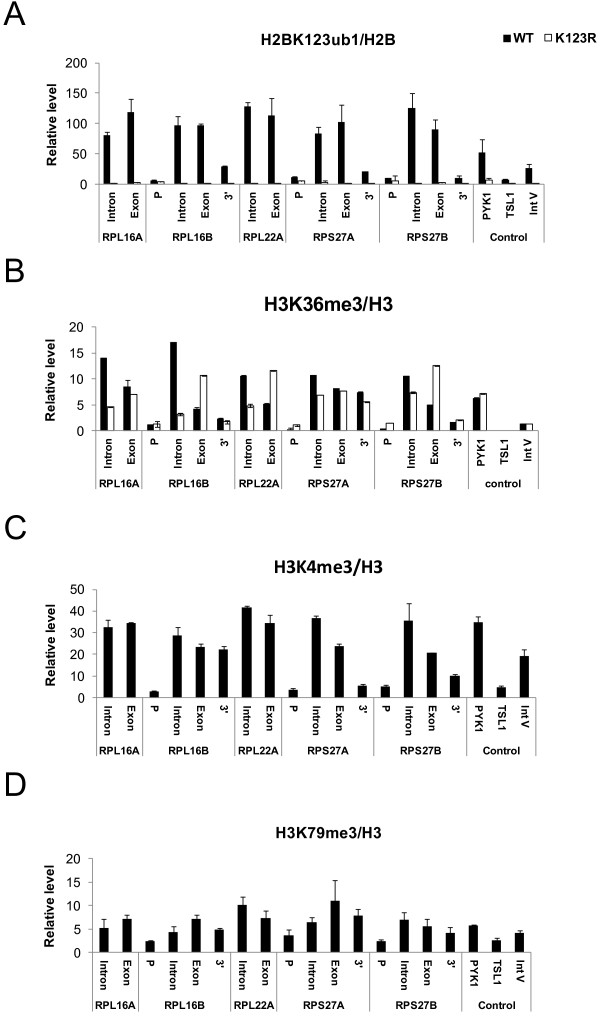
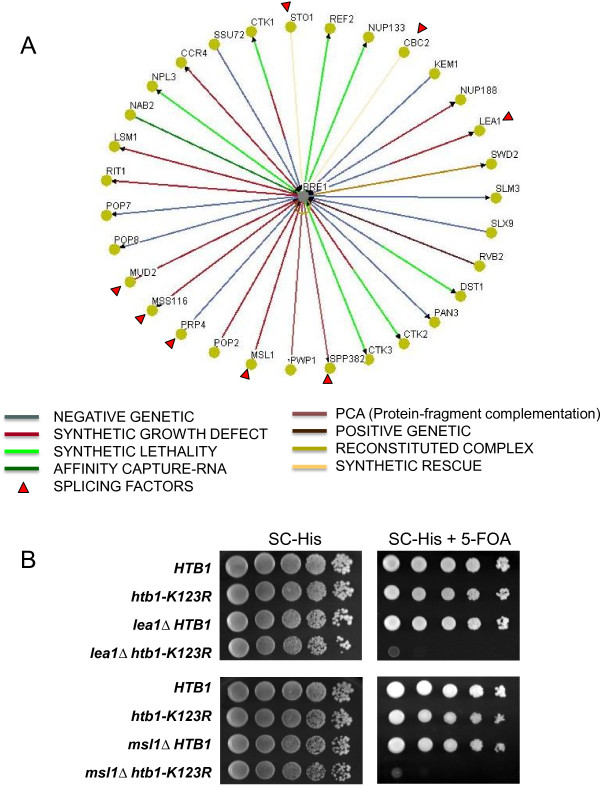
Results: Here we provide evidence that H2B monoubiquitylation (H2BK123ub1) marks introns in Saccharomyces cerevisiae. A genome-wide map of H2BK123ub1 in this organism reveals that this modification is enriched in coding regions and that its levels peak at the transcribed regions of two characteristic subgroups of genes. First, long genes are more likely to have higher levels of H2BK123ub1, correlating with the postulated role of this modification in preventing cryptic transcription initiation in ORFs. Second, genes that are highly transcribed also have high levels of H2BK123ub1, including the ribosomal protein genes, which comprise the majority of intron-containing genes in yeast. H2BK123ub1 is also a feature of introns in the yeast genome, and the disruption of this modification alters the intragenic distribution of H3 trimethylation on lysine 36 (H3K36me3), which functionally correlates with alternative RNA splicing in humans. In addition, the deletion of genes encoding the U2 snRNP subunits, Lea1 or Msl1, in combination with an htb-K123R mutation, leads to synthetic lethality.
Conclusion: These data suggest that H2BK123ub1 facilitates cross talk between chromatin and pre-mRNA splicing by modulating the distribution of intronic and exonic histone modifications.
Figures
Similar articles
-
H2B ubiquitylation modulates spliceosome assembly and function in budding yeast.Biol Cell. 2014 Apr;106(4):126-38. doi: 10.1111/boc.201400003. Epub 2014 Feb 25. Biol Cell. 2014. PMID: 24476359 Free PMC article.
-
H2B monoubiquitylation is a 5'-enriched active transcription mark and correlates with exon-intron structure in human cells.Genome Res. 2012 Jun;22(6):1026-35. doi: 10.1101/gr.120634.111. Epub 2012 Mar 15. Genome Res. 2012. PMID: 22421545 Free PMC article.
-
Differential patterns of intronic and exonic DNA regions with respect to RNA polymerase II occupancy, nucleosome density and H3K36me3 marking in fission yeast.Genome Biol. 2011 Aug 22;12(8):R82. doi: 10.1186/gb-2011-12-8-r82. Genome Biol. 2011. PMID: 21859475 Free PMC article.
-
Decoding the trans-histone crosstalk: methods to analyze H2B ubiquitination, H3 methylation and their regulatory factors.Methods. 2011 Jul;54(3):304-14. doi: 10.1016/j.ymeth.2011.02.010. Epub 2011 Mar 8. Methods. 2011. PMID: 21392582 Free PMC article. Review.
-
New connections between ubiquitylation and methylation in the co-transcriptional histone modification network.Curr Genet. 2021 Oct;67(5):695-705. doi: 10.1007/s00294-021-01196-x. Epub 2021 Jun 5. Curr Genet. 2021. PMID: 34089069 Free PMC article. Review.
Cited by
-
USP49 deubiquitinates histone H2B and regulates cotranscriptional pre-mRNA splicing.Genes Dev. 2013 Jul 15;27(14):1581-95. doi: 10.1101/gad.211037.112. Epub 2013 Jul 3. Genes Dev. 2013. PMID: 23824326 Free PMC article.
-
A role for H2B ubiquitylation in DNA replication.Mol Cell. 2012 Dec 14;48(5):734-46. doi: 10.1016/j.molcel.2012.09.019. Epub 2012 Oct 25. Mol Cell. 2012. PMID: 23103252 Free PMC article.
-
The Ulp2 SUMO protease promotes transcription elongation through regulation of histone sumoylation.EMBO J. 2019 Aug 15;38(16):e102003. doi: 10.15252/embj.2019102003. Epub 2019 Jul 17. EMBO J. 2019. PMID: 31313851 Free PMC article.
-
Transcription-associated histone modifications and cryptic transcription.Biochim Biophys Acta. 2013 Jan;1829(1):84-97. doi: 10.1016/j.bbagrm.2012.08.008. Epub 2012 Sep 7. Biochim Biophys Acta. 2013. PMID: 22982198 Free PMC article. Review.
-
Structural basis for COMPASS recognition of an H2B-ubiquitinated nucleosome.Elife. 2020 Jan 10;9:e53199. doi: 10.7554/eLife.53199. Elife. 2020. PMID: 31922488 Free PMC article.
References
Publication types
MeSH terms
Substances
Associated data
- Actions
Grants and funding
LinkOut - more resources
Full Text Sources
Molecular Biology Databases
