


A prospective examination of weight gain in hospitalized adolescents with anorexia nervosa on a recommended refeeding protocol
- PMID: 22188830
- PMCID: PMC4467563
- DOI: 10.1016/j.jadohealth.2011.06.011
A prospective examination of weight gain in hospitalized adolescents with anorexia nervosa on a recommended refeeding protocol
Abstract
Purpose: Current refeeding recommendations for adolescents hospitalized with anorexia nervosa (AN) are conservative, starting with low calories and advancing slowly to avoid refeeding syndrome. The purpose of this study was to examine weight change and clinical outcomes in hospitalized adolescents with AN on a recommended refeeding protocol.
Methods: Adolescents aged 13.1-20.5 years were followed during hospitalization for AN. Weight, vital signs, electrolytes, and 24-hour fluid balance were measured daily. Percent median body mass index (%MBMI) was calculated as 50th percentile BMI for age and gender. Calories were prescribed on admission and were increased every other day.
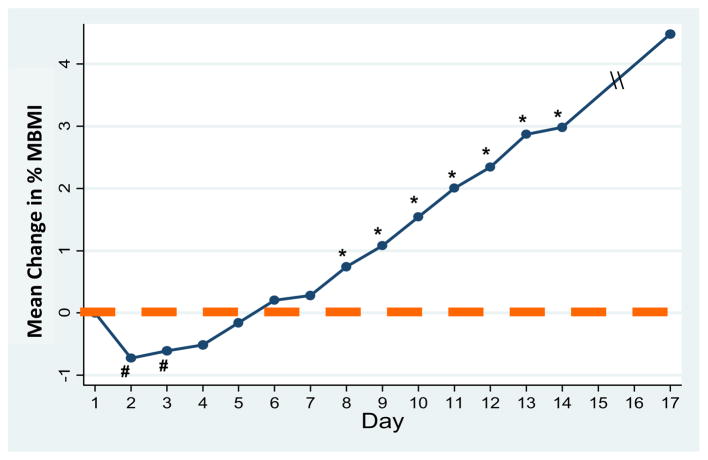
Results: Thirty-five subjects with a mean (SD) age of 16.2 (1.9) years participated over 16.7 (6.4) days. Calories increased from 1,205 (289) to 2,668 (387). No subjects had refeeding syndrome; 20% had low serum phosphorus. Percent MBMI increased from 80.1 (11.5) to 84.5 (9.6); overall gain was 2.10 (1.98) kg. However, 83% of subjects initially lost weight. Mean %MBMI did not increase significantly until day 8. Higher calories prescribed at baseline were significantly associated with faster weight gain (p = .003) and shorter hospital stay (p = .030) in multivariate regression models adjusted for %MBMI and lowest heart rate on admission.
Conclusions: Hospitalized adolescents with AN demonstrated initial weight loss and slow weight gain on a recommended refeeding protocol. Higher calorie diets instituted at admission predicted faster weight gain and shorter hospital stay. These findings support the development of more aggressive feeding strategies in adolescents hospitalized with AN. Further research is needed to identify caloric and supplementation regimens to maximize weight gain safely while avoiding refeeding syndrome.
Published by Elsevier Inc.
Figures
Comment in
-
Refeeding hospitalized adolescents with anorexia nervosa: is "start low, advance slow" urban legend or evidence based?J Adolesc Health. 2012 Jan;50(1):1-2. doi: 10.1016/j.jadohealth.2011.10.003. J Adolesc Health. 2012. PMID: 22188827 No abstract available.
References
-
- Lund BC, Hernandez ER, Yates WR, et al. Rate of inpatient weight restoration predicts outcome in anorexia nervosa. Int J Eat Disord. 2009;42:301–5. - PubMed
-
- Lock J, Litt I. What predicts maintenance of weight for adolescents medically hospitalized for anorexia nervosa? Eat Disord. 2003;11:1–7. - PubMed
-
- Baran SA, Weltzin TE, Kaye WH. Low discharge weight and outcome in anorexia nervosa. Am J Psychiatry. 1995;152:1070–2. - PubMed
-
- Forman-Hoffman VL, Ruffin T, Schultz SK. Basal metabolic rate in anorexia nervosa patients: Using appropriate predictive equations during the refeeding process. Ann Clin Psychiatry. 2006;18:123–7. - PubMed
-
- Krahn DD, Rock C, Dechert RE, et al. Changes in resting energy expenditure and body composition in anorexia nervosa patients during refeeding. J Am Diet Assoc. 1993;93:434–8. - PubMed
