


The development of salty taste acceptance is related to dietary experience in human infants: a prospective study
- PMID: 22189260
- PMCID: PMC3238456
- DOI: 10.3945/ajcn.111.014282
The development of salty taste acceptance is related to dietary experience in human infants: a prospective study
Abstract
Background: Sodium intake is related to hypertension and other diseases, but little is known about the early development of salty taste acceptance.
Objective: The prospective study asked whether dietary experience with foods containing sodium is associated with development of infant salty taste preference.
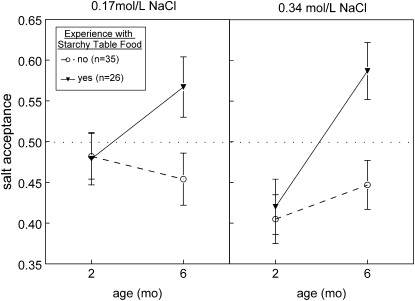
Design: Infants (n = 61) were tested at 2 and 6 mo to assess their response to 0.17 and 0.34 mol NaCl/L in water. Intake tests consisted of randomized double-blind 120-s exposure to salt solutions and water. Acceptance, calculated as solution intake relative to water, was examined as a function of exposure to starchy table food-a significant source of sodium. Dietary exposure (yes or no) was defined by maternal report. As a control, similar comparisons were based on exposure to fruit table food. A subset of 26 subjects returned at 36-48 mo for assessment of salty taste hedonics and preference.
Results: Dietary experience was related to salt acceptance, with only those infants previously exposed to starchy table foods (n = 26) preferring the salty solutions at 6 mo (P = 0.007). Fruit exposure was not associated with sodium chloride acceptance. Infants eating starchy table foods at 6 mo were more likely to lick salt from the surface of foods at preschool age (P = 0.007) and tended to be more likely to eat plain salt (P = 0.08).
Conclusions: The findings suggest an influential role of early dietary experience in shaping salty taste responses of infants and young children.
Figures
References
-
- Stamler J. The INTERSALT Study: background, methods, findings, and implications. Am J Clin Nutr 1997;65(suppl):626S–42S - PubMed
-
- Morrison AC, Ness RB. Sodium intake and cardiovascular disease. Annu Rev Public Health 2011;32:71–90 - PubMed
-
- He FJ, McGregor GA. A comprehensive review on salt and health and current experience of worldwide salt reduction programmes. J Hum Hypertens 2009;23:363–84 - PubMed
-
- US Department of Agriculture, US Department of Health and Human Services Dietary guidelines for Americans, 2010. 7th ed Washington, DC: US Government Printing Office, 2010 - PubMed
Publication types
MeSH terms
Substances
Grants and funding
LinkOut - more resources
Full Text Sources
Other Literature Sources
Medical
Research Materials
