


Core temperatures during major abdominal surgery in patients warmed with new circulating-water garment, forced-air warming, or carbon-fiber resistive-heating system
- PMID: 22189652
- PMCID: PMC3328673
- DOI: 10.1007/s00540-011-1306-1
Core temperatures during major abdominal surgery in patients warmed with new circulating-water garment, forced-air warming, or carbon-fiber resistive-heating system
Abstract
Purpose: It has been reported that recently developed circulating-water garments transfer more heat than a forced-air warming system. The authors evaluated the hypothesis that circulating-water leg wraps combined with a water mattress better maintain intraoperative core temperature ≥36°C than either forced-air warming or carbon-fiber resistive heating during major abdominal surgery.
Methods: Thirty-six patients undergoing open abdominal surgery were randomly assigned to warming with: (1) circulating-water leg wraps combined with a full-length circulating-water mattress set at 42°C, (2) a lower-body forced-air cover set on high (≈43°C), and (3) a carbon-fiber resistive-heating cover set at 42°C. Patients were anesthetized with general anesthesia combined with continuous epidural analgesia. The primary outcome was intraoperative tympanic-membrane temperature ≥36°C.
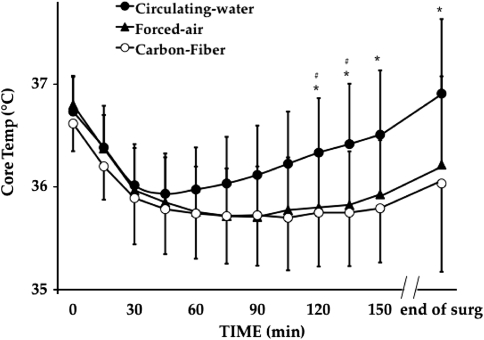
Results: In the 2 h after anesthesia induction, core temperature decreased 1.0 ± 0.5°C in the forced-air group, 0.9 ± 0.2°C in the carbon-fiber group, and 0.4 ± 0.4°C in the circulating-water leg wraps and mattress group (P < 0.05 vs. forced-air and carbon-fiber heating). At the end of surgery, core temperature was 0.2 ± 0.7°C above preoperative values in the circulating-water group but remained 0.6 ± 0.9°C less in the forced-air and 0.6 ± 0.4°C less in the carbon-fiber groups (P < 0.05 vs. carbon fiber).
Conclusions: The combination of circulating-water leg wraps and a mattress better maintain intraoperative core temperature than did forced-air and carbon-fiber warming systems.
Figures
References
-
- Frank SM, Beattie C, Christopherson R, Norris EJ, Perler BA, Williams GM, Gottlieb SO. Unintentional hypothermia is associated with postoperative myocardial ischemia. The Perioperative Ischemia Randomized Anesthesia Trial Study Group. Anesthesiology. 1993;78:468–476. doi: 10.1097/00000542-199303000-00010. - DOI - PubMed
Publication types
MeSH terms
Substances
LinkOut - more resources
Full Text Sources
