


Nonsurgical transurethral radiofrequency collagen denaturation: results at three years after treatment
- PMID: 22190917
- PMCID: PMC3235427
- DOI: 10.1155/2011/872057
Nonsurgical transurethral radiofrequency collagen denaturation: results at three years after treatment
Abstract
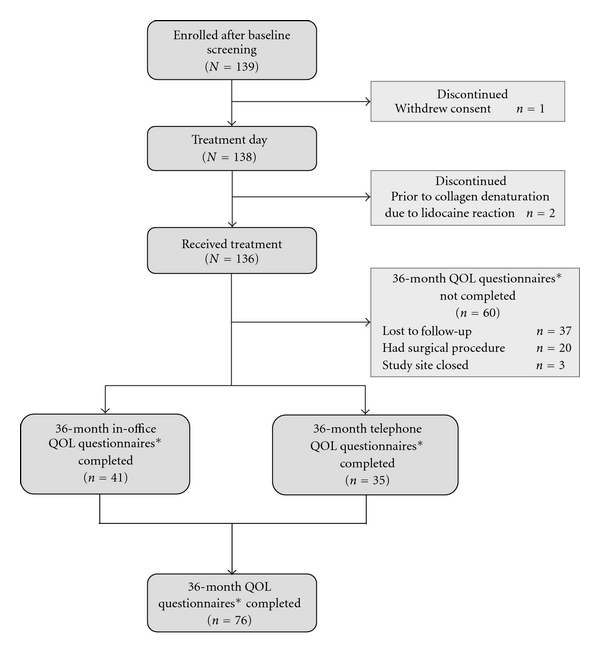
Objective. To assess treatment efficacy and quality of life in women with stress urinary incontinence 3 years after treatment with nonsurgical transurethral radiofrequency collagen denaturation. Methods. This prospective study included 139 women with stress urinary incontinence due to bladder outlet hypermobility. Radiofrequency collagen denaturation was performed using local anesthesia in an office setting. Assessments included incontinence quality of life (I-QOL) and urogenital distress inventory (UDI-6) instruments. Results. In total, 139 women were enrolled and 136 women were treated (mean age, 47 years). At 36 months, intent-to-treat analysis (n = 139) revealed significant improvements in quality of life. Mean I-QOL score improved 17 points from baseline (P = .0004), while mean UDI-6 score improved (decreased) 19 points (P = .0005). Conclusions. Transurethral collagen denaturation is a low-risk, office-based procedure that results in durable quality-of-life improvements in a significant proportion of women for as long as 3 years.
Figures
References
-
- Abrams P, Cardozo L, Fall M, et al. The standardisation of terminology of lower urinary tract function: report from the standardisation sub-committee of the international continence society. Neurourology and Urodynamics. 2002;21(2):167–178. - PubMed
-
- Blaivas JG, Appell RA, Fantl JA, et al. Definition and classification of urinary incontinence: recommendations of the Urodynamic Society. Neurourology and Urodynamics. 1997;16(3):149–151. - PubMed
-
- Bren L. Controlling urinary incontinence. FDA Consumer. 2005;39(5):10–15. http://want2care.com/free_information.html. - PubMed
-
- Shaw C, Das GR, Williams KS, Assassa RP, McGrother C. A survey of help-seeking and treatment provision in women with stress urinary incontinence. British Journal of Urology International. 2006;97(4):752–757. - PubMed
LinkOut - more resources
Full Text Sources
