Review
. 2011:2011:732413.
doi: 10.1155/2011/732413. Epub 2011 Dec 10.

Challenges in immunotherapy presented by the glioblastoma multiforme microenvironment

Affiliations
Review

Challenges in immunotherapy presented by the glioblastoma multiforme microenvironment

Christopher Jackson et al. Clin Dev Immunol. 2011.

Abstract

Glioblastoma multiforme (GBM) is the most common and aggressive primary brain tumor in adults. Despite intensive treatment, the prognosis for patients with GBM remains grim with a median survival of only 14.6 months. Immunotherapy has emerged as a promising approach for treating many cancers and affords the advantages of cellular-level specificity and the potential to generate durable immune surveillance. The complexity of the tumor microenvironment poses a significant challenge to the development of immunotherapy for GBM, as multiple signaling pathways, cytokines, and cell types are intricately coordinated to generate an immunosuppressive milieu. The development of new immunotherapy approaches frequently uncovers new mechanisms of tumor-mediated immunosuppression. In this review, we discuss many of the current approaches to immunotherapy and focus on the challenges presented by the tumor microenvironment.


Figures
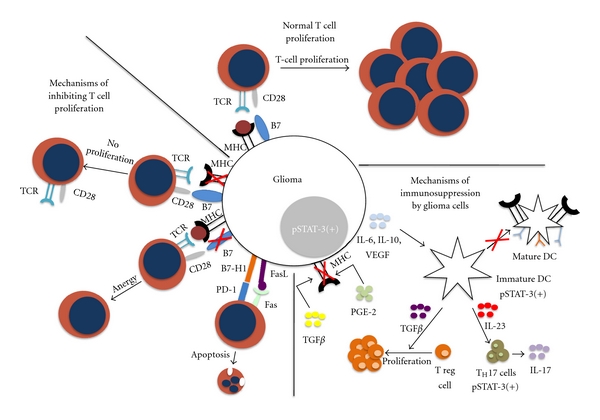
Figure 1
Figure 1
Normal T cell proliferation and mechanisms of glioma cell immunoresistance. (From top moving clockwise) Normal T cell proliferation: tumor cell antigens are presented by MHC and costimulatory molecules. Mechanisms of immunosuppression: glioma cells secrete factors leading to an immunosuppressive tumor microenvironment. TGFB and PGE-2 downregulate the expression of MHC, restricting antigen presentation and T cell proliferation. IL-6. IL-10 and VEGF are potent STAT-3 activators, leading to the proliferation of immature DCs that are not able to function as APCs. These immature DCs also secrete TGFB which aid in the proliferation of immunosuppressive Treg cells and STAT-3 positive TH17 cells. Mechanisms of inhibiting T cell proliferation: glioma cells downregulate MHC on their surface leading to the decreased antigen presentation and decreased T cell proliferation. Downregulation of B7 works via a similar mechanism in that the costimulatory signal is lost preventing T cell proliferation. Increased expression of B7-H1 and FasL act as proapoptotic signals for T cells.
Figure 2
Figure 2
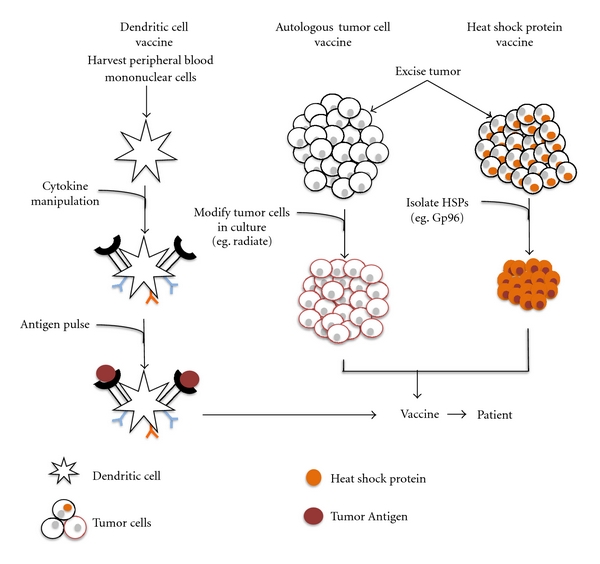
Vaccine Strategies for GBM. (From Left) Dendritic cell vaccine: peripheral blood mononuclear cells are isolated from the patient and cultured ex vivo. Cytokines are added to culture to activate the DCs. The matured DCs are pulsed with tumor antigen and then added to the vaccine preparation. Autologous tumor cell vaccine: after tumor removal, tumor cells are cultured. In some cases, these cells are modified (e.g., radiation, chemical) and then injected back into the patient. Heat shock protein vaccine: after tumor removal, tumor cells are cultured and specific heat shock proteins (e.g., Gp96) are isolated and purified. The proteins are then added to the vaccine preparation and injected into the patient.

References

    1. Stupp R, Mason WP, Van Den Bent MJ, et al. Radiotherapy plus concomitant and adjuvant temozolomide for glioblastoma. The New England Journal of Medicine. 2005;352(10):987–996. - PubMed
    1. Charles NA, Holland EC, Gilbertson R, Glass R, Kettenmann H. The brain tumor microenvironment. Glia. 2011;59(8):1169–1180. - PubMed
    1. Phillips HS, Kharbanda S, Chen R, et al. Molecular subclasses of high-grade glioma predict prognosis, delineate a pattern of disease progression, and resemble stages in neurogenesis. Cancer Cell. 2006;9(3):157–173. - PubMed
    1. Gulley JL, Drake CG. Immunotherapy for prostate cancer: recent advances, lessons learned, and areas for further research. Clinical Cancer Research. 2011;17(12):3884–3891. - PMC - PubMed
    1. Cameron F, Whiteside G, Perry C. Ipilimumab: first global approval. Drugs. 2011;71(8):1093–1104. - PubMed

LinkOut - more resources