


Health status of children alive 10 years after pediatric liver transplantation performed in the US and Canada: report of the studies of pediatric liver transplantation experience
- PMID: 22192813
- PMCID: PMC4144332
- DOI: 10.1016/j.jpeds.2011.10.038
Health status of children alive 10 years after pediatric liver transplantation performed in the US and Canada: report of the studies of pediatric liver transplantation experience
Abstract
Objectives: To determine clinical and health-related quality of life outcomes, and to derive an "ideal" composite profile of children alive 10 years after pediatric liver transplantation (LT) performed in the US and Canada.
Study design: This was a multicenter cross-sectional analysis characterizing patients enrolled in the Studies of Pediatric Liver Transplantation database registry who have survived >10 years from LT.
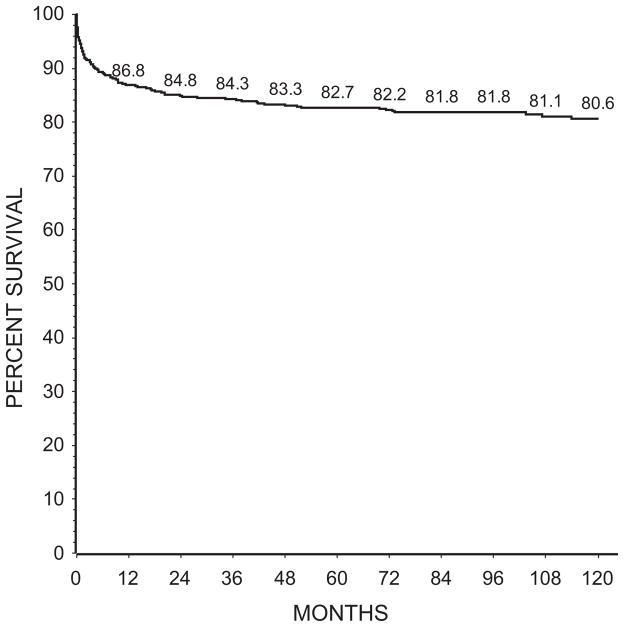
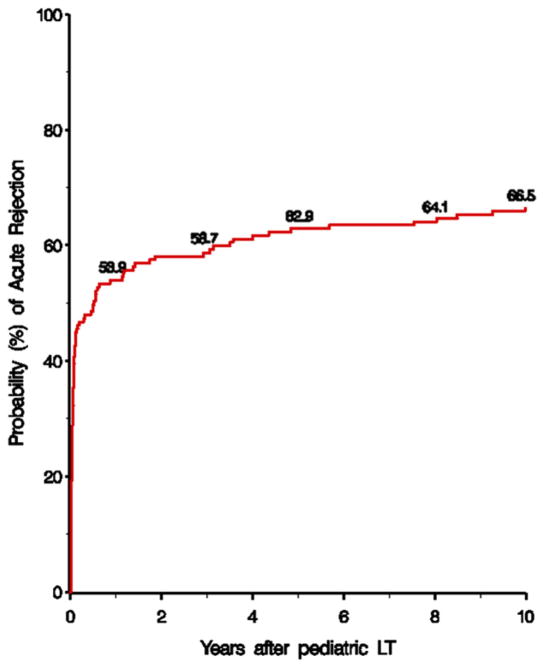
Results: A total of 167 10-year survivors were identified, all of whom received daily immunosuppression therapy. Comorbidities associated with the post-LT course included post-transplantation lymphoproliferative disease (in 5% of patients), renal dysfunction (9%), and impaired linear growth (23%). Health-related quality of life, as assessed by the PedsQL 4.0 Generic Core Scales, revealed lower patient self-reported total scale scores for 10-year survivors compared with matched healthy children (77.2±12.9 vs 84.9±11.7; P<.001). At 10 years post-LT, only 32% of patients achieved an ideal profile of a first allograft stable on immunosuppression monotherapy, normal growth, and absence of common immunosuppression-induced sequelae.
Conclusion: Success after pediatric LT has moved beyond patient survival. Availability of an ideal composite profile at follow-up provides opportunities for patients, families, and healthcare providers to identify broader sets of outcomes at earlier stages, ultimately contributing to improved outcomes after pediatric LT.
Copyright © 2012 Mosby, Inc. All rights reserved.
Conflict of interest statement
The authors declare no conflicts of interest.
Figures
References
-
- Thuluvath PJ, Guidinger MK, Fung JJ, Johnson LB, Rayhill SC, Pelletier SJ. Liver transplantation in the United States, 1999–2008. Am J Transplant. 2010;10:1003–19. - PubMed
-
- Kamath BM, Olthoff KM. Liver transplantation in children: update 2010. Pediatr Clin North Am. 2010;57:401–14. - PubMed
-
- Ng VL, Fecteau A, Shepherd R, Magee J, Bucuvalas J, Alonso E, et al. Outcomes of 5-year survivors of pediatric liver transplantation: report on 461 children from a North American multicenter registry. Pediatrics. 2008;122:1128–35. - PubMed
-
- Duffy JPK, Kao K, Ko CY, Farmer DG, McDiarmid SV, Hong JC, et al. Long-term patient outcome and quality of life after liver transplantation: analysis of 20-year survivors. Ann Surg. 2010;252:652–61. - PubMed
Publication types
MeSH terms
Grants and funding
LinkOut - more resources
Full Text Sources
Other Literature Sources
Medical
