Review
. 2012 Mar;92(2):121-32.
doi: 10.1016/j.tube.2011.11.005. Epub 2011 Dec 21.

The ins and outs of Mycobacterium tuberculosis protein export

Affiliations
Review

The ins and outs of Mycobacterium tuberculosis protein export

Lauren S Ligon et al. Tuberculosis (Edinb). 2012 Mar.

Abstract

Mycobacterium tuberculosis is an important pathogen that infects approximately one-third of the world's population and kills almost two million people annually. An important aspect of M. tuberculosis physiology and pathogenesis is its ability to export proteins into and across the thick mycobacterial cell envelope, where they are ideally positioned to interact with the host. In addition to the specific proteins that are exported by M. tuberculosis, the systems through which these proteins are exported represent potential targets for future drug development. M. tuberculosis possesses two well-known and conserved export systems: the housekeeping Sec pathway and the Tat pathway. In addition, M. tuberculosis possesses specialized export systems including the accessory SecA2 pathway and five ESX pathways. Here we review the current understanding of each of these export systems, with a focus on M. tuberculosis, and discuss the contribution of each system to disease and physiology.


Figures

Figure 1
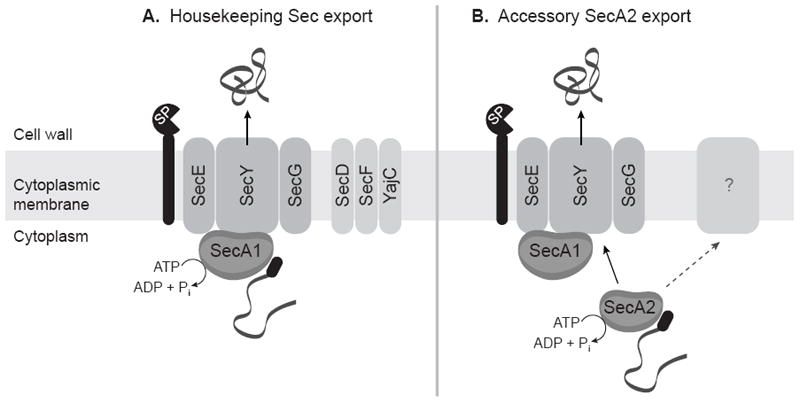
Figure 1. A model of the housekeeping Sec and accessory SecA2 export systems
(A) Preproteins with N-terminal signal peptides (black oval) are recognized by SecA1, which interacts with the SecYEG channel complex to form the translocase. SecA1 performs repeated cycles of ATP hydrolysis, pushing the unfolded preprotein through the SecYEG channel. SecD, SecF, and YajC increase efficiency of protein export. Signal peptides are removed by a LepB or LspA signal peptidase (SP), and mature proteins fold into their final conformations. (B) SecA2 recognizes a small subset of proteins and uses its ATPase activity to assist in their export. In the most likely scenario, SecA2 works with components of the housekeeping Sec export system and exports proteins across the cytoplasmic membrane through the SecYEG channel complex. However, it remains possible that other unknown components are required in addition to or in lieu of the housekeeping Sec components. The role of SecA2 in the export of proteins lacking signal peptides (not shown) is currently not understood.
Figure 2
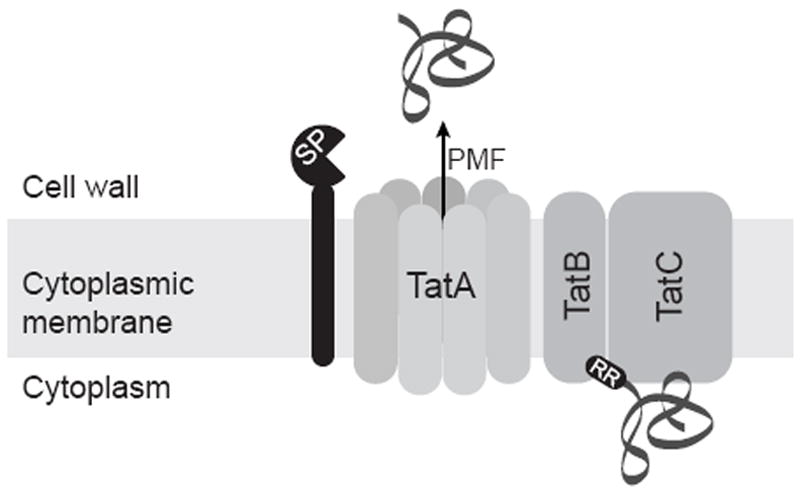
Figure 2. A model of the Tat export system
Tat preproteins contain an N-terminal signal peptide (black oval) with a twin arginine (RR) motif and fold in the cytoplasm prior to export. Tat-dependent preproteins then bind to the TatBC complex in the cytoplasmic membrane. Next, oligomers of TatA are recruited, likely forming the channel complex. In the presence of the proton motive force (PMF), preproteins are exported across the cytoplasmic membrane. Signal peptides are removed by a LepB or LspA signal peptidase (SP).
Figure 3
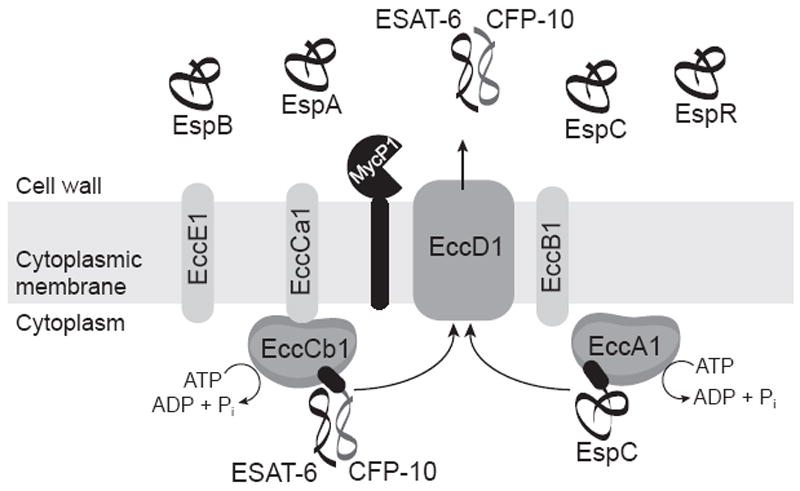
Figure 3. A model of the core components of the ESX-1 export system
ESX-1 exported proteins CFP-10 and EspC have a targeting element at their C-terminus (black ovals) that directs them to interact with cytosolic AAA ATPases EccCb1 and EccA1, respectively. Through interactions with cytoplasmic membrane proteins, these AAA ATPases are proposed to deliver proteins to an ESX-1 export channel. EccD1 is a leading candidate for being a component of this channel. ESAT-6 lacks a C-terminal targeting element and must form a complex with CFP-10 in order to be exported. The functions of EccE1, EccCa1, and EccB1 are unknown, but all are predicted cytoplasmic membrane proteins and core components of the ESX-1 pathway. MycP1 is a membrane protein with protease activity. Other proteins reported to be exported by the ESX-1 system and pictured here are EspA, EspB, and EspR.

References

    1. WHO/HTM/TB2010.7 Pn. WHO Report 2010: Global Tuberculosis Control. Geneva, Switzerland: WHO Press; 2010.
    1. Feltcher ME, Sullivan JT, Braunstein M. Protein export systems of Mycobacterium tuberculosis: novel targets for drug development? Future Microbiol. 2010;5:1581–1597. doi: 10.2217/fmb.10.112. - DOI - PMC - PubMed
    1. Moir DT, Di M, Wong E, Moore RA, Schweizer HP, Woods DE, Bowlin TL. Development and application of a cellular, gain-of-signal, bioluminescent reporter screen for inhibitors of type II secretion in Pseudomonas aeruginosa and Burkholderia pseudomallei. J Biomol Screen. 2011;16:694–705. doi: 10.1177/1087057111408605. - DOI - PMC - PubMed
    1. Swietnicki W, Carmany D, Retford M, Guelta M, Dorsey R, Bozue J, Lee MS, Olson MA. Identification of small-molecule inhibitors of Yersinia pestis Type III secretion system YscN ATPase. PLoS One. 2011;6:e19716. doi: 10.1371/journal.pone.0019716. - DOI - PMC - PubMed
    1. Paschos A, den Hartigh A, Smith MA, Atluri VL, Sivanesan D, Tsolis RM, Baron C. An in vivo high-throughput screening approach targeting the type IV secretion system component VirB8 identified inhibitors of Brucella abortus 2308 proliferation. Infect Immun. 2011;79:1033–1043. doi: 10.1128/IAI.00993-10. - DOI - PMC - PubMed

Publication types

MeSH terms

Substances

LinkOut - more resources