. 2012 Apr;200(4):308-16.
doi: 10.1192/bjp.bp.111.096321. Epub 2011 Dec 22.

Sleep and circadian rhythm disruption in schizophrenia

Affiliations

Sleep and circadian rhythm disruption in schizophrenia

Katharina Wulff et al. Br J Psychiatry. 2012 Apr.

Abstract

Background: Sleep disturbances comparable with insomnia occur in up to 80% of people with schizophrenia, but very little is known about the contribution of circadian coordination to these prevalent disruptions.

Aims: A systematic exploration of circadian time patterns in individuals with schizophrenia with recurrent sleep disruption.

Method: We examined the relationship between sleep-wake activity, recorded actigraphically over 6 weeks, along with ambient light exposure and simultaneous circadian clock timing, by collecting weekly 48 h profiles of a urinary metabolite of melatonin in 20 out-patients with schizophrenia and 21 healthy control individuals matched for age, gender and being unemployed.

Results: Significant sleep/circadian disruption occurred in all the participants with schizophrenia. Half these individuals showed severe circadian misalignment ranging from phase-advance/delay to non-24 h periods in sleep-wake and melatonin cycles, and the other half showed patterns from excessive sleep to highly irregular and fragmented sleep epochs but with normally timed melatonin production.

Conclusions: Severe circadian sleep/wake disruptions exist despite stability in mood, mental state and newer antipsychotic treatment. They cannot be explained by the individuals' level of everyday function.


Conflict of interest statement

Declaration of interest

None.

Figures

Fig. 1
Fig. 1
Variability in sleep timing of schizophrenia group (n = 20) and unemployed, control group (n = 21) for three parameters: sleep onset, sleep offset and sleep mid-point. Each dot represents a person's average standard deviation (in minutes) derived from 6 weeks of wrist actigraphy. The horizontal bars indicate the median. Those in the schizophrenia group show significantly higher variability than those in the control group, most remarkably in sleep offset.
Fig. 2
Fig. 2
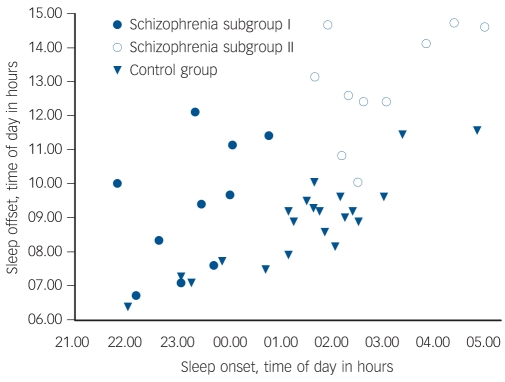
Distribution of sleep timing with sleep onset plotted relative to sleep offset in schizophrenia and control group. Each dot represents a person's average sleep onset/offset time derived from 6 weeks of wrist actigraphy. Schizophrenia subgroup I: sleep onset before 01.00 h, n = 10; schizophrenia subgroup II: sleep onset after 01.00 h, n = 10; control group n = 21.
Fig. 3
Fig. 3
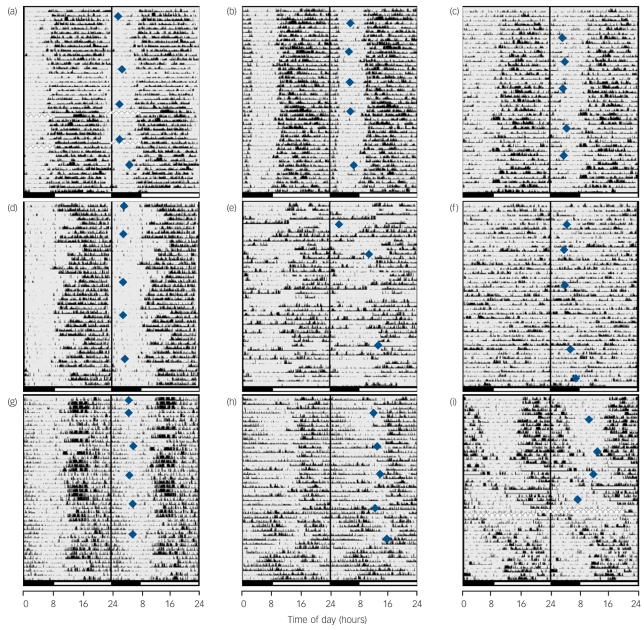
Representative examples of phenotypic variability in rest–activity patterns derived from 6 weeks' wrist activity monitoring and concurrent weekly melatonin profiling carried out in the participants' home environment. Actograms from individuals in the control group (a-c) show clear entrainment to the day/night cycle with relatively low night-time activity disrupting sleep. Actograms of those in the schizophrenia group without phase shifts (subgroup I) span from (d) robustly entrained with variable sleep periods to (e) disrupted, and (f) highly irregular rest-activity cycles accounting for major complaints about problems with sleep. Actograms of those in the schizophrenia group with circadian misalignment (subgroup II) show (g) highly delayed rest-activity periods with bed times around 04.00 h in the morning and get-up times in the afternoon, (h) reversed rest-activity cycles alternating with free-running periods or (i) delayed rest-activity periods alternating with free-running periods patterns that were never present in the control group. Blue diamonds indicate peaks in melatonin sulphate rhythms, which is a marker for the phase of the circadian clock. All controls and the majority of people in schizophrenia subgroup I had melatonin peak times within the normal range of entrainment whereas individuals in subgroup II had severely delayed or free-running peak times. Actigraphic data are 48 h double-plotted with successive days on vertical axis. Black bars on the bottom indicate night-time, open bars indicate daytime and the midline indicates midnight between day 1 and 2. Edited data are highlighted with ‘___’, and times when watch was removed and information missing are filled with ‘xxxxxxx’.
Fig. 4
Fig. 4
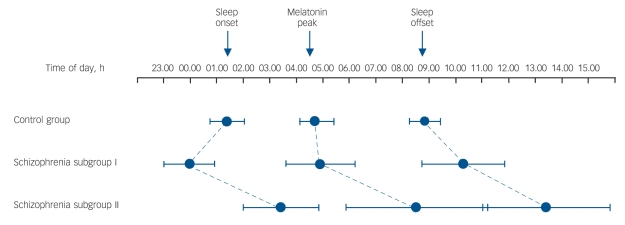
Phase relationships between habitual sleep-wake and internal circadian time (derived from melatonin sulphate) and external time of day. The control group had a somewhat late sleep onset but normal circadian entrainment and sleep offset. Schizophrenia subgroup I show an extended sleep period with normal circadian melatonin entrainment. Schizophrenia subgroup II show a marked delay in sleep-wake cycles and melatonin peak relative to time of day, indicating abnormal circadian entrainment in a subset of the schizophrenia group with sleep complaints. Whiskers indicate 95% confidence intervals of the mean.

Comment in

References

    1. Wulff K, Gatti S, Wettstein JG, Foster RG. Sleep and circadian rhythm disruption in psychiatric and neurodegenerative disease. Nat Rev Neurosci 2010; 11: 589-99 - PubMed
    1. Tandon R, Shipley JE, Taylor S, Greden JF, Eiser A, DeQuardo J, et al. Electroencephalographic sleep abnormalities in schizophrenia. Relationship to positive/negative symptoms and prior neuroleptic treatment. Arch Gen Psychiatry 1992; 49: 185-94 - PubMed
    1. Lauer CJ, Schreiber W, Pollmacher T, Holsboer F, Krieg JC. Sleep in schizophrenia: a polysomnographic study on drug-naive patients. Neuropsychopharmacology 1997; 16: 51-60 - PubMed
    1. Nofzinger EA, van Kammen DP, Gilbertson MW, Gurklis JA, Peters JL. Electroencephalographic sleep in clinically stable schizophrenic patients: two-weeks versus six-weeks neuroleptic-free. Biol Psychiatry 1993; 33: 829-35 - PubMed
    1. Chouinard S, Poulin J, Stip E, Godbout R. Sleep in untreated patients with schizophrenia: a meta-analysis. Schizophr Bull 2004; 30: 957-67 - PubMed

Publication types