. 2011:2011:378034.
doi: 10.1155/2011/378034. Epub 2011 Dec 13.

Effect of age and diabetes on the response of mesenchymal progenitor cells to fibrin matrices

Affiliations

Effect of age and diabetes on the response of mesenchymal progenitor cells to fibrin matrices

A Stolzing et al. Int J Biomater. 2011.

Abstract

Mesenchymal stem cells are showing increasing promise in applications such as tissue engineering and cell therapy. MSC are low in number in bone marrow, and therefore in vitro expansion is often necessary. In vivo, stem cells often reside within a niche acting to protect the cells. These niches are composed of niche cells, stem cells, and extracellular matrix. When blood vessels are damaged, a fibrin clot forms as part of the wound healing response. The clot constitutes a form of stem cell niche as it appears to maintain the stem cell phenotype while supporting MSC proliferation and differentiation during healing. This is particularly appropriate as fibrin is increasingly being suggested as a scaffold meaning that fibrin-based tissue engineering may to some extent recapitulate wound healing. Here, we describe how fibrin modulates the clonogenic capacity of MSC derived from young/old human donors and normal/diabetic rats. Fibrin was prepared using different concentrations to modulate the stiffness of the substrate. MSC were expanded on these scaffolds and analysed. MSC showed an increased self-renewal on soft surfaces. Old and diabetic cells lost the ability to react to these signals and can no longer adapt to the changed environment.


Figures

Figure 1
Figure 1
MSC validation. MSC isolated from humans and rats were immunophenotyped using typical MSC marker (Figures 1(a) and 1(b)), and the stem cell potential was confirmed by differentiating them into adipocytes and osteoblasts (Figures 1(c) and 1(d)).
Figure 2
Figure 2
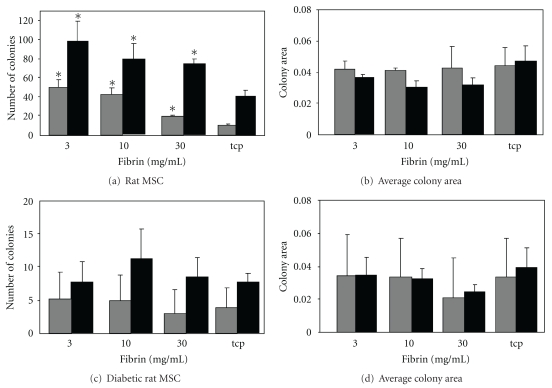
Effects of fibrin surfaces on healthy and diabetic rat MSC. MSC isolated from young and diabetic rats were grown on fibrin gels for 7 days, and then 1000 cells were seeded into the CFU assays under osteogenic conditions. ALP-positive (grey) and total colony numbers (black) were calculated for normal rat MSC (a) as well as the mean size of the colonies (b). CFU numbers for MSC from were also calculated (c) as well as the mean colony size (d). *Denotes a statistically significant difference from the other groups.
Figure 3
Figure 3
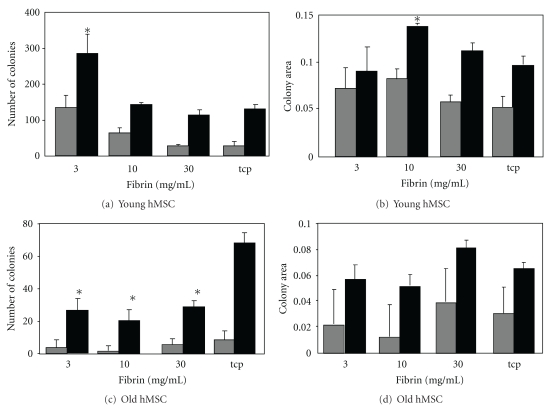
Effects of fibrin surfaces on young and old human MSC. Isolated MSC from young donors and aged donors were grown on fibrin gels for 7 days, and then 1000 cells were seeded into the CFU assays under osteogenic conditions. The number of ALP-positive colonies (grey) and total colony numbers (black) were calculated for young (a) and aged (c) MSC. Mean sizes of colonies were calculated for young (b) and aged (d) donor MSC. *Denotes a statistically significant difference from the other groups.
Figure 4
Figure 4
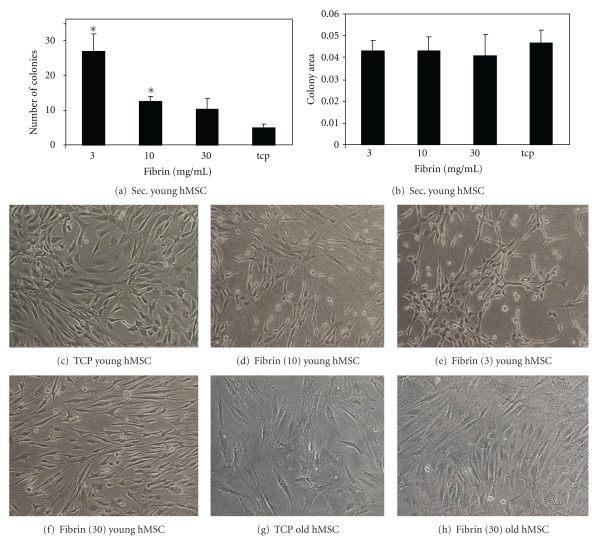
MSC morphology and self-renewal. MSC from an 18-year-old healthy donor were cultured on 10 mg/mL fibrin for 7 days before re-seeding them onto different concentrations of fibrin or TCP. We call these secondary colonies. The different surfaces were again tissue culture plastic, 3 mg/mL fibrin gel, 10 mg/mL, and 30 mg/mL (d). MSC from a 55-year-old donor are cultured on TCP and 30 mg/mL fibrin gel. Colony numbers (a) as well as size (b) are shown and the different morphologies (c–h) are shown. *Denotes a statistically significant difference from the other groups.
Figure 5
Figure 5
Tangent modulus of a range of fibrin gel produced with varying fibrinogen concentrations. Fibrin gels were made by mixing fibrinogen (3, 10, and 30 mg/mL) with thrombin (1 μl/mL). Tensile testing of the gels was performed using a Bose ElectroForce 3200 (a–c). The tangent moduli were calculated from the slope of the plot of stress versus strain at 20% strain (n = 6) (d).

References

    1. Prockop DJ, Gregory CA, Spees JL. One strategy for cell and gene therapy: harnessing the power of adult stem cells to repair tissues. Proceedings of the National Academy of Sciences of the United States of America. 2003;100(supplement 1):11917–11923. - PMC - PubMed
    1. Rao MS, Mattson MP. Stem cells and aging: expanding the possibilities. Mechanisms of Ageing and Development. 2001;122(7):713–734. - PubMed
    1. Pittenger MF, Mackay AM, Beck SC, et al. Multilineage potential of adult human mesenchymal stem cells. Science. 1999;284(5411):143–147. - PubMed
    1. Deans RJ, Moseley AB. Mesenchymal stem cells: biology and potential clinical uses. Experimental Hematology. 2000;28(8):875–884. - PubMed
    1. Stenderup K, Justesen J, Clausen C, Kassem M. Aging is associated with decreased maximal life span and accelerated senescence of bone marrow stromal cells. Bone. 2003;33(6):919–926. - PubMed