. 2011;6(12):e28654.
doi: 10.1371/journal.pone.0028654. Epub 2011 Dec 14.

Changes in human fecal microbiota due to chemotherapy analyzed by TaqMan-PCR, 454 sequencing and PCR-DGGE fingerprinting

Affiliations

Changes in human fecal microbiota due to chemotherapy analyzed by TaqMan-PCR, 454 sequencing and PCR-DGGE fingerprinting

Jutta Zwielehner et al. PLoS One. 2011.

Abstract

Background: We investigated whether chemotherapy with the presence or absence of antibiotics against different kinds of cancer changed the gastrointestinal microbiota.

Methodology/principal findings: Feces of 17 ambulant patients receiving chemotherapy with or without concomitant antibiotics were analyzed before and after the chemotherapy cycle at four time points in comparison to 17 gender-, age- and lifestyle-matched healthy controls. We targeted 16S rRNA genes of all bacteria, Bacteroides, bifidobacteria, Clostridium cluster IV and XIVa as well as C. difficile with TaqMan qPCR, denaturing gradient gel electrophoresis (DGGE) fingerprinting and high-throughput sequencing. After a significant drop in the abundance of microbiota (p = 0.037) following a single treatment the microbiota recovered within a few days. The chemotherapeutical treatment marginally affected the Bacteroides while the Clostridium cluster IV and XIVa were significantly more sensitive to chemotherapy and antibiotic treatment. DGGE fingerprinting showed decreased diversity of Clostridium cluster IV and XIVa in response to chemotherapy with cluster IV diversity being particularly affected by antibiotics. The occurrence of C. difficile in three out of seventeen subjects was accompanied by a decrease in the genera Bifidobacterium, Lactobacillus, Veillonella and Faecalibacterium prausnitzii. Enterococcus faecium increased following chemotherapy.

Conclusions/significance: Despite high individual variations, these results suggest that the observed changes in the human gut microbiota may favor colonization with C. difficile and Enterococcus faecium. Perturbed microbiota may be a target for specific mitigation with safe pre- and probiotics.


Conflict of interest statement

Competing Interests: The authors have declared that no competing interests exist.

Figures

Figure 1
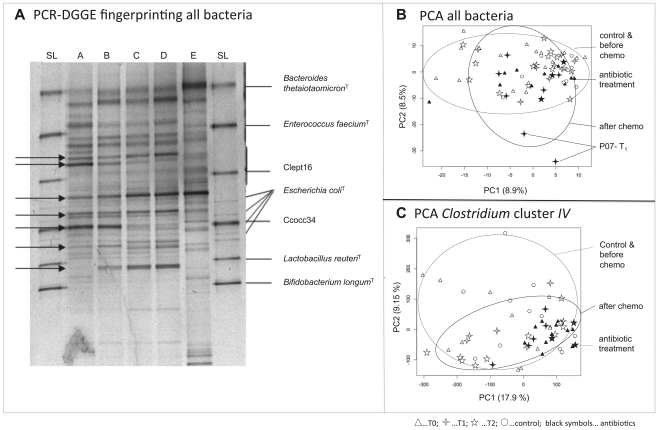
Figure 1. A PCR-DGGE fingerprinting of 16S rRNA coding regions of dominant bacteria over time.
Bands that become stronger or nearly disappear following a single chemotherapeutic treatment are indicated with arrows. B Principal components analysis (PCA) based on dominant bacteria PCR-DGGE fingerprinting. The two outliers in the lower right corner of the plot are two samples of P07 following blood stem cell transplantation. C PCA illustrating the development of Clostridium cluster IV diversity in the course of chemotherapy and antibiotic treatment. Cluster IV diversity drops right after chemotherapy, causing a grouping of samples. Samples under antibiotic treatment (indicated as grey dots) group even closer, indicating a strong influence of antibiotics on Clostridium cluster IV diversity. A, sample of P01 before chemotherapy B, C and D, samples of P01 after chemotherapy; E, healthy control; SL, unrelated standard lane; black symbols… patients under chemotherapy and antibiotic treatment.
Figure 2
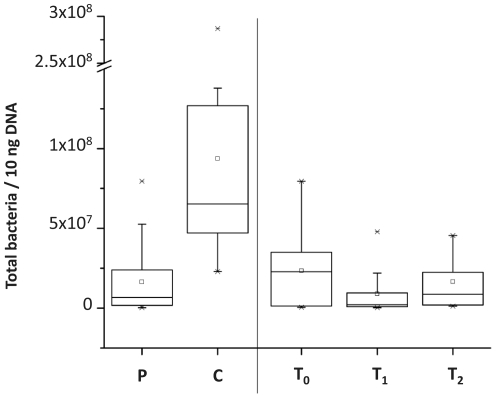
Figure 2. TaqMan qPCR quantification of bacterial 16S rRNA coding regions showing lower abundance in patients undergoing chemotherapy and antibiotic treatment (P) than healthy controls (C).
T0, samples taken before a single shot of chemotherapy; T1, 1–2 days after chemotherapy; T2, 5–9 days after chemotherapy; Asterisk indicates a significant difference at p<0.05.
Figure 3
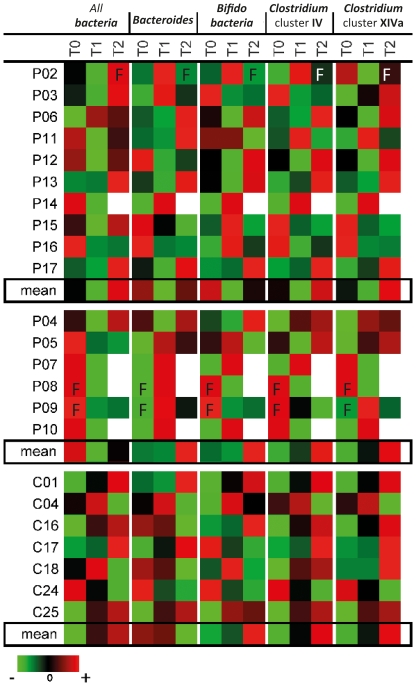
Figure 3. Abundances of bacterial 16S rRNA coding regions over time in oncology patients (P) and healthy controls (C).
The declined abundances of bacteria, Bacteroides, Clostridium cluster XIVa, Clostridium cluster IV and bifidobacteria immediately after chemotherapy (T1) were observed to recover several days after treatment (T2). Patients P04, P08 and P13 had never received chemotherapy before; P04, P05, P07, P08, P09 and P10 took antibiotics. Values were z-scored for presentation in this heatmap showing changes over time rather than absolute abundances. T0, before chemotherapy; T1, 1–2 days after chemotherapy; T2, 5–9 days after chemotherapy; F, fever; S, blood stem cell transplantation.
Figure 4
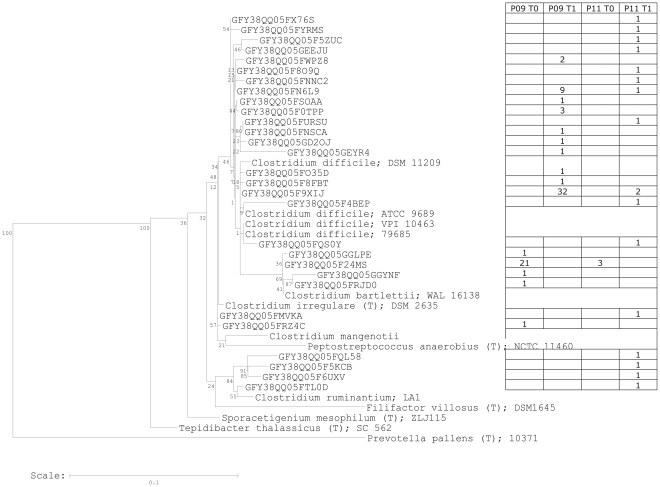
Figure 4. Phylogenetic tree showing the Peptostreptococcaceae found in samples from two oncology patients before and after chemotherapy.
Identical sequences were grouped; the table on the right hand side shows their abundances in the 454 sequencing dataset. Sequences with >98.9% similarity to Clostridium difficile appeared only in samples taken immediately after chemotherapeutic cycles. Numbers indicate bootstrap values after 100 resamplings.
Figure 5
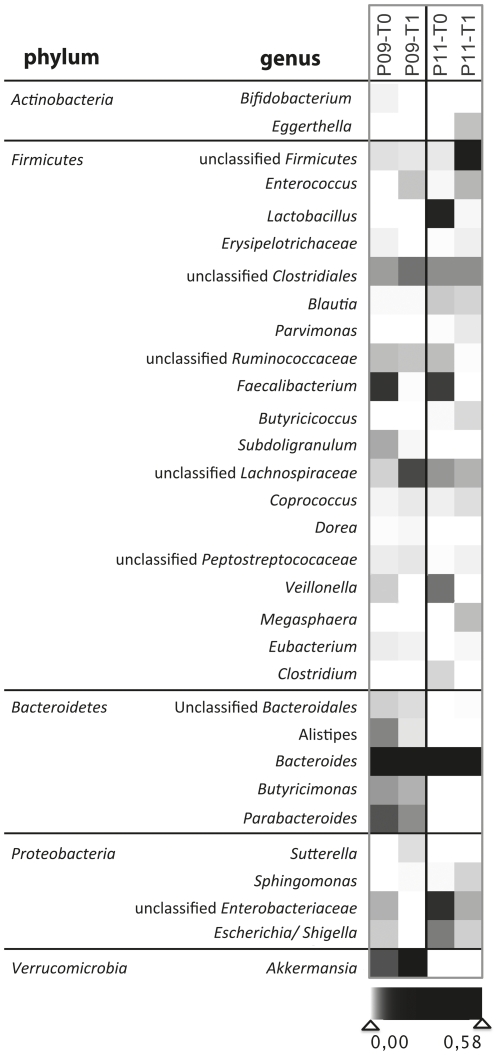
Figure 5. Heatmap showing abundances within the 454 sequencing dataset on the genus level.
High throughput sequencing of samples P09 and P11 before (T0) and after therapy (T1) further helped to characterize the influence of a single chemotherapeutic cycle on the GI-microbiota. P11 was treated with chemotherapy alone and P09 also received antibiotic treatment.

References

    1. Turroni F, Ribbera A, Foroni E, van Sinderen D, Ventura M. Human gut microbiota and bifidobacteria: from composition to functionality. Antonie Van Leeuwenhoek. 2008;94:35–50. - PubMed
    1. Vrieze A, Holleman F, Zoetendal EG, de Vos WM, Hoekstra JB, et al. The environment within: how gut microbiota may influence metabolism and body composition. Diabetologia. 2010;53:606–613. - PMC - PubMed
    1. Chung H, Kasper DL. Microbiota-stimulated immune mechanisms to maintain gut homeostasis. Curr Opin Immunol. 2010;22:455–460. - PubMed
    1. Backhed F, Ley RE, Sonnenburg JL, Peterson DA, Gordon JI. Host-bacterial mutualism in the human intestine. Science. 2005;307:1915–1920. - PubMed
    1. Ley RE, Hamady M, Lozupone C, Turnbaugh PJ, Ramey RR, et al. Evolution of mammals and their gut microbes. Science. 2008;320:1647–1651. - PMC - PubMed

Publication types

MeSH terms