. 2011;6(12):e28973.
doi: 10.1371/journal.pone.0028973. Epub 2011 Dec 14.

Reversing melanoma cross-resistance to BRAF and MEK inhibitors by co-targeting the AKT/mTOR pathway

Affiliations

Reversing melanoma cross-resistance to BRAF and MEK inhibitors by co-targeting the AKT/mTOR pathway

Mohammad Atefi et al. PLoS One. 2011.

Abstract

Background: The sustained clinical activity of the BRAF inhibitor vemurafenib (PLX4032/RG7204) in patients with BRAF(V600) mutant melanoma is limited primarily by the development of acquired resistance leading to tumor progression. Clinical trials are in progress using MEK inhibitors following disease progression in patients receiving BRAF inhibitors. However, the PI3K/AKT pathway can also induce resistance to the inhibitors of MAPK pathway.

Methodology/principal findings: The sensitivity to vemurafenib or the MEK inhibitor AZD6244 was tested in sensitive and resistant human melanoma cell lines exploring differences in activation-associated phosphorylation levels of major signaling molecules, leading to the testing of co-inhibition of the AKT/mTOR pathway genetically and pharmacologically. There was a high degree of cross-resistance to vemurafenib and AZD6244, except in two vemurafenib-resistant cell lines that acquired a secondary mutation in NRAS. In other cell lines, acquired resistance to both drugs was associated with persistence or increase in activity of AKT pathway. siRNA-mediated gene silencing and combination therapy with an AKT inhibitor or rapamycin partially or completely reversed the resistance.

Conclusions/significance: Primary and acquired resistance to vemurafenib in these in vitro models results in frequent cross resistance to MEK inhibitors, except when the resistance is the result of a secondary NRAS mutation. Resistance to BRAF or MEK inhibitors is associated with the induction or persistence of activity within the AKT pathway in the presence of these drugs. This resistance can be potentially reversed by the combination of a RAF or MEK inhibitor with an AKT or mTOR inhibitor. These combinations should be available for clinical testing in patients progressing on BRAF inhibitors.


Conflict of interest statement

Competing Interests: The authors have read the journal's policy and have the following conflicts. Antoni Ribas has has served as a consultant and has received honoraria from Hoffman-La Roche and Plexxikon, the makers of vemurafenib. This does not alter the authors' adherence to all the PLoS ONE policies of the manuscript.

Figures

Figure 1
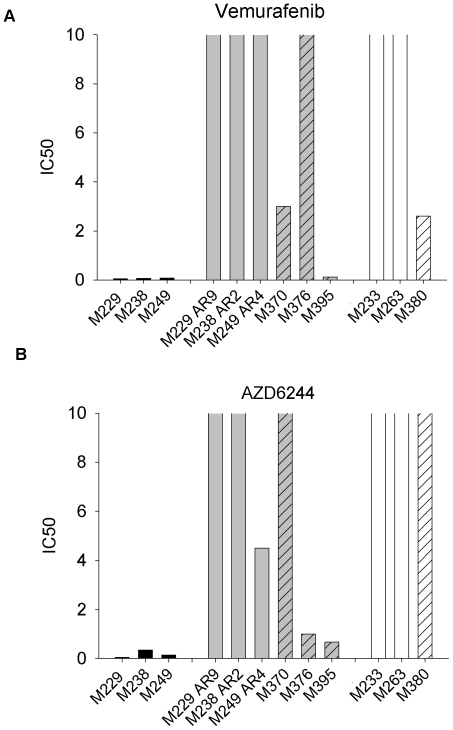
Figure 1. IC50 values of BRAFV600E mutated melanoma cells after exposure to vemurafenib (a) or AZD6244 (b).
The cells were treated for 120 hours (vemurafenib) or 72 hours (AZD6244). Cell viability was determined by MTS colorimetric assay. IC50 values (x-axis) are expressed in µM for vemurafenib or AZD6244. Black columns: Parental cell lines sensitive to vemurafenib. Gray columns: Sublines with in vitro acquired resistance to vemurafenib. Gray columns filled with coarse striped pattern: Cell lines derived from progressive lesions in patients treated with vemurafenib. White columns: vemurafenib primarily resistant cell lines. White column filled with coarse striped pattern: Cell line derived at baseline from a patient who did not respond clinically to vemurafenib.
Figure 2
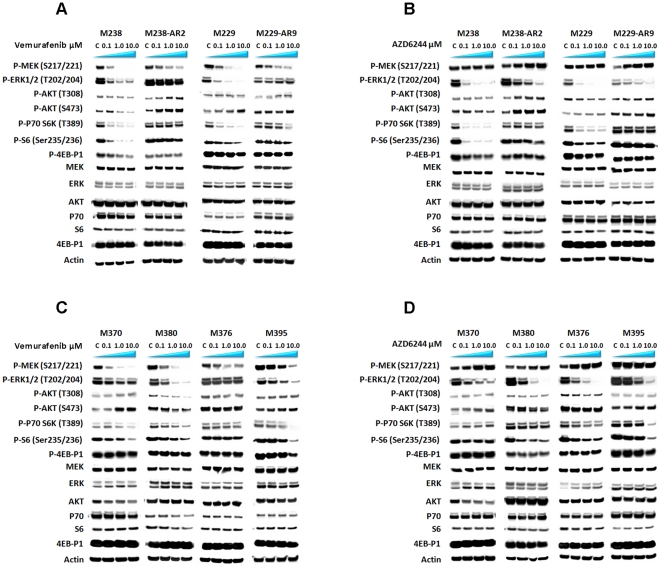
Figure 2. Effects of vemurafenib or AZD6244 on MAPK and PI3K/AKT pathways in BRAFV600E mutated cell lines.
Western blot analysis of phosphorylated and the total amount of key proteins in the MAPK and PI3K/AKT pathways after 24 hours of exposure to the solvent (DMSO), or various concentrations of the BRAF inhibitor vemurafenib or the MEK inhibitor AZD6244. The vemurafenib-sensitive M238 and M229 cell lines and the vemurafenib in vitro acquired resistant sublines M238-AR2 and M229-AR9 were cultured at different concentrations of vemurafenib (a) or AZD6244 (b). The vemurafenib-resistant cell lines derived from patient's tumor biopsies M370, M376, M395 and M380 were cultured in different concentrations of vemurafenib (c) or AZD6244 (d). p70 and p-p70 S6K in this figure are referred to S6K1 and phosphorylated form of S6K1, respectively.
Figure 3
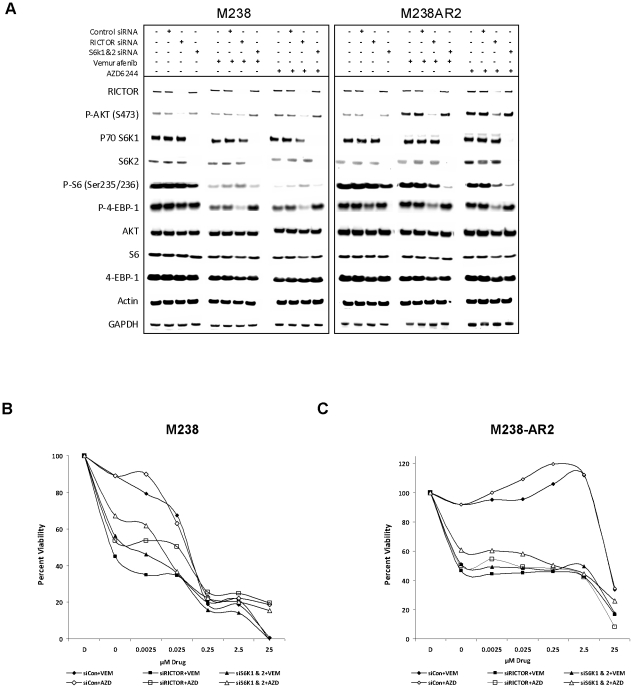
Figure 3. Effects of both S6K1 and S6K2 or RICTOR siRNA knockdown combined with vemurafenib or AZD6244.
The efficiency of siRNA knockdowns and their effects on downstream signaling determined by Western blot analysis of protein lysates or in the cases of S6K2 and GAPDH by RT-PCR of isolated mRNA (a). M238 parental (b) and M238-AR2 resistant subline (c) were transfected with siRNAs for either RICTOR or combined S6K1 & 2 or non target control siRNAs and cultured in increasing concentrations of vemurafenib or AZD6244. The effects of knockdowns on resistance and growth inhibition were analyzed after 120 hours by an MTS assay. D in each graph refers to the un-transfected untreated cells and is used as the 100% reference point for all the conditions in each graph.
Figure 4
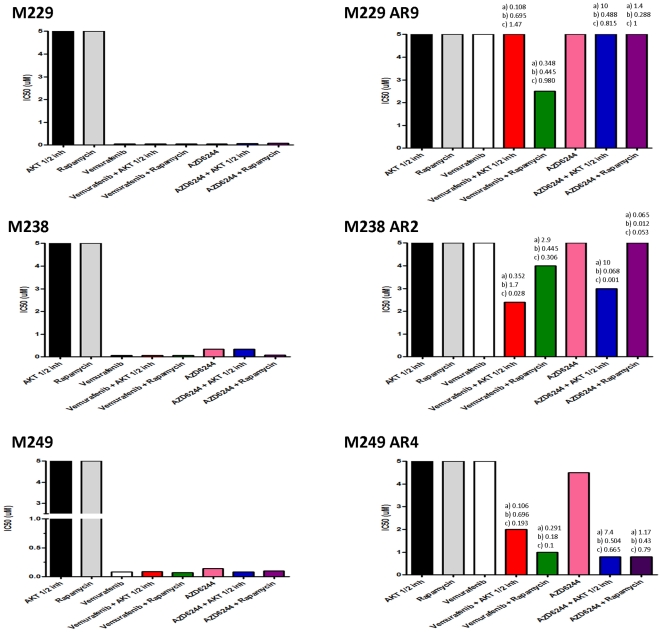
Figure 4. AKTi or rapamycin combined with vemurafenib or AZD6244 in vemurafenib-sensitive and -acquired resistant cell lines.
IC50 of the parental cell lines M229, M238 and M249, and the acquired resistance sublines M229-AR9, M238-AR2 and M249-AR4 determined in an MTS assay using single agent AKTi, rapamycin, vemurafenib or AZD6244, or in combinations. Vemurafinib or AZD6244 in combination with AKTi were tested at 1∶1 ratios at concentrations of 0.1, 1 or 5 µM, or with rapamycin at 0.1, 1 and 5 nM. For the combination studies the IC50 bar represents either vemurafenib or AZD6244 used in the combination. The combination indexes (CI) were calculated by the Chou-Talalal method and denoted over each column where a synergistic (CI<1) effect was noted. There are three CIs per condition reflective of the three different concentrations tested, 0.1; 1 and 5 for each drug at 1∶1 ratio (µM for PLX; AZD and AKTi; nM for rapamycin).
Figure 5
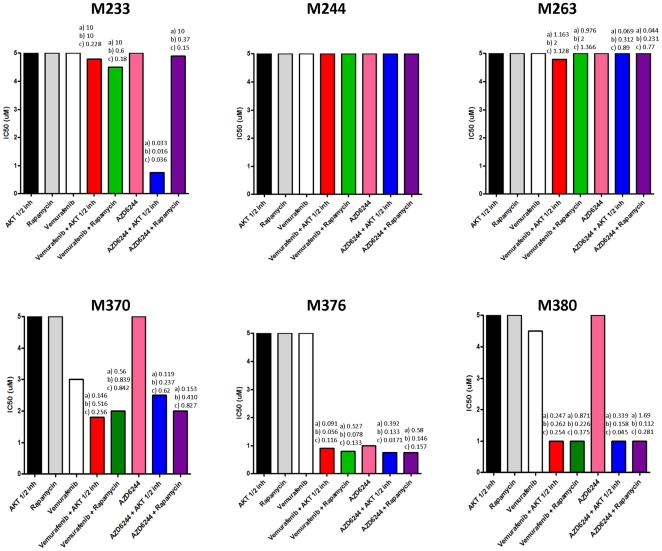
Figure 5. AKTi or rapamycin combined with vemurafenib or AZD6244 in patient-derived vemurafenib-primary/-acquired resistant cell lines.
IC50 of the primarily resistant cell lines M233, M244 and M263, and the patient-derived acquired resistance cell lines M370, M376 and the primarily resistant patient-derived cell line M380 determined by an MTS assay and analyzed for synergistic effects as described in Figure 4.

References

    1. Davies H, Bignell GR, Cox C, Stephens P, Edkins S, et al. Mutations of the BRAF gene in human cancer. Nature. 2002;417:949–954. - PubMed
    1. Gray-Schopfer V, Wellbrock C, Marais R. Melanoma biology and new targeted therapy. Nature. 2007;445:851–857. - PubMed
    1. Flaherty KT, Puzanov I, Kim KB, Ribas A, McArthur GA, et al. Inhibition of mutated, activated BRAF in metastatic melanoma. N Engl J Med. 2010;363:809–819. - PMC - PubMed
    1. Weinstein IB, Joe AK. Mechanisms of disease: Oncogene addiction–a rationale for molecular targeting in cancer therapy. Nat Clin Pract Oncol. 2006;3:448–457. - PubMed
    1. Kefford R, Arkenau H, Brown MP, Millward M, Infante JR, et al. Phase I/II study of GSK2118436, a selective inhibitor of oncogenic mutant BRAF kinase, in patients with metastatic melanoma and other solid tumors. Journal of Clinical Oncology. 2010;28:611s.

Publication types

MeSH terms