Case Reports
. 2012 Jan 13;90(1):69-75.
doi: 10.1016/j.ajhg.2011.11.013. Epub 2011 Dec 22.

Exome sequence identifies RIPK4 as the Bartsocas-Papas syndrome locus

Affiliations
Case Reports

Exome sequence identifies RIPK4 as the Bartsocas-Papas syndrome locus

Karen Mitchell et al. Am J Hum Genet. .

Abstract

Pterygium syndromes are complex congenital disorders that encompass several distinct clinical conditions characterized by multiple skin webs affecting the flexural surfaces often accompanied by craniofacial anomalies. In severe forms, such as in the autosomal-recessive Bartsocas-Papas syndrome, early lethality is common, complicating the identification of causative mutations. Using exome sequencing in a consanguineous family, we identified the homozygous mutation c.1127C>A in exon 7 of RIPK4 that resulted in the introduction of the nonsense mutation p.Ser376X into the encoded ankyrin repeat-containing kinase, a protein that is essential for keratinocyte differentiation. Subsequently, we identified a second mutation in exon 2 of RIPK4 (c.242T>A) that resulted in the missense variant p.Ile81Asn in the kinase domain of the protein. We have further demonstrated that RIPK4 is a direct transcriptional target of the protein p63, a master regulator of stratified epithelial development, which acts as a nodal point in the cascade of molecular events that prevent pterygium syndromes.


Figures

Figure 1
Figure 1
Homozygous Mutations in RIPK4 Underlie Bartsocas-Papas Syndrome (A and B) Clinical pictures of the affected child whose DNA was subject to exome sequencing. The alopecia, partial ankyloblepharon, oral synechia resulting in partial occlusion of the oral cavity, oligosyndactyly, popliteal pterygia, and fibrous tethers between feet and suprapubic region are apparent. (C) Partial pedigree of the family. The shaded symbol represents the affected child. (D) Sequence chromatograms showing segregation of the homozygous NM_020639.2:c.1127C>A mutation, which resulted in the nonsense change p.S376X and the affected phenotype. (E) Sequence chromatogram of the homozygous NM_020639.2:c.242T>A mutation, which resulted in the missense change p.Ile81Asn. (F) RIPK4 expression in E18.5 mouse epidermis. Cytoplasmic immunofluorescence (red) is observed in basal and suprabasal layers with the nuclei counterstained with DAPI (blue). The dotted line indicates the position of the basement membrane. The scale bar represents 25 μm.
Figure 2
Figure 2
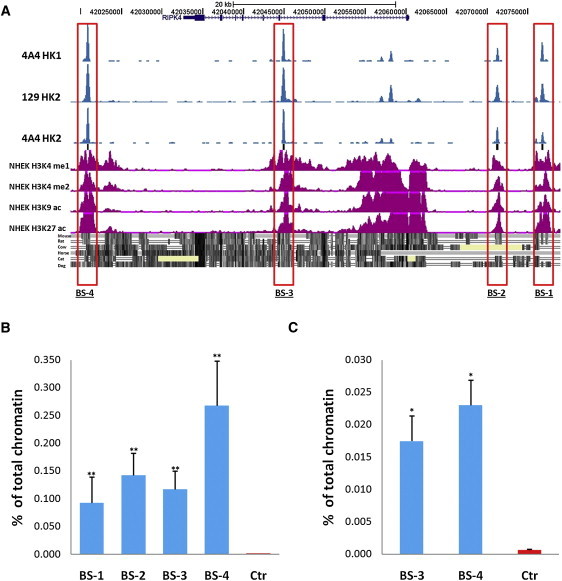
p63 Binds in to Genomic Regions in Close Proximity to RIPK4 (A) The position of the four p63 binding regions (BS-1, BS-2, BS-3, and BS-4) around RIPK4 previously identified by ChIP-seq analysis of human primary keratinocytes with the p63 antibodies 4A4 and H129 (blue peaks) correlate with highly conserved regions of the genome that are enriched for regulatory marks in normal human epidermal keratinocytes (NHEK) that are strongly associated with enhancer regions. The following abbreviations are used: H3K4 me1, monomethylated histone H3 lysine 4; H3K4 me2 dimethylated histone H3 lysine 4; H3K9 ac, acetylated histone H3 lysine 9; H3K27 ac, acetylated histone H3 lysine 27. (B) ChIP-qPCR analysis using the p63 antibody H129 in human HaCaT cells confirms specific binding of p63 to all four binding sites but not to the negative control myoglobin exon 2 (Control [Ctr]) (p = 0.0079). (C) ChIP-qPCR analysis using the p63 antibody H129 confirms specific binding of p63 to the conserved binding sites BS-3 and BS-4 but not to the negative control myoglobin exon 2 (Ctr) in E18.5 mouse epidermis (p = 0.03 Mann; Whitney U test). The error bars in B and C indicate standard error of the mean.
Figure 3
Figure 3
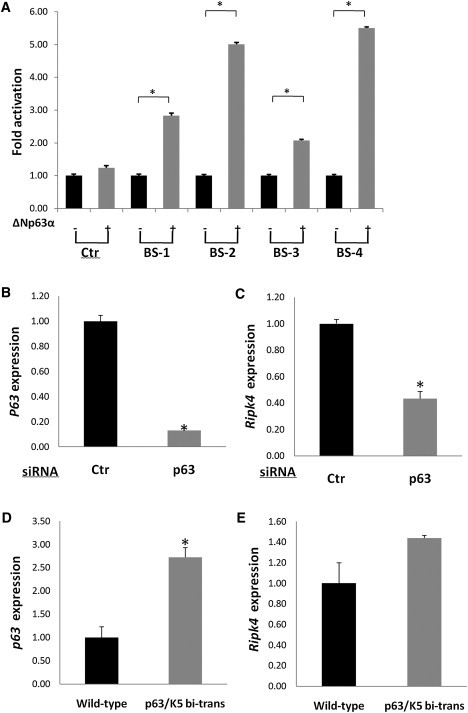
p63 Transactivates RIPK4 (A) Luciferase reporter assays demonstrate that wild-type ΔNp63α strongly activates transcription through the four binding sites (BS) located within 56 kb of RIPK4 (p = 0.03, Mann-Whitney U test). (B and C) siRNA knockdown of Trp63 in mouse primary keratinocytes results in a 7-fold reduction in Trp63 levels (p = 0.02) resulting in a more than 2-fold reduction in Ripk4 levels (p = 0.02). (D and E) qPCR analysis of epidermis from wild-type and mice overexpressing ΔNp63α indicates that Trp63 transcripts are increased ∼2.6-fold in Krt5-tTA/pTRE-ΔNp63α bitransgenic mice compared to their wild-type littermates (p = 0.05) resulting in an increase in Ripk4 transcripts in ΔNp63α overexpressing mice compared to their wild-type littermates. Although the increase in Ripk4 expression levels did not reach the threshold for significance, Pearson's correlation coefficient demonstrated an association between the relative expression of Trp63 and Ripk4 in Krt5-tTA/pTRE-ΔNp63α bitransgenic and wild-type mice that was significant (p = 0.02). Regression analysis of these data confirmed a linear relationship between increased Trp63 and Ripk4 expression levels (r2 = 0.49; p = 0.02) (Figure S5). Error bars indicate standard error of the mean.

References

    1. Fuchs E., Raghavan S. Getting under the skin of epidermal morphogenesis. Nat. Rev. Genet. 2002;3:199–209. - PubMed
    1. Watt F.M. Stem cell fate and patterning in mammalian epidermis. Curr. Opin. Genet. Dev. 2001;11:410–417. - PubMed
    1. Kondo S., Schutte B.C., Richardson R.J., Bjork B.C., Knight A.S., Watanabe Y., Howard E., Ferreira de Lima R.L.L., Daack-Hirsch S., Sander A., et al. Mutations in IRF6 cause Van der Woude and popliteal pterygium syndromes. Nat. Genet. 2002;32:285–289. - PMC - PubMed
    1. Lahtela J., Nousiainen H.O., Stefanovic V., Tallila J., Viskari H., Karikoski R., Gentile M., Saloranta C., Varilo T., Salonen R., et al. Mutant CHUK and severe fetal encasement malformation. N. Engl. J. Med. 2010;363:1631–1637. - PubMed
    1. Veenstra-Knol H.E., Kleibeuker A., Timmer A., ten Kate L.P., van Essen A.J. Unreported manifestations in two Dutch families with Bartsocas-Papas syndrome. Am. J. Med. Genet. 2003;123A:243–248. - PubMed

Publication types

MeSH terms

Supplementary concepts