


Population structure of the dengue viruses, Aragua, Venezuela, 2006-2007. Insights into dengue evolution under hyperendemic transmission
- PMID: 22197765
- PMCID: PMC3919160
- DOI: 10.1016/j.meegid.2011.12.005
Population structure of the dengue viruses, Aragua, Venezuela, 2006-2007. Insights into dengue evolution under hyperendemic transmission
Abstract
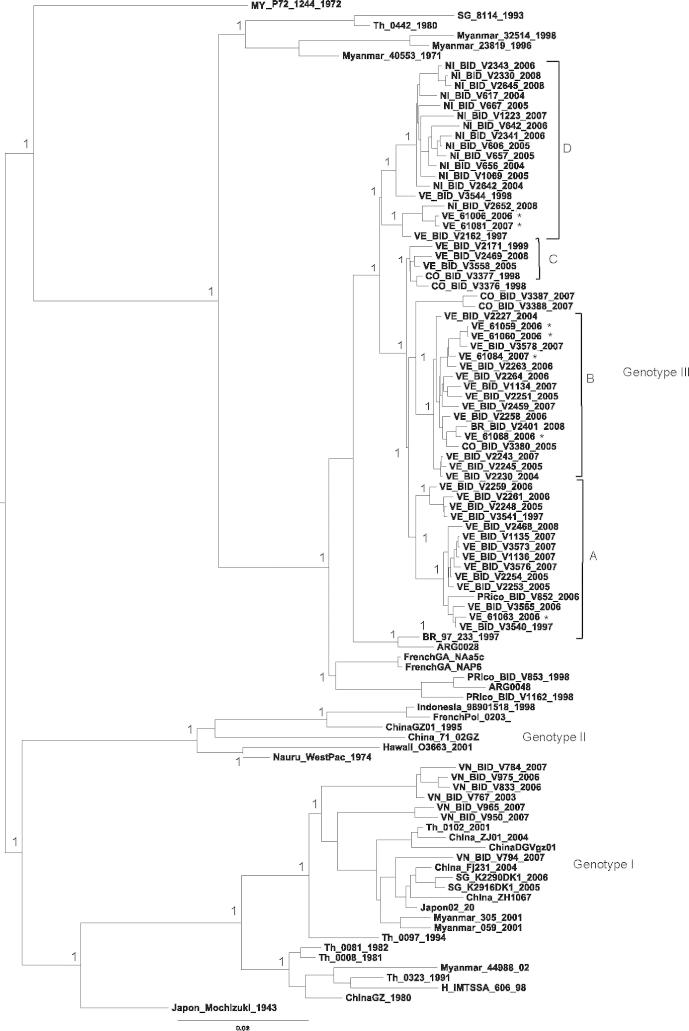
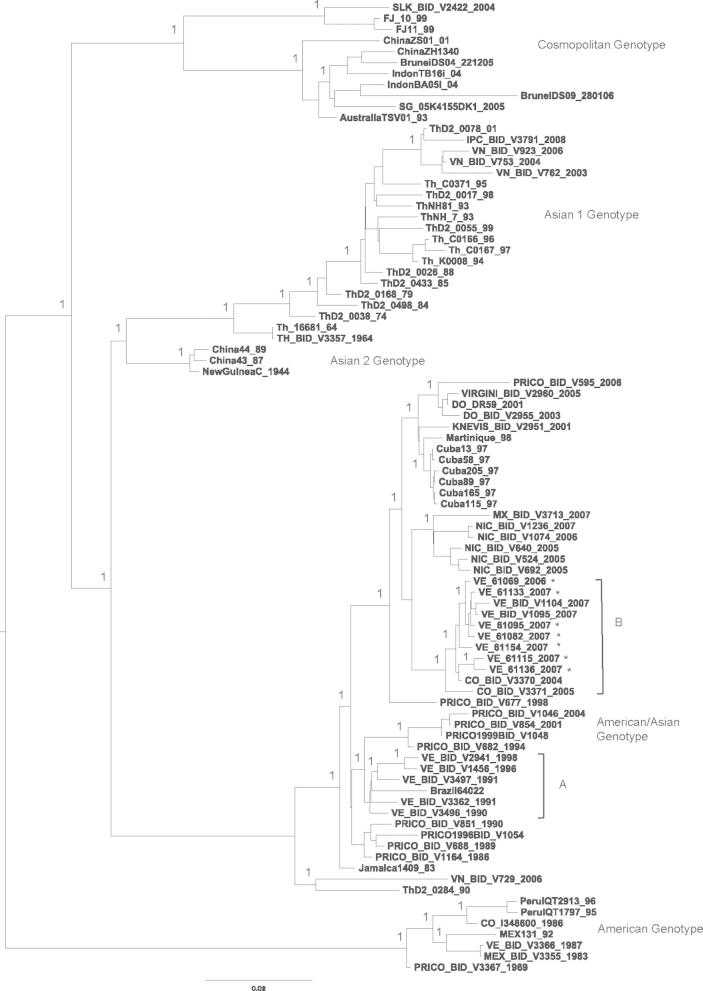
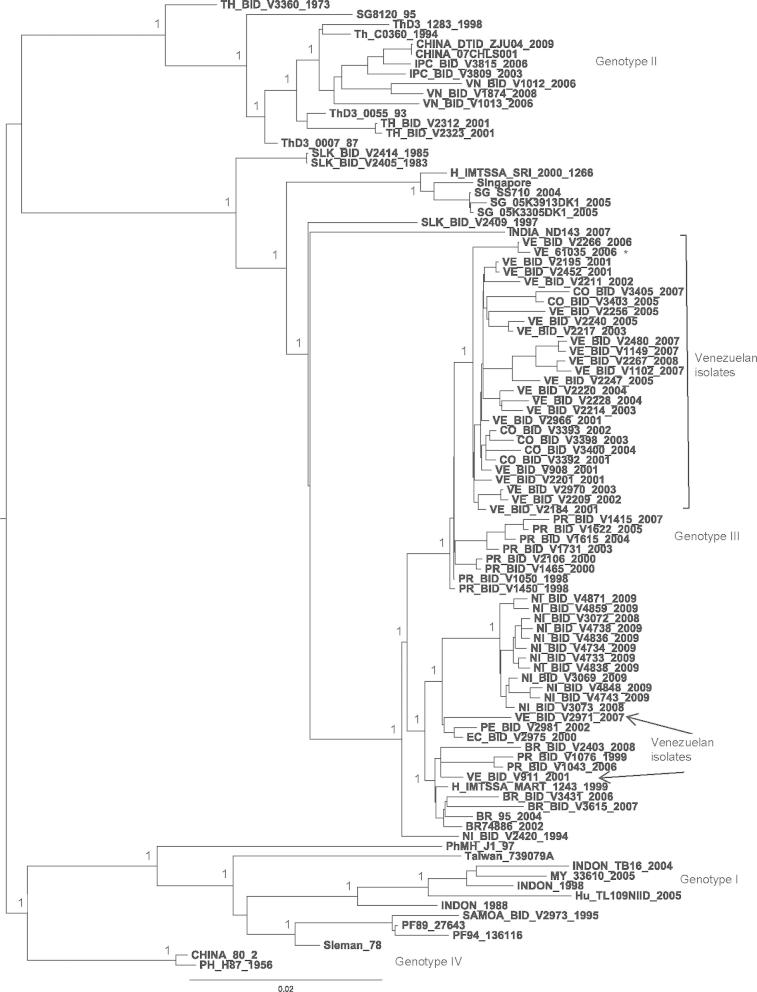
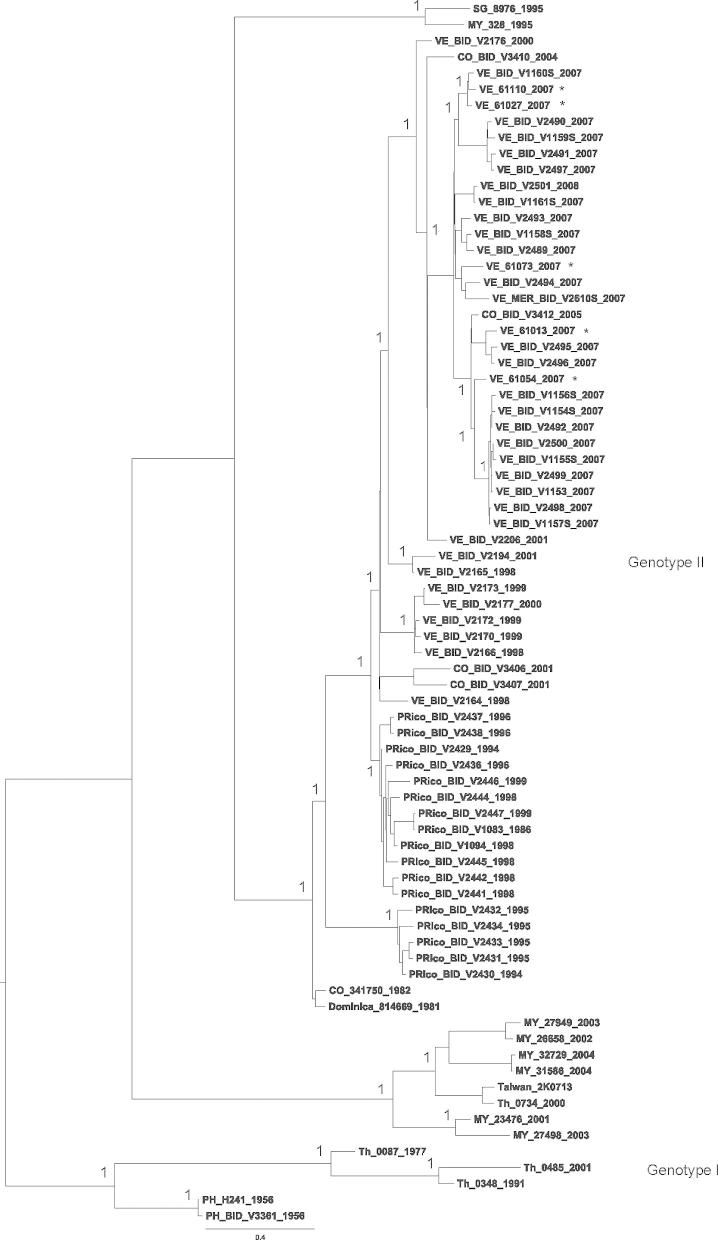
During the past three decades there has been a notable increase in dengue disease severity in Venezuela. Nevertheless, the population structure of the viruses being transmitted in this country is not well understood. Here, we present a molecular epidemiological study on dengue viruses (DENV) circulating in Aragua State, Venezuela during 2006-2007. Twenty-one DENV full-length genomes representing all of the four serotypes were amplified and sequenced directly from the serum samples. Notably, only DENV-2 was associated with severe disease. Phylogenetic trees constructed using Bayesian methods indicated that only one genotype was circulating for each serotype. However, extensive viral genetic diversity was found in DENV isolated from the same area during the same period, indicating significant in situ evolution since the introduction of these genotypes. Collectively, the results suggest that the non-structural (NS) proteins may play an important role in DENV evolution, particularly NS1, NS2A and NS4B proteins. The phylogenetic data provide evidence to suggest that multiple introductions of DENV have occurred from the Latin American region into Venezuela and vice versa. The implications of the significant viral genetic diversity generated during hyperendemic transmission, particularly in NS protein are discussed and considered in the context of future development and use of human monoclonal antibodies as antivirals and tetravalent vaccines.
Copyright © 2011 Elsevier B.V. All rights reserved.
Figures
References
-
- Alexander, N., Balmaseda, A., Coelho, I.C., Dimaano, E., Hien, T.T., Hung, N.T., Janisch, T., Kroeger, A., Lum, L.C., Martinez, E., Siqueira, J.B., Thuy, T.T., Villalobos, I., Villegas, E., Wills, B., (2011). Multicentre prospective study on dengue classification in four South-east Asian and three Latin American countries. Trop. Med. Int. Health doi:. - DOI - PubMed
-
- Alvarez M., Rodriguez-Roche R., Bernardo L., Vazquez S., Morier L., Gonzalez D., Castro O., Kouri G., Halstead S.B., Guzman M.G. Dengue hemorrhagic fever caused by sequential dengue 1–3 virus infections over a long time interval: Havana epidemic, 2001–2002. Am. J. Trop. Med. Hyg. 2006;75(6):1113–1117. - PubMed
-
- Bennett S.N., Holmes E.C., Chirivella M., Rodriguez D.M., Beltran M., Vorndam V., Gubler D.J., McMillan W.O. Selection-driven evolution of emergent dengue virus. Mol. Biol. Evol. 2003;20(10):1650–1658. - PubMed
-
- Betts M.J., Russell R.B. Amino acid properties and consequences of substitutions. In: Barnes M.R., Gray I.C., editors. Bioinformatics for Geneticists. Wiley; New Jersey: 2003. pp. 289–316.
-
- Brault A.C., Kinney R.M., Maharaj P.D., Green E.N., Reisen W.K., Huang C.Y. Replication of the primary dog kidney-53 dengue 2 virus vaccine candidate in Aedes aegypti is modulated by a mutation in the 5’ untranslated region and amino acid substitutions in nonstructural proteins 1 and 3. Vector Borne Zoonotic. Dis. 2011;11(6):683–689. - PubMed
Publication types
MeSH terms
Substances
Associated data
- Actions
- Actions
- Actions
- Actions
- Actions
- Actions
- Actions
- Actions
- Actions
- Actions
- Actions
- Actions
- Actions
- Actions
- Actions
- Actions
- Actions
- Actions
- Actions
- Actions
- Actions
LinkOut - more resources
Full Text Sources
Medical
Molecular Biology Databases
Miscellaneous
