doi: 10.1085/jgp.201110659.
Co-transmission of dopamine and glutamate
Affiliations
- PMID: 22200950
- PMCID: PMC3250102
- DOI: 10.1085/jgp.201110659
Item in Clipboard
Co-transmission of dopamine and glutamate
J Gen Physiol.
2012 Jan.
No abstract available
Figures
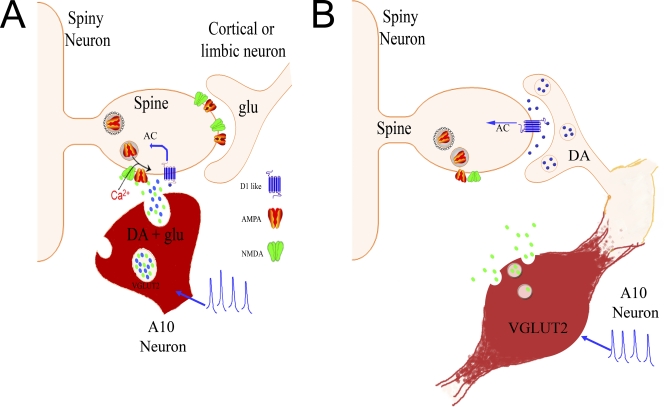
Two models of dopamine/glutamate co-transmission. Glutamate is green, dopamine is blue, and VGLUT2 in A10 neurons is labeled red. Bursting activity of mesolimbic dopaminergic neurons has been shown to activate AMPA and NMDA receptors on medium spiny neurons (as shown in Tecuapetla et al., 2010), possibly promoting the insertion of AMPA receptors, whereas activation of D1-like receptors promotes intracellular postsynaptic changes through G-coupled activation of adenylyl cyclase (AC). (A) Co-transmission from the same presynaptic terminal. Evidence from Hnasko et al. (2010) indicates that VGLUT2 may promote loading of dopamine into vesicles. This is evidence that glutamate and dopamine are packaged and released from the same vesicle at all structures. (B) Co-transmission by the same neuron at separate structures. Although medial mesolimbic neurons express both TH and VGLUT2 mRNA, NAc sections show VGLUT2+ staining sequestered in varicosities sprouting from the axons of TH+ neurons (Kawano et al., 2006; Yamaguchi et al., 2011). This suggests that the same neuron releases different neurotransmitters at different structures. Either model may explain the physiological results now presented by three studies (Hnasko et al., 2010; Stuber et al., 2010; Tecuapetla et al., 2010).
References
MeSH terms
Substances
LinkOut - more resources
Full Text Sources