


Porcine Amelogenin : Alternative Splicing, Proteolytic Processing, Protein - Protein Interactions, and Possible Functions
- PMID: 22200995
- PMCID: PMC3245678
Porcine Amelogenin : Alternative Splicing, Proteolytic Processing, Protein - Protein Interactions, and Possible Functions
Abstract
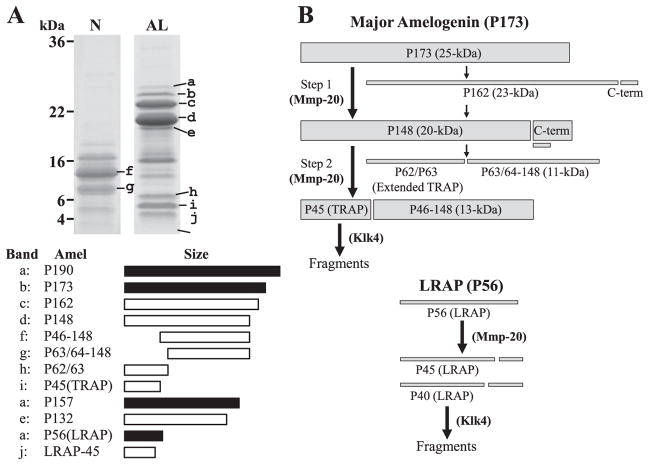
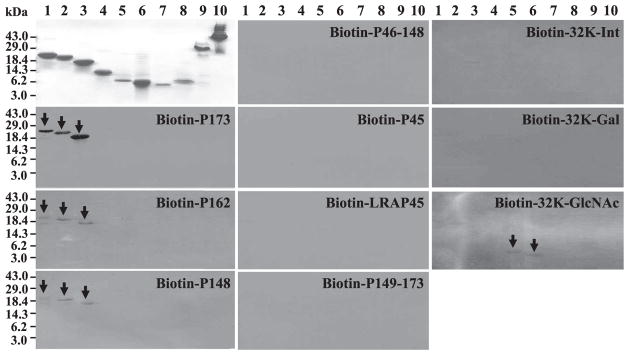
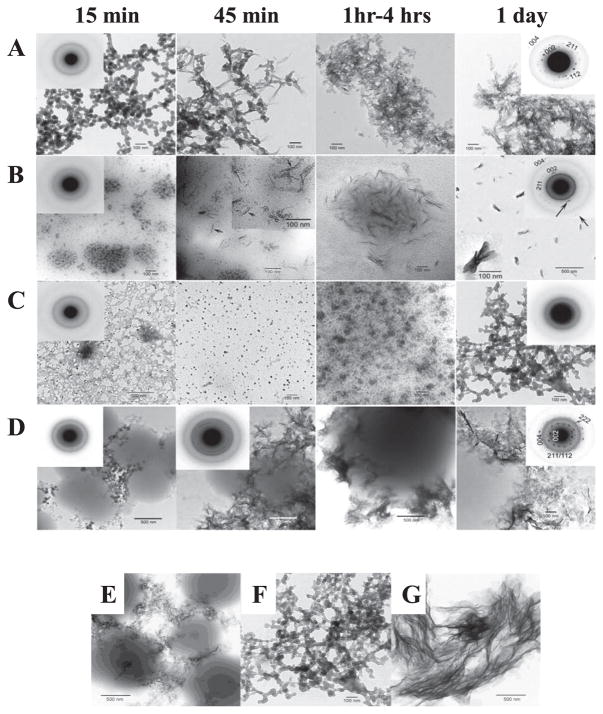
Amelogenin is the major secretory product of ameloblasts and is critical for proper tooth enamel formation. Amelogenin isoforms and their cleavage products comprise over 80% of total secretory stage enamel protein. We have isolated and characterized four secreted amelogenin isoforms from developing porcine enamel : P190 (27-kDa), P173 (25-kDa), P132 (18-kDa) and P56 (6.5-kDa ; leucine rich amelogenin polypeptide or LRAP). P190 and P132 are low abundance amelogenins that contain a novel exon 4-encoded segment of lack the exon 3-encoded segment, respectively. P173 is the most abundant (major) amelogenin isoform. Cleavage of P173 by matrix metalloproteinase 20 (Mmp20) occurs at specific sites that generates a set of N-terminal cleavage products : P162 (23-kDa), P148 (20-kDa), P62/P63 (11-kDa), and Trp(45) (6-kDa, tyrosine rich amelogenin polypeptide or TRAP). P148 is the most abundant protein in developing enamel and influences the conversion of amorphous calcium phosphate into hydroxyapatite in vitro. Mmp20 cleaves LRAP, the second abundant amelogenin isoform after Pro(45) and Pro(40). Processing by Mmp20 allows amelogenin cleavage products to serve separate functions. Over time, Mmp20 catalyzes additional cleavages that facilitate the progressive replacement of amelogenin by mineral, so enamel crystals thicken and widen with depth. Besides proteolytic processing, amelogenin protein-protein interactions are critical for function. Far-Western analyses demonstrate that the larger amelogenins (P173, P162, and P148) are only able to interact with larger amelogenins. No amelogenin-amelogenin interactions are observed for the smaller amelogenin cleavage products, TRAP or LRAP Amelogenin doesn't interact with the 32-kDa glycosylated enamelin cleavage product, unless it it partially deglycosylated.
Figures

References
-
- Uchida T, Tanabe T, Fukae M, Shimizu M, Yamada M, Miake K, Kobayashi S. Immunochemical and immunohistochemical studies, using antisera against porcine 25 kDa amelogenin, 89 kDa enamelin and the 13–17 kDa nonamelogenins, on immature enamel of the pig and rat. Histochemistry. 1991;96 :129–138. - PubMed
-
- Tanabe T, Fukae M, Uchida T, Shimizu M. The localization and characterization of proteinases for the initial cleavage of porcine amelogenin. Calcif Tissue Int. 1992;51 :213–217. - PubMed
-
- Nakahori Y, Takenaka O, Nakagome Y. A human X-Y homologous region encodes amelogenin. Genomics. 1991;9 :264–269. - PubMed
-
- Gibson CW, Golub E, Ding WD, Shimokawa H, Young M, Termine J, Rosenbloom J. Identification of the leucine-rich amelogenin peptide (LRAP) as the translation product of an alternatively spliced transcript. Biochem Biophys Res Commun. 1991;174 :1306–1312. - PubMed
Grants and funding
LinkOut - more resources
Full Text Sources
Research Materials