Partner aggression in high-risk families from birth to age 3 years: associations with harsh parenting and child maladjustment
- PMID: 22201248
- PMCID: PMC3380639
- DOI: 10.1037/a0026722
Partner aggression in high-risk families from birth to age 3 years: associations with harsh parenting and child maladjustment
Abstract
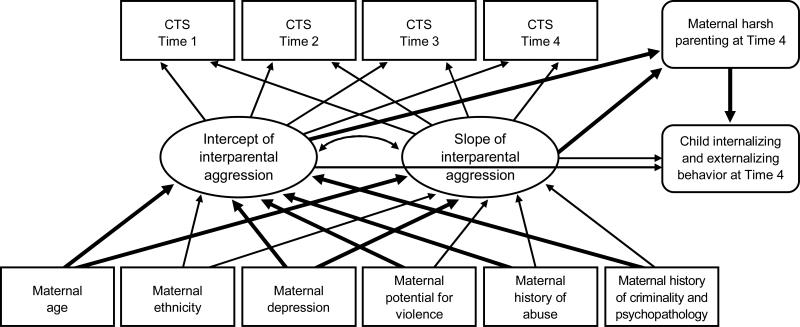
Aggression between partners represents a potential guiding force in family dynamics. However, research examining the influence of partner aggression (physically and psychologically aggressive acts by both partners) on harsh parenting and young child adjustment has been limited by a frequent focus on low-risk samples and by the examination of partner aggression at a single time point. Especially in the context of multiple risk factors and around transitions such as childbirth, partner aggression might be better understood as a dynamic process. In the present study, longitudinal trajectories of partner aggression from birth to age 3 years in a large, high-risk, and ethnically diverse sample (N = 461) were examined. Specific risk factors were tested as predictors of aggression over time, and the longitudinal effects of partner aggression on maternal harsh parenting and child maladjustment were examined. Partner aggression decreased over time, with higher maternal depression and lower maternal age predicting greater decreases in partner aggression. While taking into account contextual and psychosocial risk factors, higher partner aggression measured at birth and a smaller decrease over time independently predicted higher levels of maternal harsh parenting at age 3 years. Initial level of partner aggression and change over time predicted child maladjustment indirectly (via maternal harsh parenting). The implications of understanding change in partner aggression over time as a path to harsh parenting and young children's maladjustment in the context of multiple risk factors are discussed.
Figures
References
-
- Achenbach TM. Manual for Child Behavior Checklist/ 2-3 and 1992 Profile. University of Vermont, Department of Psychiatry; Burlington: 1992.
-
- Belsky J, Rovine M. Patterns of marital change across the transition to parenthood: Pregnancy to three years postpartum. Journal of Marriage and Family. 1990;52:5–19. doi: 10.2307/352833.
-
- Berlin LJ, Brady-Smith C, Brooks-Gunn J. Links between childbearing age and observed maternal behaviors with 14-month-olds in the Early Head Start Research and Evaluation Project. Infant Mental Health Journal. 2002;23:104–129. doi: 10.1002/imhj.10007.
-
- Bulanda JR, Brown SL. Race-ethnic differences in marital quality and divorce. Social Science Research. 2007;36:945–967. doi: 10.1016/j.ssresearch.2006.04.001.
-
- Capaldi DM, Clark S. Prospective family predictors of aggression toward female partners for at-risk young men. Developmental Psychology. 1998;34:1175–1188. doi: 10.1037/0012-1649.34.6.1175. - PubMed
Publication types
MeSH terms
Grants and funding
- MH059780/MH/NIMH NIH HHS/United States
- F31 MH094000/MH/NIMH NIH HHS/United States
- DA023920/DA/NIDA NIH HHS/United States
- HD045894/HD/NICHD NIH HHS/United States
- DA017592/DA/NIDA NIH HHS/United States
- P30 DA023920/DA/NIDA NIH HHS/United States
- P20 DA017592/DA/NIDA NIH HHS/United States
- DA021424/DA/NIDA NIH HHS/United States
- P30 MH046690/MH/NIMH NIH HHS/United States
- R01 HD045894/HD/NICHD NIH HHS/United States
- R01 DA021424/DA/NIDA NIH HHS/United States
- R01 MH059780/MH/NIMH NIH HHS/United States
- MH046690/MH/NIMH NIH HHS/United States